Need to develop heavy BVRAAM in league of AIM-174B & R-37M as well
How does it compare to meteor at same launch altitude of 20 & 8 km ?
How does it compare to meteor at same launch altitude of 20 & 8 km ?

Reconfigure the Rudram-1 for A2A role. Might need to do some WT work on the airframe/control surfaces. Nothing major.Need to develop heavy BVRAAM in league of AIM-174B & R-37M as well
Well, if the public figures of the Meteor are correct than Mk-3 will outperform the Meteor.How does it compare to meteor at same launch altitude of 20 & 8 km ?
Well, if the public figures of the Meteor are correct than Mk-3 will outperform the Meteor.
Nope, no mention of altitude. Just that max range is 200+ km. Most missile manufacturers mention their A2A missile's max range at the ~20 km launch altitude & with the launch platform at Mach 1.2-1.5. It would be fair to assume the max range of the Meteor is measured similarly.Do we have those public figure of Meteor range when launched from certain Altitude like 8 & 20 km in case of Gandiva ?. ... Kindly post them here

We do have knowledge of both Meteor and Gandiva's dimensions. The latter is both longer and thicker thus carrying more fuel than Meteor. Along with that, Gandiva has 20% higher ramjet specific impulse and 18% longer burn time than Meteor. The range and speed(along with having GaN AESA seeker) advantage over Meteor would be substantial.Do we have those public figure of Meteor range when launched from certain Altitude like 8 & 20 km in case of Gandiva ?. ... Kindly post them here
As per some reports STAR would later be converted to VLRAAM. Let's see.The AIM-174B now has an estimated max range of 640 km....... significantly outperforming the R-37, which has a range of approximately 400 km. Weighing in at a staggering 857 kg, it stands as one of the heaviest and longest-range BVRAAM ever developed.
An indigenous missile with similar capabilities....... especially when paired with future AESA radar upgrades on the Su-30MKI and cooperative engagement capabilities..... could offer a tremendous operational edge to our forces..... integrated into a network-centric warfare environment with data-link connectivity, including support from AWACS, Netra, or unmanned aerial platforms acting as forward sensors, such a long range BVRAAM would be a true force multiplier in future air combat scenarios.
Its ability to engage high-value targets at extended ranges would severely restrict enemy maneuverability and could decisively decimate adversarial aerial threats, strengthening our air dominance across the region.
Developing a liquid fueled ramjet-based Very Long Range Air-to-Air Missile would be an impractical and inefficient approach.... ..... Liquid-fueled ramjets are inherently complex, maintenance-intensive, & unsuitable for the fast-reaction, high-G environment of air-to-air engagements.......Moreover, their performance significantly degrades at high altitudes, where the air density is too low to sustain efficient combustion, especially in the stratospheric flight profiles typical of lofted BVRAAM trajectories....... Instead, the focus should be on developing a boost-sustain solid rocket motor-based BVRAAM that employs a lofted trajectory to maximize range and energy retention.....This design architecture/philosophy/approach is more robust, reliable, and suited for rapid operational deployment....... Solid propulsion systems also offer longer shelf life, simpler logistics, and instant readiness, making them ideal for frontline fighter integration like on the Su-30MKI, AMCA, or even Tejas Mk2 in the future...........high-speed, high-altitude BVRAAM using such a profile could also offer a limited secondary ballistic missile defense (BMD) capability..... potentially intercepting cruise missiles or low-end ballistic threats during their terminal phase or flight corridor overlaps.......pairing them with AESA radar, AWACS support, and networked data-link systems, such a missile would be a true multi-role force multiplier in both offensive and defensive scenarios........In my humble opinion...... a solid-fueled based lofted-trajectory VLR-BVRAAM is the most logical and strategically sound pathway to ensuring air dominance & long-range deterrence.As per some reports STAR would later be converted to VLRAAM. Let's see.
So basically a Rudram or Brahmos derivative BVRAAM? What would be the challenges to convert those into BVRAAM without losing significant range?Developing a liquid fueled ramjet-based Very Long Range Air-to-Air Missile would be an impractical and inefficient approach.... ..... Liquid-fueled ramjets are inherently complex, maintenance-intensive, & unsuitable for the fast-reaction, high-G environment of air-to-air engagements.......Moreover, their performance significantly degrades at high altitudes, where the air density is too low to sustain efficient combustion, especially in the stratospheric flight profiles typical of lofted BVRAAM trajectories....... Instead, the focus should be on developing a boost-sustain solid rocket motor-based BVRAAM that employs a lofted trajectory to maximize range and energy retention.....This design architecture/philosophy/approach is more robust, reliable, and suited for rapid operational deployment....... Solid propulsion systems also offer longer shelf life, simpler logistics, and instant readiness, making them ideal for frontline fighter integration like on the Su-30MKI, AMCA, or even Tejas Mk2 in the future...........high-speed, high-altitude BVRAAM using such a profile could also offer a limited secondary ballistic missile defense (BMD) capability..... potentially intercepting cruise missiles or low-end ballistic threats during their terminal phase or flight corridor overlaps.......pairing them with AESA radar, AWACS support, and networked data-link systems, such a missile would be a true multi-role force multiplier in both offensive and defensive scenarios........In my humble opinion...... a solid-fueled based lofted-trajectory VLR-BVRAAM is the most logical and strategically sound pathway to ensuring air dominance & long-range deterrence.
Don't worry, we have also a dedicated VLRAAM in development known as Astra MK4 with triple-pulse rocket motor. It's has been known to those of us who follow DRDO news. You can also contact @marich01 for more info of the same.So basically a Rudram or Brahmos derivative BVRAAM? What would be the challenges to convert those into BVRAAM without losing significant range?
Which seeker Astra mk1 is using now??DRDO & IAF conduct successful flight-test of Astra Beyond Visual Range Air-to-Air missile with indigenous Radio Frequency Seeker from Su-30 Mk-I
Posted On: 11 JUL 2025 7:53PM by PIB Delhi
Defence Research & Development Organisation (DRDO) & Indian Air Force (IAF) successfully conducted the flight-test of indigenous Beyond Visual Range Air-to-Air missile (BVRAAM) ‘Astra’ equipped with indigenous Radio Frequency (RF) Seeker from Su-30 Mk-I platform off the coast of Odisha on July 11, 2025. During the tests, two launches were carried out against high-speed unmanned aerial targets at different ranges, target aspects and launch platform conditions. In both the cases, the missiles destroyed the targets with pin-point accuracy.
During the tests, all subsystems performed as per expectations including the RF seeker which has been indigenously designed & developed by DRDO. The flawless performance of the Astra weapon system was validated through flight data captured by Range Tracking instruments deployed by Integrated Test Range, Chandipur. These successful flight tests have re-established the accuracy and reliable performance of Astra weapon system with indigenous seeker.
Astra BVRAAM has a range exceeding 100 kms and is equipped with state-of-the art guidance and navigation system. In addition to various laboratories of DRDO, more than 50 public and private industries including Hindustan Aeronautics Limited have contributed towards successful realisation of the weapon system.
Raksha Mantri Shri Rajnath Singh complimented DRDO, IAF and industry involved in the design and development of RF seeker and stated that the successful testing of the missile with indigenous seeker is a major milestone in critical defence technolog
Ku-band pulsed doppler seeker from RCI. This could be an improved version, possibly even AESA.Which seeker Astra mk1 is using now??
It's Land version of Astra only
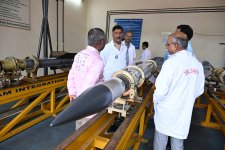
Due to this mainly see the jig show VL-SRSAM marked. Astra group at DRDL is responsible for fair few things including STAR too. Plus notice the missile in the back with the test check mark added. One more test likely soon since PDC is very close.This guy is claiming something else