
Translation..Yes it's pretty ordinary now and for the next 10 or more years, but we can make it 4.9 gen come 2040. If someone is willing to pay for it.SUPER RAFALE – Et si la France avait déjà son chasseur de 6e génération ?
SUPER RAFALE - What if France already had its 6th generation fighter?
The Rafale F5 propels Dassault into the 6th generation: on-board AI, networked combat, drones and stealth. Does France already have its aircraft of the future?
While the United States is pumping billions into its NGAD programme and the Europeans are mired in ego battles over the SCAF, France is quietly but surely forging ahead. With successive improvements, the Rafale has made a name for itself in theatres of operation and at international air shows. But with the arrival of the F5 standard, scheduled for 2030, a milestone has been reached. A turning point. One that leads some experts to say that the Rafale, without changing its name, is changing generation.
So let's ask the question straight out: is the Rafale F5 a generation 4.5 fighter, or already a 6G that doesn't know it? One thing is certain: Dassault's “Super Rafale” no longer has much to envy from the promises of futuristic projects. And with good reason: it anticipates them.
The brains behind the Super Rafale is the network.
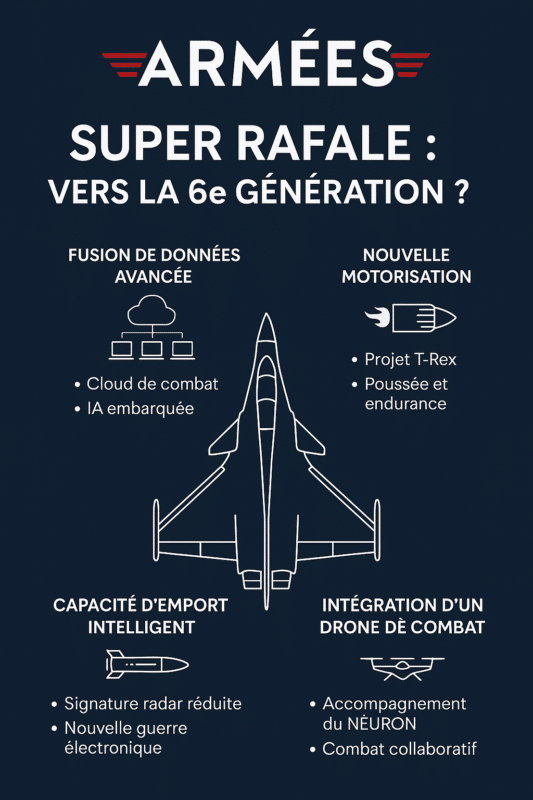
It's not its looks or silhouette that will catapult the Rafale F5 into another era. It's what's inside it. And above all in the head. The aircraft will benefit from a complete overhaul of its combat system, with on-board artificial intelligence, massive on-board data processing, real-time sensor fusion, and above all the ability to network with other manned and unmanned platforms.
In other words, the Rafale F5 no longer fights like an aircraft. It fights as a connected warfare system, capable of taking the initiative, directing the fire of others, and even coordinating a mini-fleet of drones. This principle, ‘collaborative combat’, is one of the pillars of the 6th generation. And Dassault is incorporating it into an aircraft that is already flying.
The icing on the cake: France is also developing its own sovereign ‘combat cloud’, to guarantee the coherence and security of these exchanges in a contested environment. No need to wait for the SCAF: this future is coming with the F5.
AI comes on board, but doesn't take control
As we said, the Rafale F5 will be equipped with artificial intelligence, not to replace the pilot, but to assist him and take the load off his shoulders. Analysis of the tactical situation, automatic detection of threats, prioritisation of targets, management of weapon systems and sensors: these are all tasks that AI will be able to automate or anticipate. This is a first for the French Air Force.
Above all, the F5 is designed from the outset to operate with drones, in particular a militarised version of the Neuron. The idea? To create a complementary duo: the Rafale thinks, the Neuron strikes. The Rafale illuminates, the Neuron attracts missiles. The Rafale observes, the Neuron transmits. This is exactly what the F-35 does with its loyal wingmen. Except that here, it's more economical, more flexible and more French.
New engine: the T-Rex project changes the game
An aircraft is only as good as its engine. That's where the T-Rex comes in. Behind this code name: a new engine designed by Safran. More compact, more powerful, calibrated to meet the energy requirements of the F5, which will be carrying ever more electronics, jammers, computers...
This engine will also offer greater efficiency, longer-term super-cruise capability, and improved thermal management. Once again, this is one of the key criteria of the 6G: energy autonomy. The fighter of the future must do more than just fly fast. It must power an electronic arsenal without being detected. That's the challenge we're currently working on.
Not stealthy? No problem: it will be discreet when it needs to be
Some will object: ‘But the Rafale is not stealthy’. That's true, in its airframe. But modern stealth is no longer just about angular shapes. It requires electronic intelligence. And in this respect, the Rafale F5 will be a discreet fortress:
The F5 is not an F-117. But it will be invisible when it needs to be, and visible when it decides to be. This balance is in line with French doctrine, which focuses on flexibility and resilience.
- New-generation electronic warfare pod
- MICA NG missiles adapted for discreet carriage
- Radar and thermal signature reduction
- Intelligent jamming depending on the situation
A credible timetable, promises kept
At a time when the American NGAD is exploding in cost and the European Tempest/SCAF is bogged down in governance, the Rafale F5 is a solid roadmap.
Dassault is not promising an aircraft for 2045. Delivered in 2030, no later, derived from an aircraft already in service, reliable, certified and maintained. A Rafale F5 will leave the Mérignac production lines with 80% fewer components than a Rafale F3R... but without reinventing the wheel.
What about exports? Can the Super Rafale outperform its rivals?
India, Egypt, Indonesia, the Emirates, Greece, Brazil, Serbia... the list of countries attracted by the Rafale continues to grow. And with the F5, the advantage is growing. The Super Rafale comes between two generations. It fills a gap. Where others are waiting for the SCAF or the NGAD, it will already be ready. And operational.
And that's its strength: it can be delivered, controlled and supported. And it's highly relevant to countries that don't want to wait until 2045 to modernise their fleets.
By 2030, who else can offer an aircraft capable of carrying out autonomous, connected, AI-assisted raids, commanding a squadron of drones, while remaining affordable? No one can. Except perhaps China. And even then.
The Super Rafale, the weapon of the present with the logic of the future
No, the Rafale F5 will not officially be a 6th generation fighter. Its airframe, despite improvements, does not meet the standards of the all-furbo fighter. Its structure is not modular, and it is not part of an SCAF programme.
But yes, the Rafale F5 already embodies 80% of the 6th generation. It anticipates its codes, exploits its doctrines, and makes them operational well before the others!
And above all: it will be ready when the others are still in the mock-up stage, even if it is digital.
Once again, France is proving that it can do things faster, smarter and more strategically. The Super Rafale may well be the last manned fighter in history. But what a finale!
Oh and FCAS isn't looking good either


