Dassault Rafale - Updates and Discussion

The UK plans to retire its Typhoons as early as 2040 with years of life still left in them. They're betting on the F-35 + GCAP for the future.

Going by media reports, the Germans bought EW-configured Typhoons to replace their Tornados only under pressure from local labour unions. The German AF preferred the F-35 (though the NATO N deterrent role would have had a lot to do with it). The Italians and Spanish both fly F-35s too.

France has no other pony in the race other than Rafale. FCAS is still a long way off. For this reason, they will continue to invest in it. For India, this means better lifetime support and upgrade roadmap.

Most importantly, the Rafale will take up the N-delivery role at some point (if it hasn't already) and Rafale is arguably the only non-US Western jet certified for the role.
 
The Typhoon is worse than everything except WVR combat.

Typhoon lost to the Rafale in WVR too.

The benefit of Rafale was it was designed after the Typhoon, and after the French had worked on the Typhoon and quit.

The only advantage Typhoon has is supersonic performance, but it's only a marginal superiority.
 
  • Agree
Reactions: Rajput Lion
F-35 AND Su are incompatible.

It is one or the other. I don't say this in chauvinistic American fashion, but being realistic.

I hope India can commit just as much as China has committed to Pakistan.

As long as Su-57 carries all Indian avionics and the Indian F-35 is modified to the same capacity as the Israeli version, then they will be compatible to a significant extent. With purely Russian hardware, then no.

Anyway it's unlikely that India will buy Russian and American at the same time.

India isn't interested in any imports either. The IAF have their minds set on LCA, MRFA, and AMCA. They are developing an iPhone type intranet that only Indian avionics can seamlessly integrate with, and imports like MRFA will have to ride that network externally via middleware. So the IAF is not gonna be too keen on importing stuff that doesn't fully integrate with their new network. Which would imply anything imported needs to have out-of-the-ordinary physical characteristics that can make up for lack of avionics integration, and neither Su-57 nor F-35 fit that bill.
 
Typhoon lost to the Rafale in WVR too.

The benefit of Rafale was it was designed after the Typhoon, and after the French had worked on the Typhoon and quit.

The only advantage Typhoon has is supersonic performance, but it's only a marginal superiority.
Yes the Typhoon is only a good Mirage 2000, we didn't need that, Rafale is in a different league. At the start of the programme, the Rafale was intended to replace the Jaguar...
 
For all those who claimed that we lost a Rafale on 7th Early morning.

Government of India in all party meeting briefing about Op Sindoor had told all the political parties of India on record that no Indian aircraft was hit in the operation or downed.

That engine video must be a terrific deep fake then. I don't trust the tail number without video though, but it's well made, especially that finish on the fastners.
 
  • Like
Reactions: YoungWolf
That engine video must be a terrific deep fake then. I don't trust the tail number without video though, but it's well made, especially that finish on the fastners.
I told you It was a deep fake. My sources have never been wrong. Normally in such operations we do not approach them for info as it can be misunderstood for snooping. But This source is so close to me that there is no chance of misundersting me.
I had told you that it was Chinese state media which was helping create this narrative to save the reputation of their third rate systems. All the deep fakes were created by China.
 
That engine video must be a terrific deep fake then. I don't trust the tail number without video though, but it's well made, especially that finish on the fastners.
I cannot possibly imagine the video being faked like that. Eventually tech will reach there, but right now???
 
F-35 AND Su are incompatible.

It is one or the other. I don't say this in chauvinistic American fashion, but being realistic.

I hope India can commit just as much as China has committed to Pakistan.
We require both at least in limited numbers until our own AMCA becomes combat ready.
 
  • Like
Reactions: South block
Don't think America will sell the F-35 and allow Su-57.

F-35 is a pretty big commitment both ways.
With Trump in power and the tarrif war. We can literally start a supply line factory of f-35's.
And in fact the indian economy is strong and large enough to mass produce f-35's, su-57, rafales and f-15EX easily without even having a slight dent in its exchequer.
 
Eric Trappier makes France shine in the world, through his patriotism and frankness.

As well as his loyalty to the family spirit of the Marcel Dassault Group, the flagship of our industry, which plays a daily role in our security and sovereignty.

Presentation of his insignia of Commander of the Legion of Honour.

 
Eric Trappier makes France shine in the world, through his patriotism and frankness.

As well as his loyalty to the family spirit of the Marcel Dassault Group, the flagship of our industry, which plays a daily role in our security and sovereignty.

Presentation of his insignia of Commander of the Legion of Honour.


Hello Sir

What is The NEWS in FRANCE regarding this India Pakistan conflict

Especially about Rafale
 
SUPER RAFALE – Et si la France avait déjà son chasseur de 6e génération ?
SUPER RAFALE - What if France already had its 6th generation fighter?

The Rafale F5 propels Dassault into the 6th generation: on-board AI, networked combat, drones and stealth. Does France already have its aircraft of the future?

While the United States is pumping billions into its NGAD programme and the Europeans are mired in ego battles over the SCAF, France is quietly but surely forging ahead. With successive improvements, the Rafale has made a name for itself in theatres of operation and at international air shows. But with the arrival of the F5 standard, scheduled for 2030, a milestone has been reached. A turning point. One that leads some experts to say that the Rafale, without changing its name, is changing generation.

So let's ask the question straight out: is the Rafale F5 a generation 4.5 fighter, or already a 6G that doesn't know it? One thing is certain: Dassault's “Super Rafale” no longer has much to envy from the promises of futuristic projects. And with good reason: it anticipates them.

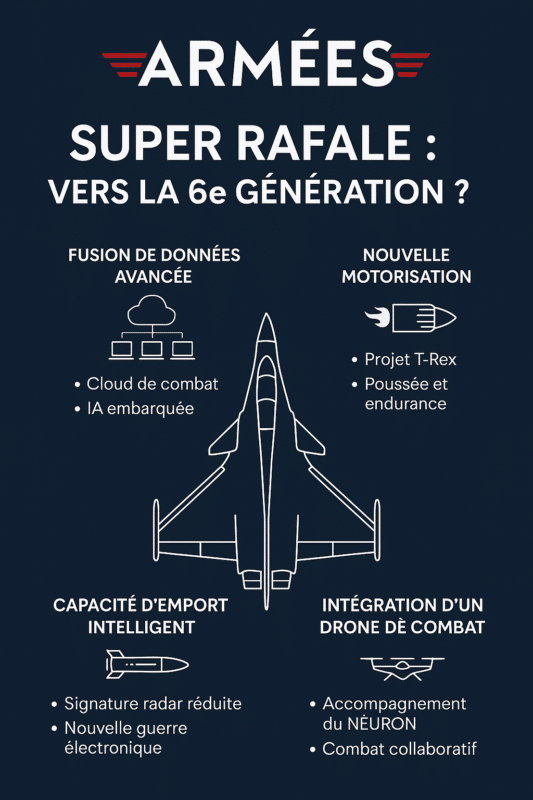
Super-Rafale-533x800.png

The brains behind the Super Rafale is the network.

It's not its looks or silhouette that will catapult the Rafale F5 into another era. It's what's inside it. And above all in the head. The aircraft will benefit from a complete overhaul of its combat system, with on-board artificial intelligence, massive on-board data processing, real-time sensor fusion, and above all the ability to network with other manned and unmanned platforms.

In other words, the Rafale F5 no longer fights like an aircraft. It fights as a connected warfare system, capable of taking the initiative, directing the fire of others, and even coordinating a mini-fleet of drones. This principle, ‘collaborative combat’, is one of the pillars of the 6th generation. And Dassault is incorporating it into an aircraft that is already flying.

The icing on the cake: France is also developing its own sovereign ‘combat cloud’, to guarantee the coherence and security of these exchanges in a contested environment. No need to wait for the SCAF: this future is coming with the F5.

AI comes on board, but doesn't take control

As we said, the Rafale F5 will be equipped with artificial intelligence, not to replace the pilot, but to assist him and take the load off his shoulders. Analysis of the tactical situation, automatic detection of threats, prioritisation of targets, management of weapon systems and sensors: these are all tasks that AI will be able to automate or anticipate. This is a first for the French Air Force.

Above all, the F5 is designed from the outset to operate with drones, in particular a militarised version of the Neuron. The idea? To create a complementary duo: the Rafale thinks, the Neuron strikes. The Rafale illuminates, the Neuron attracts missiles. The Rafale observes, the Neuron transmits. This is exactly what the F-35 does with its loyal wingmen. Except that here, it's more economical, more flexible and more French.

New engine: the T-Rex project changes the game

An aircraft is only as good as its engine. That's where the T-Rex comes in. Behind this code name: a new engine designed by Safran. More compact, more powerful, calibrated to meet the energy requirements of the F5, which will be carrying ever more electronics, jammers, computers...

This engine will also offer greater efficiency, longer-term super-cruise capability, and improved thermal management. Once again, this is one of the key criteria of the 6G: energy autonomy. The fighter of the future must do more than just fly fast. It must power an electronic arsenal without being detected. That's the challenge we're currently working on.

Not stealthy? No problem: it will be discreet when it needs to be

Some will object: ‘But the Rafale is not stealthy’. That's true, in its airframe. But modern stealth is no longer just about angular shapes. It requires electronic intelligence. And in this respect, the Rafale F5 will be a discreet fortress:
  • New-generation electronic warfare pod
  • MICA NG missiles adapted for discreet carriage
  • Radar and thermal signature reduction
  • Intelligent jamming depending on the situation
The F5 is not an F-117. But it will be invisible when it needs to be, and visible when it decides to be. This balance is in line with French doctrine, which focuses on flexibility and resilience.

A credible timetable, promises kept

At a time when the American NGAD is exploding in cost and the European Tempest/SCAF is bogged down in governance, the Rafale F5 is a solid roadmap.
Dassault is not promising an aircraft for 2045. Delivered in 2030, no later, derived from an aircraft already in service, reliable, certified and maintained. A Rafale F5 will leave the Mérignac production lines with 80% fewer components than a Rafale F3R... but without reinventing the wheel.

What about exports? Can the Super Rafale outperform its rivals?

India, Egypt, Indonesia, the Emirates, Greece, Brazil, Serbia... the list of countries attracted by the Rafale continues to grow. And with the F5, the advantage is growing. The Super Rafale comes between two generations. It fills a gap. Where others are waiting for the SCAF or the NGAD, it will already be ready. And operational.

And that's its strength: it can be delivered, controlled and supported. And it's highly relevant to countries that don't want to wait until 2045 to modernise their fleets.

By 2030, who else can offer an aircraft capable of carrying out autonomous, connected, AI-assisted raids, commanding a squadron of drones, while remaining affordable? No one can. Except perhaps China. And even then.

The Super Rafale, the weapon of the present with the logic of the future

No, the Rafale F5 will not officially be a 6th generation fighter. Its airframe, despite improvements, does not meet the standards of the all-furbo fighter. Its structure is not modular, and it is not part of an SCAF programme.

But yes, the Rafale F5 already embodies 80% of the 6th generation. It anticipates its codes, exploits its doctrines, and makes them operational well before the others!

And above all: it will be ready when the others are still in the mock-up stage, even if it is digital.

Once again, France is proving that it can do things faster, smarter and more strategically. The Super Rafale may well be the last manned fighter in history. But what a finale!

 
SUPER RAFALE – Et si la France avait déjà son chasseur de 6e génération ?
SUPER RAFALE - What if France already had its 6th generation fighter?

The Rafale F5 propels Dassault into the 6th generation: on-board AI, networked combat, drones and stealth. Does France already have its aircraft of the future?

While the United States is pumping billions into its NGAD programme and the Europeans are mired in ego battles over the SCAF, France is quietly but surely forging ahead. With successive improvements, the Rafale has made a name for itself in theatres of operation and at international air shows. But with the arrival of the F5 standard, scheduled for 2030, a milestone has been reached. A turning point. One that leads some experts to say that the Rafale, without changing its name, is changing generation.

So let's ask the question straight out: is the Rafale F5 a generation 4.5 fighter, or already a 6G that doesn't know it? One thing is certain: Dassault's “Super Rafale” no longer has much to envy from the promises of futuristic projects. And with good reason: it anticipates them.

Super-Rafale-533x800.png

The brains behind the Super Rafale is the network.

It's not its looks or silhouette that will catapult the Rafale F5 into another era. It's what's inside it. And above all in the head. The aircraft will benefit from a complete overhaul of its combat system, with on-board artificial intelligence, massive on-board data processing, real-time sensor fusion, and above all the ability to network with other manned and unmanned platforms.

In other words, the Rafale F5 no longer fights like an aircraft. It fights as a connected warfare system, capable of taking the initiative, directing the fire of others, and even coordinating a mini-fleet of drones. This principle, ‘collaborative combat’, is one of the pillars of the 6th generation. And Dassault is incorporating it into an aircraft that is already flying.

The icing on the cake: France is also developing its own sovereign ‘combat cloud’, to guarantee the coherence and security of these exchanges in a contested environment. No need to wait for the SCAF: this future is coming with the F5.

AI comes on board, but doesn't take control

As we said, the Rafale F5 will be equipped with artificial intelligence, not to replace the pilot, but to assist him and take the load off his shoulders. Analysis of the tactical situation, automatic detection of threats, prioritisation of targets, management of weapon systems and sensors: these are all tasks that AI will be able to automate or anticipate. This is a first for the French Air Force.

Above all, the F5 is designed from the outset to operate with drones, in particular a militarised version of the Neuron. The idea? To create a complementary duo: the Rafale thinks, the Neuron strikes. The Rafale illuminates, the Neuron attracts missiles. The Rafale observes, the Neuron transmits. This is exactly what the F-35 does with its loyal wingmen. Except that here, it's more economical, more flexible and more French.

New engine: the T-Rex project changes the game

An aircraft is only as good as its engine. That's where the T-Rex comes in. Behind this code name: a new engine designed by Safran. More compact, more powerful, calibrated to meet the energy requirements of the F5, which will be carrying ever more electronics, jammers, computers...

This engine will also offer greater efficiency, longer-term super-cruise capability, and improved thermal management. Once again, this is one of the key criteria of the 6G: energy autonomy. The fighter of the future must do more than just fly fast. It must power an electronic arsenal without being detected. That's the challenge we're currently working on.

Not stealthy? No problem: it will be discreet when it needs to be

Some will object: ‘But the Rafale is not stealthy’. That's true, in its airframe. But modern stealth is no longer just about angular shapes. It requires electronic intelligence. And in this respect, the Rafale F5 will be a discreet fortress:
  • New-generation electronic warfare pod
  • MICA NG missiles adapted for discreet carriage
  • Radar and thermal signature reduction
  • Intelligent jamming depending on the situation
The F5 is not an F-117. But it will be invisible when it needs to be, and visible when it decides to be. This balance is in line with French doctrine, which focuses on flexibility and resilience.

A credible timetable, promises kept

At a time when the American NGAD is exploding in cost and the European Tempest/SCAF is bogged down in governance, the Rafale F5 is a solid roadmap.
Dassault is not promising an aircraft for 2045. Delivered in 2030, no later, derived from an aircraft already in service, reliable, certified and maintained. A Rafale F5 will leave the Mérignac production lines with 80% fewer components than a Rafale F3R... but without reinventing the wheel.

What about exports? Can the Super Rafale outperform its rivals?

India, Egypt, Indonesia, the Emirates, Greece, Brazil, Serbia... the list of countries attracted by the Rafale continues to grow. And with the F5, the advantage is growing. The Super Rafale comes between two generations. It fills a gap. Where others are waiting for the SCAF or the NGAD, it will already be ready. And operational.

And that's its strength: it can be delivered, controlled and supported. And it's highly relevant to countries that don't want to wait until 2045 to modernise their fleets.

By 2030, who else can offer an aircraft capable of carrying out autonomous, connected, AI-assisted raids, commanding a squadron of drones, while remaining affordable? No one can. Except perhaps China. And even then.

The Super Rafale, the weapon of the present with the logic of the future

No, the Rafale F5 will not officially be a 6th generation fighter. Its airframe, despite improvements, does not meet the standards of the all-furbo fighter. Its structure is not modular, and it is not part of an SCAF programme.

But yes, the Rafale F5 already embodies 80% of the 6th generation. It anticipates its codes, exploits its doctrines, and makes them operational well before the others!

And above all: it will be ready when the others are still in the mock-up stage, even if it is digital.

Once again, France is proving that it can do things faster, smarter and more strategically. The Super Rafale may well be the last manned fighter in history. But what a finale!

Discrete MICA carriage and 80% fewer parts than the F3R are very impressive features.