

Indian companies working on micro/small turbojet engines:
Small Turbojet Engine Developments in India for UCAV & Missile Applications
- Thread starter Himanshu
- Start date
You are using an out of date browser. It may not display this or other websites correctly.
You should upgrade or use an alternative browser.
You should upgrade or use an alternative browser.




GD Jetcat India showcased their turbo-engines in AeroIndia. This is the Indian division of the German parent company:
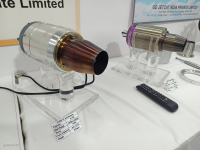
This engine below is the same Vedaa Aeronautics engine ?

From what I understand Veda Aeronautics' primary interest/expertise is in loitering munition. They had to indigenize this engine for their LM. This is why Kalyani-Veda Aeronautics deal is win-win.This engine below is the same Vedaa Aeronautics engine ?
With Kalyani's help Veda can further indigenize their sub 100 Kgf turbojets. When they make LM's that would need 120-400 Kgf turbojet engines they can easily access Kalyani's portfolio.
We have any more info on the PBS India made engines status ? they seem to take part in recent expos but hardly seen much mentionIndian companies working on micro/small turbojet engines:

Meet PBS India at AERO INDIA 2025
Meet PBS India at AERO INDIA 2025PBS India invites you to join us at Aero India 2025, Asia@s premier aerospace and defense exhibition, where we will showcase our cutting-edge technologies designed to revolutionize aerial and defense systems.
Yes, they were participating in one of those seminars. They have started some licence production if I remember correctly.We have any more info on the PBS India made engines status ? they seem to take part in recent expos but hardly seen much mention
Meet PBS India at AERO INDIA 2025
Meet PBS India at AERO INDIA 2025PBS India invites you to join us at Aero India 2025, Asia@s premier aerospace and defense exhibition, where we will showcase our cutting-edge technologies designed to revolutionize aerial and defense systems.www.pbsindia.com
Bengaluru-based aerospace startup Nabhdrishti Aerospace has raised $3 million in a seed funding round led by Accel, with participation from IIMA Ventures and other existing investors. The company is working on fuel-flex gas turbines for power generation and aircraft propulsion.
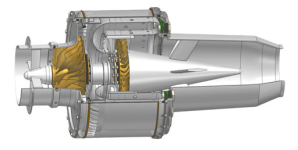




SiriNor tests electric jet engine in India
By Ben Sampson
25th April 2025

Norwegian-Indian company Sirinor's is developing a tip-driven propulsion system using distributed edge-mounted motors rather than a hub mounted engine (Image: SiriNor)
SiriNor has successfully tested what it claims is the world’s first all-electric jet engine at its facility in Pune, India. The test on April 22 validated the engine at Technology Readiness Level 6 under NASA’s framework.
The Norwegian aerospace company with an Indian subsidiary reported that its engine prototype exceeded the design intent of 40,000 RPM and 10 kgf thrust as measured by a load cell during the ground test. The company sees this as a critical step toward full commercialization.
“This ground test is not just a technical milestone. It’s a moment of validation for our amazing team and our common vision,” said Ivar Aune, chairman and CEO of SiriNor.

The company is developing a tip-driven propulsion system using distributed edge-mounted motors rather than a hub-mounted engine. Built for thrusts ranging from 1kN to 90+ kN, the engine design aims to support ranges exceeding 4,000 km.
SiriNor is targeting UAV engine commercialization by mid-2026, followed by certification for larger platforms including ground-effect vehicles and aircraft.
The company has raised early-stage funding, reaching a US$20 million valuation following the successful test. SiriNor plans to raise another USD$5 million before the summer this year.

According to SiriNor, its engine architecture removes the need for combustion chambers and high-cost alloys, potentially cutting manufacturing costs by 30% and maintenance costs by up to 40% for aircraft engines. The power source-agnostic engine can work with both battery and hydrogen electric energy sources.
“Our engine architecture is designed for flexibility. It’s compatible with both battery and hydrogen electric energy sources, supports thrust ranges for everything from drones to commercial jets, and its simplicity brings unprecedented efficiency to aerospace manufacturing,” said Abhijeet Inamdar, co-founder of SiriNor and CEO of SiriNor India.
SiriNor said it has seven letters of intent with global drone, ground-effect vehicle, and small aircraft developers and operators. The company employs engineers from both Norway and India, with team members having previous experience at companies including Airbus, Tata Vistara, GE, Pratt & Whitney, and Equinor.
SiriNor tests electric jet engine in India | Aerospace Testing International
By Ben Sampson
25th April 2025
Norwegian-Indian company Sirinor's is developing a tip-driven propulsion system using distributed edge-mounted motors rather than a hub mounted engine (Image: SiriNor)
SiriNor has successfully tested what it claims is the world’s first all-electric jet engine at its facility in Pune, India. The test on April 22 validated the engine at Technology Readiness Level 6 under NASA’s framework.
The Norwegian aerospace company with an Indian subsidiary reported that its engine prototype exceeded the design intent of 40,000 RPM and 10 kgf thrust as measured by a load cell during the ground test. The company sees this as a critical step toward full commercialization.
“This ground test is not just a technical milestone. It’s a moment of validation for our amazing team and our common vision,” said Ivar Aune, chairman and CEO of SiriNor.
The company is developing a tip-driven propulsion system using distributed edge-mounted motors rather than a hub-mounted engine. Built for thrusts ranging from 1kN to 90+ kN, the engine design aims to support ranges exceeding 4,000 km.
SiriNor is targeting UAV engine commercialization by mid-2026, followed by certification for larger platforms including ground-effect vehicles and aircraft.
The company has raised early-stage funding, reaching a US$20 million valuation following the successful test. SiriNor plans to raise another USD$5 million before the summer this year.
According to SiriNor, its engine architecture removes the need for combustion chambers and high-cost alloys, potentially cutting manufacturing costs by 30% and maintenance costs by up to 40% for aircraft engines. The power source-agnostic engine can work with both battery and hydrogen electric energy sources.
“Our engine architecture is designed for flexibility. It’s compatible with both battery and hydrogen electric energy sources, supports thrust ranges for everything from drones to commercial jets, and its simplicity brings unprecedented efficiency to aerospace manufacturing,” said Abhijeet Inamdar, co-founder of SiriNor and CEO of SiriNor India.
SiriNor said it has seven letters of intent with global drone, ground-effect vehicle, and small aircraft developers and operators. The company employs engineers from both Norway and India, with team members having previous experience at companies including Airbus, Tata Vistara, GE, Pratt & Whitney, and Equinor.
SiriNor tests electric jet engine in India | Aerospace Testing International

Hyderabad company Raghu Vamsi develops fully indigenous micro turbojet engine for UAVs - Times of India
India Business News: Hyderabad-based Raghu Vamsi Machine Tools Pvt Ltd has developed an indigenous micro turbojet engine, INDRA RV25: 240N, in partnership with IIT-Hyderab
 timesofindia.indiatimes.com
SiriNor tests electric jet engine in India
By Ben Sampson
25th April 2025
View attachment 43412
Norwegian-Indian company Sirinor's is developing a tip-driven propulsion system using distributed edge-mounted motors rather than a hub mounted engine (Image: SiriNor)
SiriNor has successfully tested what it claims is the world’s first all-electric jet engine at its facility in Pune, India. The test on April 22 validated the engine at Technology Readiness Level 6 under NASA’s framework.
The Norwegian aerospace company with an Indian subsidiary reported that its engine prototype exceeded the design intent of 40,000 RPM and 10 kgf thrust as measured by a load cell during the ground test. The company sees this as a critical step toward full commercialization.
“This ground test is not just a technical milestone. It’s a moment of validation for our amazing team and our common vision,” said Ivar Aune, chairman and CEO of SiriNor.
View attachment 43413
The company is developing a tip-driven propulsion system using distributed edge-mounted motors rather than a hub-mounted engine. Built for thrusts ranging from 1kN to 90+ kN, the engine design aims to support ranges exceeding 4,000 km.
SiriNor is targeting UAV engine commercialization by mid-2026, followed by certification for larger platforms including ground-effect vehicles and aircraft.
The company has raised early-stage funding, reaching a US$20 million valuation following the successful test. SiriNor plans to raise another USD$5 million before the summer this year.
View attachment 43414
According to SiriNor, its engine architecture removes the need for combustion chambers and high-cost alloys, potentially cutting manufacturing costs by 30% and maintenance costs by up to 40% for aircraft engines. The power source-agnostic engine can work with both battery and hydrogen electric energy sources.
“Our engine architecture is designed for flexibility. It’s compatible with both battery and hydrogen electric energy sources, supports thrust ranges for everything from drones to commercial jets, and its simplicity brings unprecedented efficiency to aerospace manufacturing,” said Abhijeet Inamdar, co-founder of SiriNor and CEO of SiriNor India.
SiriNor said it has seven letters of intent with global drone, ground-effect vehicle, and small aircraft developers and operators. The company employs engineers from both Norway and India, with team members having previous experience at companies including Airbus, Tata Vistara, GE, Pratt & Whitney, and Equinor.
SiriNor tests electric jet engine in India | Aerospace Testing International
This Shell-backed Startup from Pune Is Building a Jet Engine To Make India Atmanirbhar in the Air
SiriNor is a collective of three innovators, one dream and a result that promises to reduce India’s import dependence for aircraft engines.
Shruti Tripathi
Updated on: 10 June 2025 11:01 am
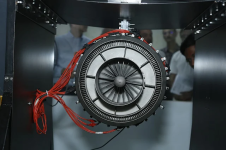
This Shell-backed Startup From Pune Is Building a Jet Engine To Make India Atmanirbhar in the Air
At 19, while most of his peers had their noses buried in textbooks, Pramod Vaditya was smelling a far bigger opportunity. That had always been his way—a restless mind unwilling to be shackled by structured learning. His creative energy needed an outlet—and soon, he found it in the blue skies of aerospace technology. Vaditya was determined to build a fighter jet engine for India.
To grasp the sheer audacity of that dream, look no further than this: Nearly 30 years and ₹2,000 crores after it was unveiled as India’s flagship jet engine mission in 1986—with the full weight of government support—the Kaveri project slipped quietly into oblivion, failing to pass a basic test. The engine maxed out at 65 kilonewtons of dry thrust—well short of the 90 kilonewtons needed to power a modern fighter jet. It is now being repurposed to power drones.
However, for Pramod, a man bent upon making history, all this was important learning but a part of forgettable history. People who know him well swear that Pramod was never content with absorbing theory.
“He wanted to turn every lecture into action to build, to experiment, and to contribute to India's aerospace future. For Vaditya, India’s dependence on foreign countries for jet engine technology was not just a technical gap; it was a slur on national pride, strategic autonomy, and sovereignty, “says Dr Pandiya Maruthu, Vaditya’s College Professor.
Dr. Maruthu recalls the unmistakable glint in his student’s eyes—the fire of a young mind determined to do something meaningful for his country.
Vaditya’s aviation dream soon took wings when he stumbled upon Abhijeet Inamdar on LinkedIn, a fellow engineer who had recently quit his corporate job and, remarkably, shared the same passion. What began as casual messages quickly grew into deep, late-night conversations about engines, innovation, and the future of Indian aerospace.
Inamdar found a ray of hope in Vaditya’s dream. At the time, he and his wife, Sirihathai, were living in the US, where she had been diagnosed with stage 4 cancer. As her condition worsened, the couple longed to be closer to her family during those difficult days. Sirihathai eventually passed away, but Inamdar chose to keep her memory alive in a profound way—by naming their ambitious jet engine project SiriNor in her honour.
Not long after, a serendipitous conversation between Pramod, Abhijeet, and Norwegian entrepreneur Ivar Aune gave shape and form to their bold idea of building India’s jet engine of its own. This shared ambition laid the foundation for SiriNor, which was officially launched in January 2022 and is backed by British energy giant Shell.
What Makes SiriNor Stand Out?
As the three innovators tunneled through the project, they realized there was no light at the end of treating engines as just another piece of equipment. What they needed was a breakthrough—something that would change the game entirely. Soon, they hit upon the idea of a ‘tip-turbine-based electric fan engine’ architecture capable of generating high thrust without combustion.
In simpler terms, SiriNor created a technique that could lift drones and aircraft using high-powered compressor fans, replacing the traditional method of burning fuel in conventional engines.
According to the co-founders, SiriNor's engine design enables scalable thrust configurations for the entire range of flying machines, from UAVs to fighter jets.
“Our design has undergone feasibility studies at IISc Bangalore and has been validated by industry experts, confirming its potential to deliver over 90 kN of thrust and a flight range of up to 4,000 km using existing power sources like batteries or fuel cells,” said Inamdar.
In April, the startup completed the on-ground test of its proprietary propulsion system in Pune. The milestone validated the engine at Technology Readiness Level 6 (TRL 6) under NASA’s framework, marking a critical step towards full commercialization, the company said.
Building on this validation, SiriNor has secured patents for its zero-emission supersonic and subsonic fan engine technologies and has also filed a global application under the Patent Cooperation Treaty (PCT) to protect its innovation internationally.
SiriNor aims to work its way up the aviation propulsion market, starting with UAVs and scaling up to engines for full fighter aircraft. Waiting on the runway for launch by Q3 2026 is a small engine designed for fixed-wing drones/UAVs (Unmanned Aerial Vehicles) in defence applications.
“It was clear to us that critical materials and technologies were the main stumbling blocks on the way of building powerful engines,” says Abhijeet Inamdaar. “Therefore, unlike conventional combustion engines, our engines operate at temperatures below 400°C, eliminating the need for super-alloys or exotic materials (nickel, cobalt, iron, titanium alloys). This makes the entire supply chain indigenous.” According to the company’s co-founders, the electrically driven propulsion system is expected to cost at least 30% less than conventional jet engines—making it more affordable while still ensuring healthy profit margins for SiriNor.
Roadblocks In SiriNor’s Journey
SiriNor has raised over $1 million from notable investors. Still, the co-founder believes that their ascent could have been smoother if only they had not been held back by unnecessary barriers. Still, with 20 individuals, including engineers, interns, and industry advisors, working passionately to realise their dream, the founders have nothing but deeply satisfying memories of the five-year journey.
Such ambitious enterprises, however, require intensive and consistent funding, which has been difficult to sustain over the years, they say. “To date, over $ 3 million has been sourced for the project from a mix of sweat, equity, capital raises, non-dilutive grants, and in-kind support from manufacturers, investors, and professionals who believed in our vision. But it remains uncertain whether the government will procure our product, and our investments will yield any returns,” says Inamdar.
Additionally, with the electric jet market worldwide being dominated by a handful of aviation giants, such as Boeing, GE, and Safran, gaining even a foothold in the global market would be a daunting challenge for start-ups like SiriNor. In fact, such targets are, for the moment, much too far-fetched to merit serious consideration—especially without serious government support.
The fact is that developing technology for aviation and defence, involving complex innovations such as jet engines, takes loads of capital and time. Prototypes must jump through several hoops of rigorous testing before even getting a sniff of the market. There is never any guarantee of success. “Given these endemic risks, government support is crucial to ensure that funding constraints do not stop start-ups like SiriNor from dreaming.”
The need for such support has never been more urgent. "The Indian aerospace ecosystem is still dominated by players like Hindustan Aeronautics Limited (HAL), which primarily operate with the support of international partnerships,” adds Inamdar. “However, a majority of components for India’s jet engine development are still imported,” a high-risk gambit given how the world is reordering itself around rapidly changing power dynamics, shifting affiliations and unprecedented geopolitical re-alignments. Self-reliance in sectors like defence is no longer desirable—it is essential, as underlined by Sindoor. The need to pull out all the stops is even more compelling in light of the country’s ambitious flight into the space of next-generation fighters like Multi-Role Fighter Aircraft (MRFA), Tejas Mk2, and the Advanced Medium Combat Aircraft (AMCA).
The co-founders of SirNor are aware of the gravity of the times for India, a rising global economic power encircled by inimical forces, which cannot be held in check by diplomacy alone. India needs deterrent military power, riding on next-generation platforms. The work of SiriNor, in that context, epitomises a break from the past. It is a daring step into the future, riding on the jet engine of self-reliance and innovation.
This Shell-backed Startup From Pune Is Building a Jet Engine To Make India

As the three innovators tunneled through the project, they realized there was no light at the end of treating engines as just another piece of equipment. What they needed was a breakthrough—something that would change the game entirely. Soon, they hit upon the idea of a ‘tip-turbine-based electric fan engine’ architecture capable of generating high thrust without combustion.
In simpler terms, SiriNor created a technique that could lift drones and aircraft using high-powered compressor fans, replacing the traditional method of burning fuel in conventional engines.
According to the co-founders, SiriNor's engine design enables scalable thrust configurations for the entire range of flying machines, from UAVs to fighter jets.
“Our design has undergone feasibility studies at IISc Bangalore and has been validated by industry experts, confirming its potential to deliver over 90 kN of thrust and a flight range of up to 4,000 km using existing power sources like batteries or fuel cells,” said Inamdar.

Too good to be true claims.