Taiwan (ROC) Navy. Updates and discussions

Amarante

Senior member
Jun 22, 2021
1,720
2,065
La Défense, France

Taiwan To Upgrade Kang Ding-Class Frigates With French Assistance​

The Taiwanese navy (ROC Navy) provisioned a 43.1 billion New Taiwan Dollar (1.37 billion USD) budget to upgrade its 6 La Fayette type, Kang Ding-class, frigates from 2022.

A Taiwanese media, UP MEDIA, quoted an anonymous source, saying that despite the shadow of the commission and kickback scandal, in which both Taiwanese and French parties were involved (when Taiwan procured the frigates in the 1990s), Taiwan has been negotiating with the French Directorate General of Armaments (Direction générale de l’armement, DGA) for the upgrade.

After France approved Taiwan’s request, DGA requested Naval Group (formerly DCN and DCNS) to negotiate the scope of the upgrade. Therefore, this upgrade program is a foreign military sale.

Taiwan’s NCSIST (National Chung-Shan Institute of Science and Technology, a Taiwanese state owned corporation) once wanted to become the prime contractor, with the reason of Indigenous National defense (國防自主國艦國造). However, the ROC Navy insisted on France being the prime contractor for the upgrade program, to integrate systems developed by NCSIST, such as the TC-2N surface-to-air missile (SAM) system.

Assistance by French experts
According to the report, the French experts involved in the upgrade program are led by a retired French navy senior officer, probably a commander or captain. The officer was said to be an expert of technologies, and have a background in submarine technologies. Taiwan has given privilege to the French officer responsible for the program.

The ROC Navy has provided information about the upgrade program to the parliament. According to the information, the upgrade program has 3 stages. In the first stage, French experts and NCSIST’s Hsunlien Project (迅聯專案) personnel will evaluate system integration and test them, examine the ships, make blueprints, and finish the evaluation for extension and modification constructions.

France have agreed to share technologies to Taiwan in order to modify and integrate the vertical launch system (VLS) that was developed locally by NCSIST as part of the Huayang Project(華陽計畫). In February 2021, Up Media reported that NCSIST bought Mk 41 VLS from Lockheed Martin and did some reverse engineering to develop its own VLS technology for launching shipborne variants of Taiwan’s indigenous surface-to-air missiles. But Lockheed Martin said that if NCSIST don’t pay the licensing revenue, no more parts and technology transfer will be provided. The French experts is said to provide technologies for installing the NCSIST’s 32-cell Huayang VLS into the B turret position (in place of the RIM-72C Sea Chaparral) of the frigates, without violating Lockheed Martin’s license.

About Kang Ding-class Frigates
In the 1990s, Taiwan procured 6 new frigates based on the La Fayette design from France. However, Chinese intervention made Taiwan unable to secure France-made weapon systems for the ships. ROC Navy had to equip the ships with U.S. made and Taiwanese made weapon systems, including RIM-72C Sea Chaparral SAM system, which has been criticized for decades because of its extremely short range and is considered inadequate for defense against modern anti-ship missiles and aircrafts.

The Kang Ding-class mainly conducts anti air warfare (AAW), anti-submarine warfare (ASW), escort, anti-blockade, and joint surface interception operations.

The 6 Kang Ding class are: Kang Ding (康定, PFG-1202), Xi Ning (西寧, PFG-1203), Kun Ming (昆明, PFG-1205), Di Hua (迪化, PFG-1206), Wu Chang (武昌, PFG-1207), Chen De (承德, PFG-1208). All are named after provincial capitals in China under ROC’s pre-1949 political system.

 
  • Like
Reactions: BMD and randomradio
Taiwan’s new submarine suffers failure during sea trial

Hai-Kun.webp

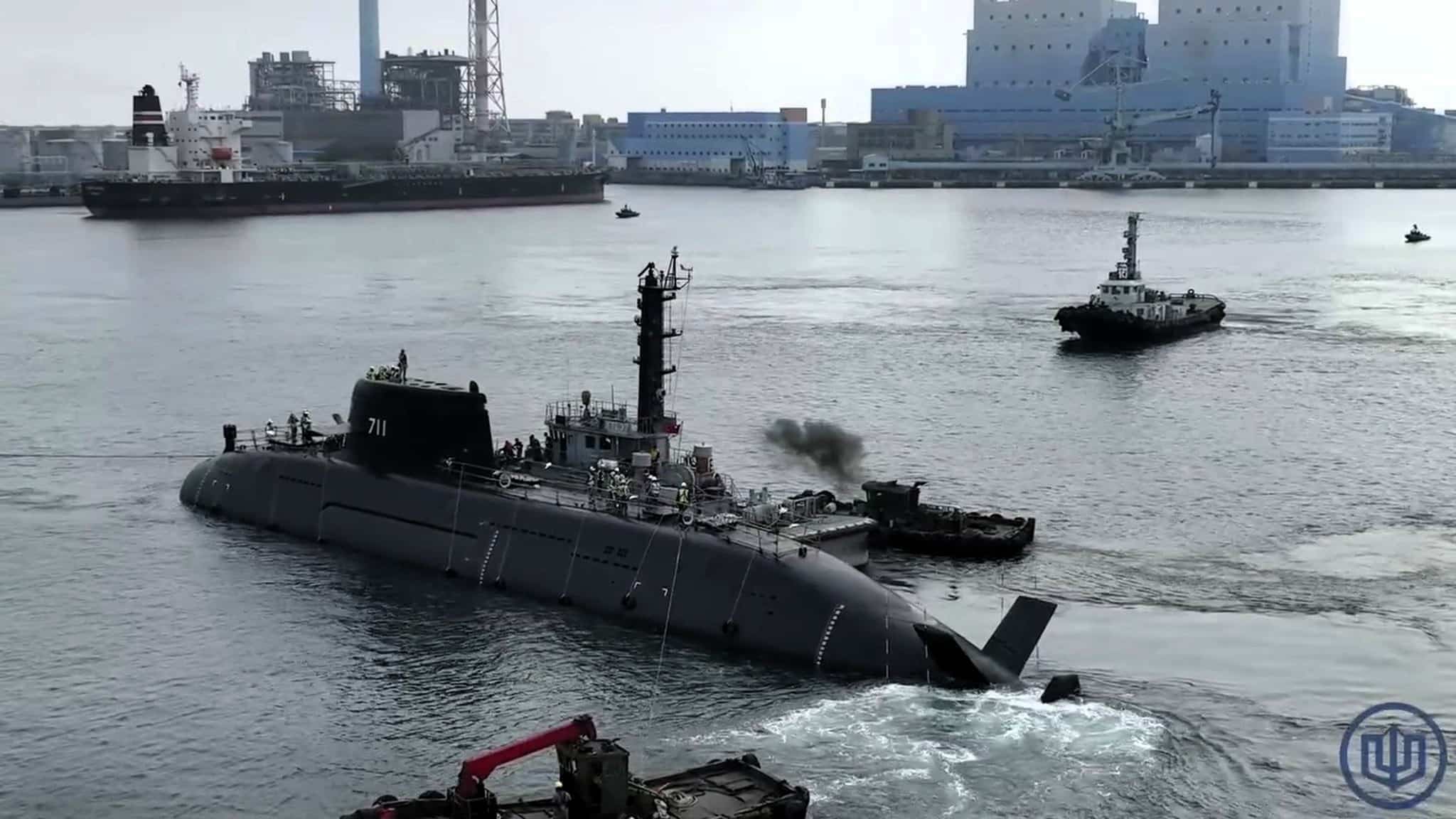
Taiwan’s domestically built Hai Kun submarine experienced a serious hydraulic system failure during sea trials, temporarily leaving the vessel without powered control of its X-shaped stern rudder and forcing sailors to rely on manual steering to avoid an accident, according to an exclusive report by Mirror Media.

The incident occurred during the submarine’s second sea trial, when all hydraulic systems reportedly failed, rendering the X-shaped tail rudder inoperable.

A person serving aboard Hai Kun (SS-711) told Mirror Media that the situation quickly became critical.


“The hydraulic system completely failed, and the X-shaped rudder could not turn at all,” the source said. “Everyone relied on soldiers lining up inside the steering gear compartment, taking turns using human power to operate the rudder, which allowed the submarine to escape danger.”

Hai Kun is the lead boat of Taiwan’s Indigenous Defense Submarine program, a flagship effort led by CSBC Corp. Taiwan and supported by the Republic of China Navy. Naval authorities and the shipbuilder have repeatedly stated that the submarine’s sea trials are conducted under “the highest standards, with comprehensive safety measures in place.”

Responding to Mirror Media’s report, Taiwan’s Navy Command acknowledged the incident but said all procedures were followed and the situation remained under control.

“The prototype submarine’s sea trials adhere to the principle of identifying problems, resolving them, and gradually strengthening system tuning and defect improvements,” the Navy Command said in a response. “The vessel’s control system is equipped with automatic, semi-automatic, and manual operation modes as multiple layers of redundancy. The response actions that day were carried out according to procedures and within safety limits.”

The Navy added that after returning to port, necessary corrective actions were completed and the submarine’s systems are now operating normally.

According to the source cited by Mirror Media, the second sea trial took place on June 26, when Hai Kun sailed under its own power for surface navigation testing, system verification, and maneuverability checks. CSBC previously stated publicly that the results of the second sea trial met expected objectives and that, following adjustments and preparations, the program would proceed toward submerged testing and deeper-water trials.

However, the insider described a far more alarming scenario. The submarine reportedly departed port operating on battery power when the hydraulic systems suddenly failed, leaving the X-shaped rudder locked in place.

“The submarine could only continue straight ahead,” the source said. “Personnel were immediately assembled in the stern steering gear room. The rudder control levers were brought out, and each person cranked them by hand. When someone ran out of strength, the next person took over.”

The source added that two tugboats accompanying Hai Kun during the trial were forced to tightly control the submarine’s bow, using pushing force to influence its direction and prevent a collision with other vessels while the rudder was partially restored through manual effort.

A person familiar with Hai Kun’s construction told Mirror Media that the submarine’s X-shaped tail rudder was a major design focus, precisely because of the risks associated with steering failures. As a result, the submarine was designed with multiple layers of redundancy beyond the primary hydraulic system.

“Submarines are typically equipped with several independent hydraulic pumps,” the source said, explaining that these pumps are powered by separate electrical sources or auxiliary diesel engines. “When the main system fails, the backup hydraulic circuit should immediately take over.”

If all hydraulic power is lost, the individual said, the final safeguard is mechanical manual control, requiring crew members to physically operate the rudder via linkages, gears, or cable systems in the steering gear compartment.

The Navy did not disclose specific technical details about the failure, nor whether it could affect the broader testing schedule. Officials emphasized that sea trials are intended to expose weaknesses before the submarine enters operational service.