Turkey booted off F-35 Program

That's a polite way of saying it's cack.
The RuAF plans to induct 75 planes starting this year. I don't think they'd do so, if they weren't confident about it. Further, between the Chinese attempts at construction of a true blue 5th generation FA & that of the Russians, I'd go with the latter to get as close to the real thing as possible. Meanwhile, let's see how does your 5th generation FA program pan out given your neighbors attempts at coming out with a 6th generation FA in the same time frame.
 
The RuAF plans to induct 75 planes starting this year. I don't think they'd do so, if they weren't confident about it. Further, between the Chinese attempts at construction of a true blue 5th generation FA & that of the Russians, I'd go with the latter to get as close to the real thing as possible. Meanwhile, let's see how does your 5th generation FA program pan out given your neighbors attempts at coming out with a 6th generation FA in the same time frame.
75 planes over what period of time? My guess is like about 5-7 years.

I wouldn't, not saying that the Chinese are great aerospace engineers but they're fantastic thieves.

Oh, the Franco-German plane is 6th gen now is it, but wait, the Gripen NG was also 6th gen, so these planes must be 7th gen right.
 
75 planes over what period of time? My guess is like about 5-7 years.
5-7 years from the first induction, I reckon.

I wouldn't,
Your opinion.

Oh, the Franco-German plane is 6th gen now is it, but wait, the Gripen NG was also 6th gen, so these planes must be 7th gen right.

Take it up with the French ( French members here) & the Swedes.
 
The RuAF plans to induct 75 planes starting this year. I don't think they'd do so, if they weren't confident about it. Further, between the Chinese attempts at construction of a true blue 5th generation FA & that of the Russians, I'd go with the latter to get as close to the real thing as possible. Meanwhile, let's see how does your 5th generation FA program pan out given your neighbors attempts at coming out with a 6th generation FA in the same time frame.

But UK has already made massive progress with their 5th gen jets. They have produced many brochures, full scale mock up using plastic, sound/light/ animation set etc.
 
Then their F- 16 fleet will rust fast.
Look at the bright side. Once Turkey starts cannnibalizing their F-16s, Pakistan will appear out of nowhere hat in hand with an endearing smile and appeals in the name of the ummah brotherhood. Of course, if the Pakistani economy collapses further and there's a very good likelihood of that happening then Turkey could well play the role intended for Pakistan.

@zarvan ; @safriz
 
Then their F- 16 fleet will rust fast.

Can't say. Any attempt to purchase the PAK FA can only be made after 2025, and by the time they get some it will be 2030. By then, out of 270 aircraft, 240 aircraft will be between 30 and 40 years old and will have received all the upgrades necessary.

Also, the Turks are now ready to replace American avionics with their own. Like the new indigenous EW suite.
Turkish defense giant ASELSAN upgrades F-16 jets with national self-protection system

By the time the PAK FA sanctions come in, they will have enough spares and capability to operate their F-16s to the end of their lives, which won't be a lot by then. The TF-X is being designed to replace the F-16s anyway.
 
But UK has already made massive progress with their 5th gen jets. They have produced many brochures, full scale mock up using plastic, sound/light/ animation set etc.
Taranis testing.... Radar modelling using Replica....
 
Turkey's economy to contract in 2019, limited growth ahead
Ezgi Erkoyun July 17, 2019​

ISTANBUL (Reuters) - Turkey’s economy is expected to contract in 2019 for the first time in a decade and to see only modest growth in the following two years, a Reuters poll showed on Wednesday.

1563909649621.png
FILE PHOTO: People stroll at the Grand Bazaar, known as the Covered Bazaar, in Istanbul, Turkey November 14, 2018. REUTERS/Murad SezerÊ/File Photo​

The poll of more than 40 economists showed the Turkish economy shrinking 1.5% this year, according to the median forecast. The government’s own sharply-lowered forecast for this year envisages an expansion of 2.3%.

There was a wide range of estimates in the July 4-16 Reuters poll, from growth of 1% to a contraction of 5%. The poll sees growth of 2.4% in 2020 and 3.4% in 2021.

“Early indicators for Q2 point to a renewed slowdown because of financial market volatility and elevated political uncertainty, which raise the risk of a double-dip recession,” economists at Nomura said.

In the second and third quarters of 2019 the economy is forecast to contract by 2.5% and 1.1%, respectively, before returning to growth of just 1.0% in the final three months of the year, the poll medians showed.

Second quarter GDP growth is due to be announced on Sept. 2.

Turkey’s economy last contracted on an annual basis in 2009, by 4.7%. From 2010 to 2017, its compound growth rate was 6.6% thanks to a construction boom driven by cheap capital following the global financial crisis.

But hit by a currency crisis that triggered a near-30% lira slide against the dollar, the Turkish economy contracted 2.6% in the first three months of the year after shrinking 3.0% in the fourth quarter of last year,

That lira slide pushed inflation to a 15-year high, severely limited companies’ ability to service foreign debt and multiplied bad loans in the banking sector.

Meanwhile, investors have voiced concern over possible U.S. sanctions after Russia delivered S-400 air defense missile system parts to Turkey. Ankara and Washington have been at odds over the deployment of the system as it could compromise F-35 fighter jets, made by Lockheed Martin.

RATE CUTS?
The central bank hiked its policy rate to 24% in September in the face of the currency crisis and has left it unchanged since, though the recent dismissal of the central bank governor has unnerved investors over the institution’s independence.

President Tayyip Erdogan, a self-described “enemy of interest rates”, dismissed Murat Cetinkaya on July 6 for not following instructions. His successor, Murat Uysal, hinted at rate cuts on Monday.

Ratings agency Fitch downgraded Turkey’s sovereign rating deeper into junk territory, saying Cetinkaya’s dismissal heightened doubt over authorities’ tolerance for a period of sustained below-trend growth.

Economists predicted the central bank would lower its key rate to 22.00% by the end of the third quarter and to 20% by year-end, according to the poll median.

“We now expect the CBRT to cut rates by 200 basis points on July 25 and see a cumulative 500 basis points fall by the end of this year,” JP Morgan said in a recent note.

Further cuts in the central bank’s main policy rate would be possible if geopolitical risks are avoided and Ankara introduces credible policies, JP Morgan added.

The current account deficit - which ballooned last year but has since receded as the economy slowed - is expected to stand at 1.0% of GDP this year, lower than a government forecast and down from last year.

------------------------------------------------------------------------------------------------------------------------------------
Source: Reuters

Tough times ahead for Turkey... might get some pretty good vacation deals though.
 

Turkey’s Air Force Is Obsolete, Warns New Study​

Turkey’s air force is becoming obsolete, according to a new Turkish study.

“Turkey and the Turkish Air Force's air warfare capabilities face a serious test over the next 10 to 20 years,” writes Can Kasapoglu, director of the security and defense program at Turkish think tank EDAM, who authored the report.

Kasapoglu describes the weakness of Turkish airpower as a “techno-generation problem.” The Turkish Air Force’s fourth-generation F-16s and third-generation F-4s – which are essentially Cold War aircraft – are reaching the end of their lifespans. Turkish plans to replace them with 100 fifth-generation F-35A stealth fighters have collapsed after Turkey was kicked out of the F-35 program amid U.S. anger over Turkey’s purchase of Russian S-400 anti-aircraft missiles. Meanwhile, Turkey’s rivals – including Greece and Israel – are receiving F-35s, or generation 4.5 fighters like France’s Rafale.

“If an intermediate solution is not found, Turkish air power will fall behind world trends,” Kasapoglu warns.

The report suggests that giving up the F-35 in favor of S-400 missiles was a bad bargain. “Turkey's defense planning and national security requirements, are not suitable for a SAM-intensive force structure. The S-400 strategic SAM system, which has just entered the inventory of the Turkish Armed Forces, will not perform at the desired level due to the shortcomings in the network-centered architecture.”

Nor are armed drones a substitute for the F-35. Turkey has garnered a reputation as a drone power after Turkey-made TB2 and Israeli-made Harop drones decimated Armenian troops and armored vehicles during the 2020 Nagorno-Karabakh War. But EDAM rejects the idea that drones can substitute for advanced manned aircraft. “Although there is a potential for change within the scope of artificial intelligence and algorithmic warfare, air warfare parameters are still shaped around manned platforms.”

That leaves the TF-X project to develop a homegrown fifth-generation stealth fighter by 2029. But problems finding a suitable engine from overseas manufacturers “may extend the time needed to enter the inventory,” noted EDAM.

It’s not just Turkey’s air force that will feel the loss of the F-35. The loss jeopardizes the Turkish Navy’s plans for an amphibious assault ship – essentially a light aircraft carrier — equipped with short-takeoff and vertical landing F-35Bs, according to EDAM.

The study also warns of Turkish weakness in air and missiles defense. Turkish forces in northern Syria have been bombed by Syrian and Russian aircraft, while United Arab Emirates jets reportedly struck a Turkish airbase in Libya in 2020 after Turkish forces intervened in the Libyan civil war. “The air defense of the Turkish Armed Forces' forward-deployed combat elements and cross-border bases is becoming an increasingly serious requirement in the lessons learned from the Libyan and Syrian experience,” says EDAM.

Turkey is also surrounded by nations with ballistic missiles, including Syria, Armenia, Iran and Russia. Even here, losing the F-35 is a problem: the stealth jet and its advanced sensors could play a vital role in missile defense, both as an interceptor and by conducting strikes against missile launchers, the study says.

The report makes clear that Turkey has only one real solution to maintain its airpower. “Turkey should return to its priority as the F-35 program. The mentioned policy advice is of great importance both for the combat capabilities of the Turkish Air Force and for the technological and economic gains and employment capacity of the Turkish defense industry.”
 
  • Like
Reactions: Chain Smoker

Turkey’s Air Force Is Obsolete, Warns New Study​

Turkey’s air force is becoming obsolete, according to a new Turkish study.

“Turkey and the Turkish Air Force's air warfare capabilities face a serious test over the next 10 to 20 years,” writes Can Kasapoglu, director of the security and defense program at Turkish think tank EDAM, who authored the report.

Kasapoglu describes the weakness of Turkish airpower as a “techno-generation problem.” The Turkish Air Force’s fourth-generation F-16s and third-generation F-4s – which are essentially Cold War aircraft – are reaching the end of their lifespans. Turkish plans to replace them with 100 fifth-generation F-35A stealth fighters have collapsed after Turkey was kicked out of the F-35 program amid U.S. anger over Turkey’s purchase of Russian S-400 anti-aircraft missiles. Meanwhile, Turkey’s rivals – including Greece and Israel – are receiving F-35s, or generation 4.5 fighters like France’s Rafale.

“If an intermediate solution is not found, Turkish air power will fall behind world trends,” Kasapoglu warns.

The report suggests that giving up the F-35 in favor of S-400 missiles was a bad bargain. “Turkey's defense planning and national security requirements, are not suitable for a SAM-intensive force structure. The S-400 strategic SAM system, which has just entered the inventory of the Turkish Armed Forces, will not perform at the desired level due to the shortcomings in the network-centered architecture.”

Nor are armed drones a substitute for the F-35. Turkey has garnered a reputation as a drone power after Turkey-made TB2 and Israeli-made Harop drones decimated Armenian troops and armored vehicles during the 2020 Nagorno-Karabakh War. But EDAM rejects the idea that drones can substitute for advanced manned aircraft. “Although there is a potential for change within the scope of artificial intelligence and algorithmic warfare, air warfare parameters are still shaped around manned platforms.”

That leaves the TF-X project to develop a homegrown fifth-generation stealth fighter by 2029. But problems finding a suitable engine from overseas manufacturers “may extend the time needed to enter the inventory,” noted EDAM.

It’s not just Turkey’s air force that will feel the loss of the F-35. The loss jeopardizes the Turkish Navy’s plans for an amphibious assault ship – essentially a light aircraft carrier — equipped with short-takeoff and vertical landing F-35Bs, according to EDAM.

The study also warns of Turkish weakness in air and missiles defense. Turkish forces in northern Syria have been bombed by Syrian and Russian aircraft, while United Arab Emirates jets reportedly struck a Turkish airbase in Libya in 2020 after Turkish forces intervened in the Libyan civil war. “The air defense of the Turkish Armed Forces' forward-deployed combat elements and cross-border bases is becoming an increasingly serious requirement in the lessons learned from the Libyan and Syrian experience,” says EDAM.

Turkey is also surrounded by nations with ballistic missiles, including Syria, Armenia, Iran and Russia. Even here, losing the F-35 is a problem: the stealth jet and its advanced sensors could play a vital role in missile defense, both as an interceptor and by conducting strikes against missile launchers, the study says.

The report makes clear that Turkey has only one real solution to maintain its airpower. “Turkey should return to its priority as the F-35 program. The mentioned policy advice is of great importance both for the combat capabilities of the Turkish Air Force and for the technological and economic gains and employment capacity of the Turkish defense industry.”
 

US committed to deepening cooperation with Turkey: Official​

ANKARA
The US is committed to deepening cooperation with Turkey, and the two countries have so many common interests, the US Assistant Secretary of State for European and Eurasian Affairs said.

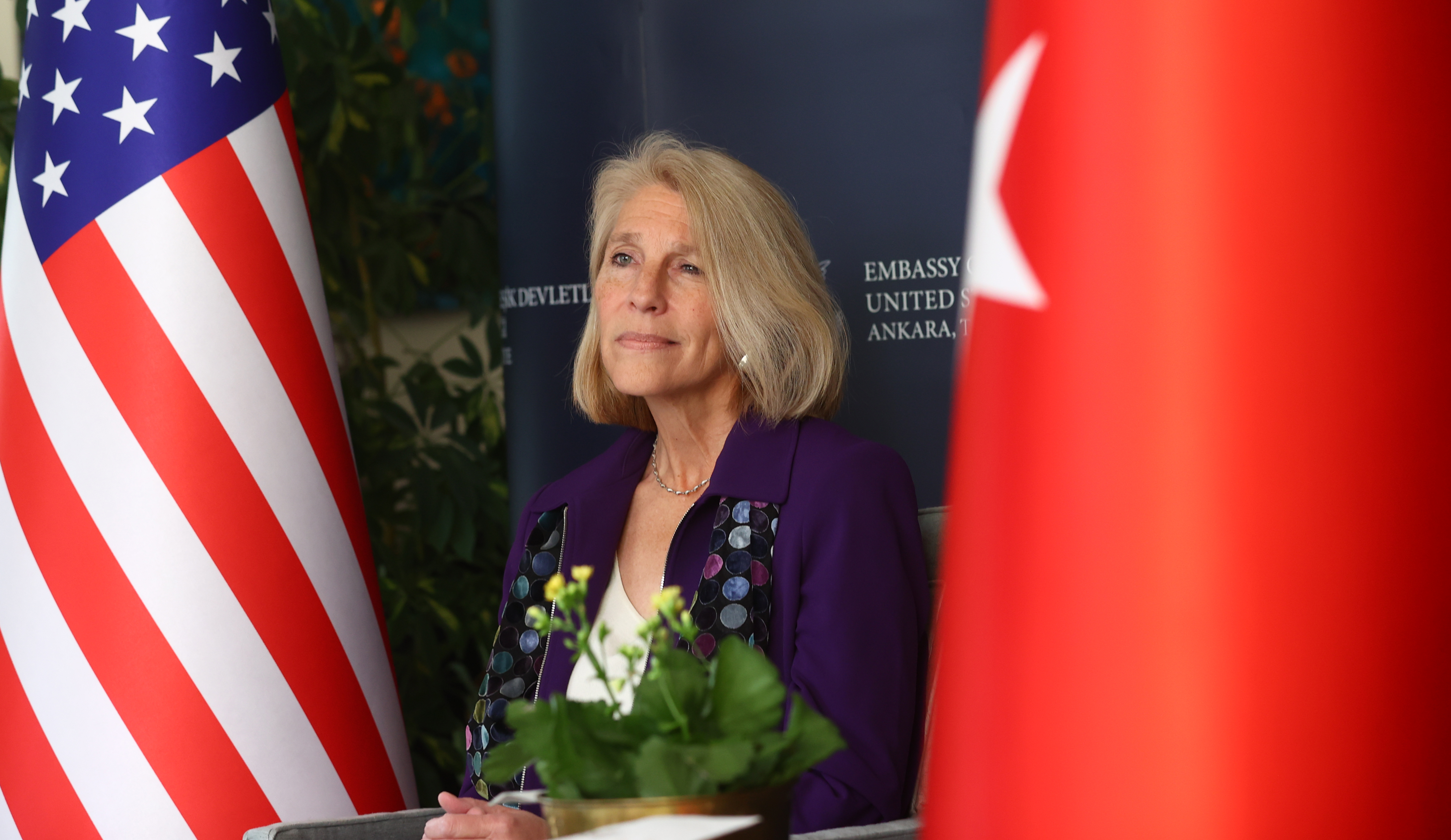
Speaking exclusively to Anadolu Agency during her visit to Turkey, Karen Donfried said she is relatively new in her position and visiting Turkey as early in her tenure as she could is very important to her.

"And that reflects the fact that Turkey is such a longstanding and valued NATO partner. We share so many common interests, and there's so much we can do together. So I was eager to get to Ankara and start those conversations in person," she said.

Responding to a question regarding the dialogue mechanisms between the two countries, Donfried said the timing of her visit is "auspicious" because it came after the in-person meeting between US President Joe Biden and Turkish President Recep Tayyip Erdogan in Rome on the margins of the G20 Summit.

"That conversation led both to agree that we should deepen our dialogue on the many issues where we can work effectively together. So most of my conversations at the Foreign Ministry focused on that topic of how it is that we can fill out that conversation the two presidents had with a concrete proposal. I'm very much looking forward to continuing that discussion," she said.

Donfried.jpg


'Dialogue continues on a very regular basis between the US and Turkey'

Regarding whether there are any planned high-level visits from the US to Turkey after her visit, Donfried said, "there certainly will be continued opportunities."

Recalling the recent high-level Defense Group meeting in Washington, she said: "So I want to point out that this dialogue continues on a very regular basis between the US and Turkey. And the next opportunity for that senior-level dialogue will be at the NATO foreign ministerial, which will take place in late November, early December. And certainly, our two foreign ministers will be working together in that NATO context on the very important agenda that unites us there."

Stating that the next NATO summit that will take place in June 2022 in Madrid will focus on a new strategic direction of the alliance for the next ten years, Donfried said: "I think that provides a wonderful opportunity for the US and Turkey, together with all of our NATO allies, to think strategically about both the regional and global challenges that face us today."


'We are committed to deepening our cooperation with Turkey'

Donfried was also asked about the increase of the US military presence in Greece, which caused discomfort in Turkey. A letter sent by the US Secretary of State Antony Blinken to Greek Prime Minister Kyriakos Mitsotakis after the signing of the National Defense Cooperation Agreement includes the wording "firm determination of the two countries against actions that threaten peace," which raises the issue of whether the United States is taking a position with Greece against Turkey.

"I am very sorry to hear that it caused concern in Turkey. That's because I think to deeper the US engagement in any NATO ally is a good thing. And the US is equally interested in deepening our cooperation here in Turkey. Certainly, the purpose of my visit is to think together with our Turkish partners -- how is it that the US and Turkey can work more closely. And I think the cooperation with Greece should be seen absolutely in that light.

"You'll remember that when President Biden came into office, he talked about America being back and the United States wanting to deepen our engagement with our key allies, reinvigorate our alliances and partnerships, and that is very much the spirit of what the US is doing with its Greek ally. And we are as committed to deepening our cooperation with Turkey," she added.

Donfried-1.jpg


Confidence in reaching resolution

Responding to a question on Turkey's $1.4 billion payment for F-35 fighter jets and ongoing talks on the possibility of a refund or the sale of F-16s to Turkey, Donfried said, "the United States and Turkey have a robust defense relationship that has many facets to it."

She said the high-level Defense Group meeting in Washington this week covered a range of issues, including these topics.

"And I think the important thing here is that there is an ongoing process through which the United States and Turkey are working on these issues. And I am confident that working together, we will reach a resolution," she added.


'Legislative requirements of CAATSA are different with regard to an ally'

Asked about the waiver of sanctions on the Nord Stream 2 pipeline project and some media reports suggesting a waiver for India's purchase of Russia's S-400 air defense system, Donfried said there are "a lot of different pieces in the question that you just posed."

"And a Nord Stream 2, the legislation which the administration is responding to carries a different acronym, it's called PEESA [Protecting Europe's Energy Security Act]. And I won't go into the details of that."

"Then you mentioned CAATSA [Countering America's Adversaries Through Sanctions Act], with regard to Turkey, and the S400, and then CAATSA in a potential context of a deal with India," she said.

"On India piece, there have been no decisions made about that. So I think it's important to be clear about that. But then also, the legislative requirements of CAATSA are different with regard to an ally. So I think it's also important to understand that India and Turkey are treated differently in that legislation. So it's a complicated set of issues. But just to repeat that there's no decision on India. And I think we shouldn't put India and Turkey in the same basket when we think about CAATSA. And the fact that Turkey is a NATO ally of the United States, and the legislative implications of that are important to remember in that context."


Purchase of F-16s

Donfried said the US welcomes Turkey's interest in the purchase of F-16s.

"And I know that there's a delegation going shortly to Washington to continue the conversation on this. And we will continue through this technical process to move this request forward," she added.
 
"And a Nord Stream 2, the legislation which the administration is responding to carries a different acronym, it's called PEESA [Protecting Europe's Energy Security Act]. And I won't go into the details of that."
oops, these laws are for our whims & fancies , if we cant arm twist then we have different laws for that.

lets pass a law any cntry which imposes sanction on India invites counter sanctions like decrease market access or increased import duty on their products.
 
Pakistan dudes might be replacing Turkey. India needs to be take corrective action on 5th Gen jets before that.
Turkish fifth gen isn't coming anytime soon. It's most likely they will junk the programme entirely since even their trainer aircraft can't come online.