

Have we secured the INSTC yet?India in talks with Russia's Rosneft to tap Siberian rare earth reserves
By Dipanjan Roy Chaudhury, ET Bureau
Last Updated: Jun 20, 2026, 06:18:00 AM IST
View attachment 52627
India faced a shortage of rare earth magnets after China clamped down on exports.
Synopsis
India is collaborating with Russian giant Rosneft to explore Siberia's rare earth deposits, aiming to secure vital mineral supplies. These elements are crucial for electric vehicle motors and advanced electronics, areas where India currently depends on imports. Following past export disruptions, this partnership, initiated during the India-Russia summit, seeks to develop processing technologies and potentially produce essential rare-earth magnets.
New Delhi: India is in talks with Russian oil producer Rosneft to study the mineral composition of its rare earth deposits in Siberia, according to an official, as part of efforts to secure supplies of critical minerals.
Rare earth elements are essential for producing permanent magnets, which are essential for electric vehicle motors and find application across new-age electronics. India relies on imports of these elements to meet its domestic needs, as it does not have commercial-scale facilities for refining and separating.
The country faced an acute shortage of rare earth magnets after China, its largest supplier, clamped down on exports. During the annual India-Russia summit in December, the two countries had decided to launch collaboration in the rare earth and critical minerals sector.
Russia holds some of the world's largest reserves of rare earth elements, primarily in Siberia and the Murmansk region. Rosneft had acquired the deposit in Siberia's Tomtor region last year. In May, JSC Giredmet, a unit of Rosatom's scientific division, signed a memorandum of understanding with India's Nexon Geochem for research and development of technologies for processing raw materials of rare earths.
Giredmet also signed a letter of intent with India's Technology Innovation in Exploration & Mining Foundation (TEXMiN), part of the Indian Institute of Technology (Indian School of Mines). The agreement provides for joint research and development of technologies for producing neodymium-iron-boron (NdFeB) rare-earth permanent magnets, including the full metallurgical cycle and pilot validation of Giredmet technologies.
Can bonds replace rental income? The ₹40,000 monthly cash flow math - The Economic Times
Indian Electronics Manufacturing Developments : News and Discussions
- Thread starter RISING SUN
- Start date
You are using an out of date browser. It may not display this or other websites correctly.
You should upgrade or use an alternative browser.
You should upgrade or use an alternative browser.



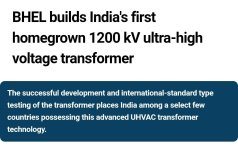

BHEL builds India's first homegrown 1200 kV ultra-high voltage transformer - CNBC TV18
The equipment was manufactured under a controlled environment at BHEL's newly built transformer facility in Bhopal, using advanced manufacturing and testing infrastructure to meet stringent quality standards.
very old news?View attachment 52977
BHEL builds India's first homegrown 1200 kV ultra-high voltage transformer - CNBC TV18
The equipment was manufactured under a controlled environment at BHEL's newly built transformer facility in Bhopal, using advanced manufacturing and testing infrastructure to meet stringent quality standards.www.cnbctv18.com

India's first 1200 kV transformer made by BHEL commissioned | Bhopal News - Times of India
With the commissioning of the 1200 kV Transmission system, India joins the elite group of countries like Russia, Japan and China who have commissioned
 timesofindia.indiatimes.com

Good move by GoI.

More of this please.
I like this guy. Put him in charge of more things.
We need a similar push in other industries like pharmaceuticals. We are half way there, without external push we cant reach next level.
The other huge advantage for India - Japan is a leader in green REE separation and recycling tech. India doesn't need to destroy its environment the way China did.
Japan company to set up rare earths magnet unit in Andhra Pradesh
Japan's Proterial will invest ₹2,250 crore to build a rare earth magnet plant in Andhra Pradesh. This facility will produce vital components for electric vehicles and wind turbines. The move aims to boost India's local rare earth value chain. It also reduces dependence on Chinese sources. This...economictimes.indiatimes.com
Japan's Proterial, a global leader in advanced materials, will set up a rare earth permanent magnet manufacturing facility in Andhra Pradesh with an investment of ₹2,250 crore, marking a key step toward building India's local rare earth value chain and reducing its reliance on Chinese sources, said people with knowledge of the matter.
The project, to be located at Achutapuram in Anakapalli district, will manufacture 1.2 kilo tonnes per annum (ktpa) of sintered neodymium-iron-boron (NdFeB) permanent magnets, among the most critical components used in electric vehicles, wind turbines, industrial motors, electronics, aerospace and defence systems. The State Investment Promotion Committee approved the project at its meeting last week.
The proposed investment comes at a time when India is actively seeking to reduce dependence on imported rare earth magnets and build indigenous manufacturing capabilities in strategic sectors.
The Centre recently approved a dedicated incentive programme to encourage domestic production of sintered rare earth permanent magnets, underscoring the national importance of the sector.
The company didn't respond to queries.
Proterial, formerly Hitachi Metals, is regarded as one of the global pioneers of NdFeB magnet technology and remains a leading supplier of advanced magnetic materials worldwide. The Japanese company posted consolidated revenue of ₹45,000 crore last year and operates in North America, Europe, China and Asia."
Development of Technologies for Separation and Refinement of Heavy Rare Earths | NEDO
This project will promote hREE resource recycling and resource securing in a government-led manner in Japan. It will be helpful for stabilization materials industry in Japan, increasing independency from specific countries and reduce future supply risks of hREE.
Last edited:



No way lol, they prolly imported it rather than directly dealing with said company.
Canadian climate technology developer Enervoxa plans talks with India's Vedanta, Hindalco Industries (HALC.NS), opens new tab and state-run NALCO as it looks to set up a processing plant in the country to extract rare earths from a waste byproduct of aluminium production.
A commercial-scale plant would cost around $250 million to $350 million and could be financed through a combination of strategic equity and project financing, Enervoxa Chief Executive Vandit Verma told Reuters. The company is looking at potential locations in eastern India for the project, he said.
Recovering rare earth concentrates from bauxite residue — a byproduct of aluminium production known as red mud — is a relatively new commercial application that has gained momentum amid growing geopolitical concerns over China's dominance of rare earth processing.
India holds substantial rare earth reserves but lacks industrial-scale facilities capable of processing the minerals to high purity levels. The country is also the world's second-largest aluminium producer and its third-biggest consumer.
Enervoxa has spent eight years developing its own process to recover rare earths from red mud, Verma said in an interview on Wednesday.
In addition to aluminium producers, Enervoxa plans to approach engineering companies, steel manufacturers and critical minerals processing companies to develop an integrated value chain for the products recoverable from red mud, which also include iron oxide, coagulants, pigments and titanium-bearing materials.
The company also plans to seek Indian government assistance, Verma said.
India's Jawaharlal Nehru Aluminium Research Development and Design Centre, along with other stakeholders under government think tank NITI Aayog, is conducting research into metal extraction and rare earth element enrichment from red mud, the government said last year.
Enervoxa's project could involve either full processing of red mud within India or production of a rare earth concentrate for refining at a dedicated downstream facility, Verma said.
The company is currently focused on evaluating commercial opportunities with companies in India, North America, Southeast Asia and other alumina-producing regions, he said.
A commercial-scale plant would cost around $250 million to $350 million and could be financed through a combination of strategic equity and project financing, Enervoxa Chief Executive Vandit Verma told Reuters. The company is looking at potential locations in eastern India for the project, he said.
Recovering rare earth concentrates from bauxite residue — a byproduct of aluminium production known as red mud — is a relatively new commercial application that has gained momentum amid growing geopolitical concerns over China's dominance of rare earth processing.
India holds substantial rare earth reserves but lacks industrial-scale facilities capable of processing the minerals to high purity levels. The country is also the world's second-largest aluminium producer and its third-biggest consumer.
Enervoxa has spent eight years developing its own process to recover rare earths from red mud, Verma said in an interview on Wednesday.
In addition to aluminium producers, Enervoxa plans to approach engineering companies, steel manufacturers and critical minerals processing companies to develop an integrated value chain for the products recoverable from red mud, which also include iron oxide, coagulants, pigments and titanium-bearing materials.
The company also plans to seek Indian government assistance, Verma said.
India's Jawaharlal Nehru Aluminium Research Development and Design Centre, along with other stakeholders under government think tank NITI Aayog, is conducting research into metal extraction and rare earth element enrichment from red mud, the government said last year.
Enervoxa's project could involve either full processing of red mud within India or production of a rare earth concentrate for refining at a dedicated downstream facility, Verma said.
The company is currently focused on evaluating commercial opportunities with companies in India, North America, Southeast Asia and other alumina-producing regions, he said.

L&T launched a dedicated Electronic Products & Systems (EPS) business and will invest ₹5,000 crore over 5 years.
India proposes extending tax breaks for contract manufacturing in a boost for Apple
- Fifteen-year tax break for income from storing electronics parts
- Tax exemption for making phones, tablets, laptops, and wearables
- India is set to make 26% of the world's iPhones in 2026
- Tax exemption for foreign diamond miners, traders selling rough diamonds
Last edited:
The thing is that while our value added has skyrocketed compared to the past the screens etc are still being produced outside of India, Im not really satisfied until India can make everything within the country bar the chips and maybe the camera modules. I do hope the ECMS and ISM 2.0 schemes can help us reach that goal though.

From Consumer to Competitor: How China Views India's Photovoltaic Rise
From Consumer to Competitor: How China Views India's Photovoltaic Rise
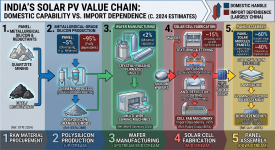
In the past few days, the Chinese internet has been abuzz with news of India ‘stealing’ businesses from China, this time in the photovoltaic (PV) space. India’s photovoltaic module production capacity has “skyrocketed” from less than 10 GW in 2018 to 172 GW in 2026 (almost on par with global annual installation capacity), registering a 17-fold increase over eight years. Meanwhile, in China, leading photovoltaic companies have been reporting record-breaking losses totalling tens of billions of yuan since the fourth quarter of 2023, falling into the deepest quagmire of losses in history.
From Consumer to Competitor: How China Views India's Photovoltaic Rise
From Consumer to Competitor: How China Views India's Photovoltaic Risewww.orfonline.org
In the past few days, the Chinese internet has been abuzz with news of India ‘stealing’ businesses from China, this time in the photovoltaic (PV) space. India’s photovoltaic module production capacity has “skyrocketed” from less than 10 GW in 2018 to 172 GW in 2026 (almost on par with global annual installation capacity), registering a 17-fold increase over eight years. Meanwhile, in China, leading photovoltaic companies have been reporting record-breaking losses totalling tens of billions of yuan since the fourth quarter of 2023, falling into the deepest quagmire of losses in history.
It's a good start, but there's a long road ahead:


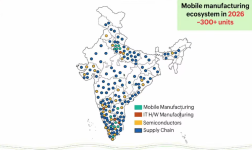
'Indian-Designed, Indian-Branded Phones By 2028': Union Minister's Big Promise
The Minister claimed that the "entire manufacturing sector was totally stymied by the kind of rules, regulations, and laws" during the previous Congress governments.

Come 2028, India will have its own Apple, Samsung - the global industry's biggest players in smartphone business - moment, IT Minister Ashwini Vaishnaw told NDTV on Friday.
"This is 23 October 2026. Please note it: 23 October 2028. You will have Indian-designed, Indian-manufactured, Indian-branded mobile phones," Vaishnaw told NDTV World Summit in Delhi.
Demonstrating the complexities involved in the process, the Minister asked NDTV's Editor-in-Chief Rahul Kanwal, who was interviewing him, to hand him his mobile phone for him to explian better.
"In this small little real estate you have to have radio frequency communication. You have the antenna, compute, memory, all the passive components, a camera module, a display, and power management. Everything has to be built into this small little device. You have to manage the weight, the power management, and everything you have to do within this small little real estate, a small little form factor. That's why it's extremely complex to design a mobile phone," Vaishnaw said.
Three years ago, the Minister said, he threw the challenge to Indian designers.
"Three years back we gave this challenge to Indian designers: why can't you design the PCB, which is the motherboard of a mobile phone? Why can't you design that? Two companies came forward and they designed it. One of them designed it very well and today that company's design has been selected by the largest US telecom service provider," the Minister said.
"In the US when you buy a phone you also get a 12-month contract with the telecom service provider so they have already got the contract. They have designed and delivered a 5G-plus mobile phone to one of the largest telecom service providers in the US. That phone is today already manufactured and delivered to the customers. That capability we have been able to develop over 3.5 years, over the last few years, and that capability is now available for us," he said.
"Now we will use that capability to have the Indian brand, Indian design, and Indian IP retained in India and that mobile phone will be one of the largest-selling," the Minister promised.
The Minister claimed that the "entire manufacturing sector was totally stymied by the kind of rules, regulations, and laws" during the previous Congress governments.
"The entire manufacturing sector was totally stymied by the kind of rules, regulations, and laws the Congress governments of those periods created. From 1990 onwards there was an opening up. That opening up played very well till 2004. From 2004 to 2014 once again that entire control mindset, instead of timing things, that entire left-leaning mindset came and things went back. From 2014 onwards our Prime Minister came back with the philosophy of Make in India," he said.
The Minister said that the entire historical context of the economy, the politico-economic context of our country will have to be seen "to understand where we stand".
"We are manufacturing mobile phones, drones, missiles, trains, and some of the most advanced equipment. That's why we are able to say that today electronics goods are among those exported out of India. Electronics is the third-largest exported item. Imagine 12 years ago: could you even think of electronics as an exported item from India? It was difficult to even imagine that. Today it is already third. Very soon it will become second," he said.
