First NSIL-HAL-L&T launch of PSLV was the C62 mission that failed with AnveshaThere is privatisation of PSLV manufacturing. First launch in Jan 2027.
Same with LVM3.
Indian Space Industry : Updates & Discussions
- Thread starter Ashwin
- Start date
You are using an out of date browser. It may not display this or other websites correctly.
You should upgrade or use an alternative browser.
You should upgrade or use an alternative browser.


Nope. See this https://www.youtube.com/watch?v=cNAwt05uuK8&t=3120s.First NSIL-HAL-L&T launch of PSLV was the C62 mission that failed with Anvesha
First launch has payload, next four don't currently. Those 4 could launch 76 satellites.
Timestamp?Nope. See this https://www.youtube.com/watch?v=cNAwt05uuK8&t=3120s.
First launch has payload, next four don't currently. Those 4 could launch 76 satellites.
Timestamp is already there in the url. Atleast, click the play button.Timestamp?
I've watched the entire video. No where does it say what you said. Except 5 NSIL PSLVs under realisation.Timestamp is already there in the url. Atleast, click the play button.
Last edited:
You needed to see the slide in the given timestamp, and not full video.I've watched the entire video. No where does it say what you said. Except 5 NSIL PSLVs under realisation.
Second launch flight N2 has payloads in an old manifesto. Don't know if those would still be the payloads for N2. Second sentence is my estimate based on Parthu's statement of each satellite weighing 200 kg.First launch has payload, next four don't currently. Those 4 could launch 76 satellites.
One month before the presentation seen in the video

First industry-built PSLV launch slips to March 2027 - The Economic Times
The launch has seen multiple schedule changes since NewSpace India Ltd, the commercial arm of the Indian Space Research Organisation (ISRO), awarded the contract to the HAL-L&T consortium in 2022.
From November 2025

India’s first commercial PSLV rocket set to launch Oceansat satellite early next year
India's first commercially built PSLV rocket will launch the Oceansat satellite early next year, marking a milestone in space exploration.
"ISRO feels that the demand for satellites is high. And, we may end up doing another ten launches after these five," Ramchandani said, adding that the space agency was keen to step back from manufacturing the PSLV and encourage the industry to produce the proven rocket.
He said the first PSLV built by HAL-L&T consortium will launch the Oceansat satellite early next year.


IN-SPACe selects 3 space cos for satellite-based urban settlement mapping
SpacePixxel, KaleidEO and Azista Industries will receive ₹1.46 crore to develop high-resolution settlement layers using Indian satellite data, with pilots in Bengaluru and Shimla
Shine Jacob
Chennai
Updated : Nov 17 2026 | 3:36 PM IST
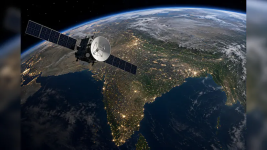
Following successful demonstrations, the selected companies may receive work orders from user agencies to scale up their solution (AI-generated image).
The Indian National Space Promotion and Authorisation Centre (IN-SPACe) has selected three Indian space companies under its Seed Fund Scheme for Use Case Demonstration by Non-Government Entities (NGEs) to develop high-resolution Indian Human Settlement Layers (IHSL) across Indian cities.
SpacePixxel Technologies, KaleidEO Space Systems and Azista Industries will collectively receive seed funding of Rs 1.46 crore to develop and demonstrate an indigenous satellite-based system for three-dimensional reconstruction of India’s built environment using monocular imagery.
The initiative, undertaken under the Announcement of Opportunity for the Development of High-Resolution Indian Human Settlement Layers, aims to address NITI Aayog’s requirement for accurate and detailed geospatial data on human settlements.
The data can be used for urban planning, infrastructure development, disaster-risk assessment and population assessment.
The selected companies will develop models using Earth Observation data to generate three integrated outputs covering built-up surface and building type, building height, and built-up volume.
The outputs will capture both the horizontal and vertical dimensions of urban settlements, allowing planners to assess how Indian cities are expanding and densifying.
The techniques will be developed at high spatial resolution using Indian satellite data.
Pilot demonstrations will cover Bengaluru and Shimla, representing two contrasting urban contexts — a large metropolitan region and a hill city.
The project will derive settlement patterns across two time periods, enabling comparisons of urban growth and changes in built-up density over time.
Pawan Goenka, chairman, IN-SPACe, said Indian cities were expanding rapidly both horizontally and vertically, making accurate built-environment data increasingly important for urban planning.
“India’s cities are expanding rapidly, both horizontally and vertically. Effective urban planning requires an accurate understanding of the built environment, but critical data gaps often limit this,” Goenka said.
“This initiative addresses that gap by bringing together Indian satellite data, indigenous technology and clearly defined requirements from government departments. It gives Indian companies an opportunity to develop solutions for real-world urban challenges,” he added.
“More importantly, successful pilots can lay the foundation for scalable, homegrown capabilities that can be deployed across Indian cities,” Goenka said.
Shamika Ravi, member of the Economic Advisory Council to the Prime Minister, said modern policymaking required more contemporary forms of data.
“Modern policymaking needs modern and real-time data. Our 21st century policymaking cannot rely solely on 20th century data collection methods and should now embrace modern forms of data,” Ravi said.
“Starting with Bengaluru and Shimla, this IN-SPACe supported project will provide pathways to build indigenous satellite data on human settlements, allowing recognition of urbanisation as it happens,” she added.
Rajeev Jyoti, director, Technical Directorate, IN-SPACe, said the selection process was highly competitive.
“The technical evaluation process was highly competitive, with 26 proposals received. Total 13 proposals were shortlisted and finally 3 proposals were selected for funding support to translate promising concepts into pilot demonstrations,” he said.
The projects will be periodically monitored by a Project Facilitation and Monitoring Committee comprising representatives from user departments and the Indian Space Research Organisation (Isro).
Following successful demonstrations, the selected companies may receive work orders from user agencies to scale up their solutions.
IN-SPACe said the initiative is intended to translate government requirements into viable commercial opportunities while strengthening the capabilities of India’s private space ecosystem in developing indigenous, application-led space technologies.
https://www.business-standard.com/c...acepixxel-kaleideo-azista-126111700737_1.html
SpacePixxel, KaleidEO and Azista Industries will receive ₹1.46 crore to develop high-resolution settlement layers using Indian satellite data, with pilots in Bengaluru and Shimla
Shine Jacob
Chennai
Updated : Nov 17 2026 | 3:36 PM IST
Following successful demonstrations, the selected companies may receive work orders from user agencies to scale up their solution (AI-generated image).
The Indian National Space Promotion and Authorisation Centre (IN-SPACe) has selected three Indian space companies under its Seed Fund Scheme for Use Case Demonstration by Non-Government Entities (NGEs) to develop high-resolution Indian Human Settlement Layers (IHSL) across Indian cities.
SpacePixxel Technologies, KaleidEO Space Systems and Azista Industries will collectively receive seed funding of Rs 1.46 crore to develop and demonstrate an indigenous satellite-based system for three-dimensional reconstruction of India’s built environment using monocular imagery.
The initiative, undertaken under the Announcement of Opportunity for the Development of High-Resolution Indian Human Settlement Layers, aims to address NITI Aayog’s requirement for accurate and detailed geospatial data on human settlements.
The data can be used for urban planning, infrastructure development, disaster-risk assessment and population assessment.
The selected companies will develop models using Earth Observation data to generate three integrated outputs covering built-up surface and building type, building height, and built-up volume.
The outputs will capture both the horizontal and vertical dimensions of urban settlements, allowing planners to assess how Indian cities are expanding and densifying.
The techniques will be developed at high spatial resolution using Indian satellite data.
Pilot demonstrations will cover Bengaluru and Shimla, representing two contrasting urban contexts — a large metropolitan region and a hill city.
The project will derive settlement patterns across two time periods, enabling comparisons of urban growth and changes in built-up density over time.
Pawan Goenka, chairman, IN-SPACe, said Indian cities were expanding rapidly both horizontally and vertically, making accurate built-environment data increasingly important for urban planning.
“India’s cities are expanding rapidly, both horizontally and vertically. Effective urban planning requires an accurate understanding of the built environment, but critical data gaps often limit this,” Goenka said.
“This initiative addresses that gap by bringing together Indian satellite data, indigenous technology and clearly defined requirements from government departments. It gives Indian companies an opportunity to develop solutions for real-world urban challenges,” he added.
“More importantly, successful pilots can lay the foundation for scalable, homegrown capabilities that can be deployed across Indian cities,” Goenka said.
Shamika Ravi, member of the Economic Advisory Council to the Prime Minister, said modern policymaking required more contemporary forms of data.
“Modern policymaking needs modern and real-time data. Our 21st century policymaking cannot rely solely on 20th century data collection methods and should now embrace modern forms of data,” Ravi said.
“Starting with Bengaluru and Shimla, this IN-SPACe supported project will provide pathways to build indigenous satellite data on human settlements, allowing recognition of urbanisation as it happens,” she added.
Rajeev Jyoti, director, Technical Directorate, IN-SPACe, said the selection process was highly competitive.
“The technical evaluation process was highly competitive, with 26 proposals received. Total 13 proposals were shortlisted and finally 3 proposals were selected for funding support to translate promising concepts into pilot demonstrations,” he said.
The projects will be periodically monitored by a Project Facilitation and Monitoring Committee comprising representatives from user departments and the Indian Space Research Organisation (Isro).
Following successful demonstrations, the selected companies may receive work orders from user agencies to scale up their solutions.
IN-SPACe said the initiative is intended to translate government requirements into viable commercial opportunities while strengthening the capabilities of India’s private space ecosystem in developing indigenous, application-led space technologies.
https://www.business-standard.com/c...acepixxel-kaleideo-azista-126111700737_1.html
1. Skyroot is targeting another launch this year. Rocket no 2, 3 & 4 are under construction.
2. Cadence of 1 launch per month by end of 2027.
3. Skyroot wants to build re-usable rockets. Vikram 1 & 2 will continue as small satellite launch vehicles. Vikram 3 might not happen.
4. Vikram 1 will be the workhorse. Vikram 2 will carry 3X the payload of Vikram 1.
5. The re-usable rocket might be a medium or heavy lifter. Built to launch constellations of satellites. They will target USD 500 per kg with this re-usable launcher.
Updates:
1. Skyroot is targeting another Vikram-1 launch by end of 2026. Rocket no. 3, 4 & 5 are under construction.
2. Vikram-2 will take 1+ ton to orbit (to LEO, I presume). That rocket is being built right now. Vikram-2 was previously stated to carry 900 kg to LEO. It will be powered by "a top notch cycle" Methalox engine. Probably referring to the Dhawan engine.
3. They have ambitions towards human space launches in the long run.

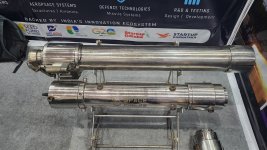

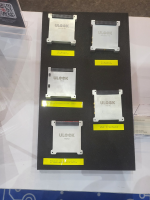
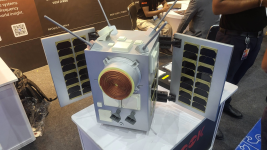
Some guy pointed in another thread how Indian space program is in declineUpdates:
1. Skyroot is targeting another Vikram-1 launch by end of 2026. Rocket no. 3, 4 & 5 are under construction.
2. Vikram-2 will take 1+ ton to orbit (to LEO, I presume). That rocket is being built right now. Vikram-2 was previously stated to carry 900 kg to LEO. It will be powered by "a top notch cycle" Methalox engine. Probably referring to the Dhawan engine.
3. They have ambitions towards human space launches in the long run.

It has entered the next step of evolution.


Payloads of Vikram-I Flight #2 announced! Launch aimed for late-2026.
- NILA III - a 4U cubesat by HEX20
 , carrying a resistojet electric thruster by OhmSpace


- SCOPE - a 4U cubesat by Skyroot themselves
- EXOpod Nova - an 8U deployer by Exolaunch
 , which will deploy the two satellites
T-Hub is incubating a space start up called "Cosmo Crawler". They had tested a small-scale "Alligator CCE1" thruster:
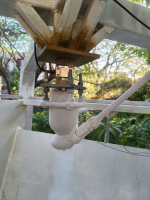

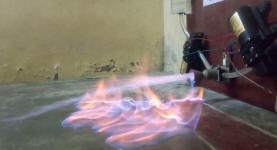
This engine used gaseous methane & LOX as propellant. Pressure fed with a chamber pressure of 8-9 bar.
Hot fire videos:
View attachment 01Alligator CCE1.mp4
View attachment 02Alligator CCE1.mp4
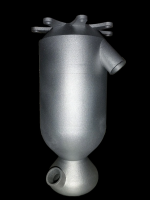
They plan to scale up this engine to produce 2200+ kgf thrust (~21.57 kN). Electric motor driven pump fed. This is what the scaled-up engine will look like:
They have also tested their 10-ton class Kerolox engine:

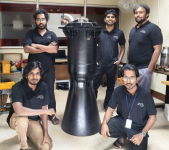
They plan on scaling up this Kerolox engine to booster class engine. This is a render from their website. Don't know if it is the real model or a placeholder. Looks very similar to many Soviet/Russian engines:

The Methalox engine will serve as upper stage RCS. It is being fitted on a very "Gaganyaan" look alike upper stage:
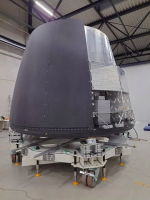
Eventually they want to build a fully re-usable hybrid landing rocket. No details on payload class of this rocket.
This engine used gaseous methane & LOX as propellant. Pressure fed with a chamber pressure of 8-9 bar.
Hot fire videos:
View attachment 01Alligator CCE1.mp4
View attachment 02Alligator CCE1.mp4
They plan to scale up this engine to produce 2200+ kgf thrust (~21.57 kN). Electric motor driven pump fed. This is what the scaled-up engine will look like:
They have also tested their 10-ton class Kerolox engine:
They plan on scaling up this Kerolox engine to booster class engine. This is a render from their website. Don't know if it is the real model or a placeholder. Looks very similar to many Soviet/Russian engines:
The Methalox engine will serve as upper stage RCS. It is being fitted on a very "Gaganyaan" look alike upper stage:
Eventually they want to build a fully re-usable hybrid landing rocket. No details on payload class of this rocket.