French Navy upgrade and discussion

French MoD Selects Top Contenders for DANAE Armed Surface Drone Project​

French MoD Selects Top Contenders for DANAE Armed Surface Drone Project
The French Defence Innovation Agency (Agence de l’innovation de défense — AID) and the French Navy (Marine nationale) have officially selected the three industrial partners moving forward in the DANAE armed USV program.
1791810401780.png
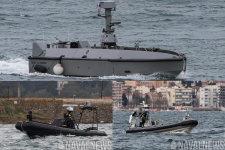
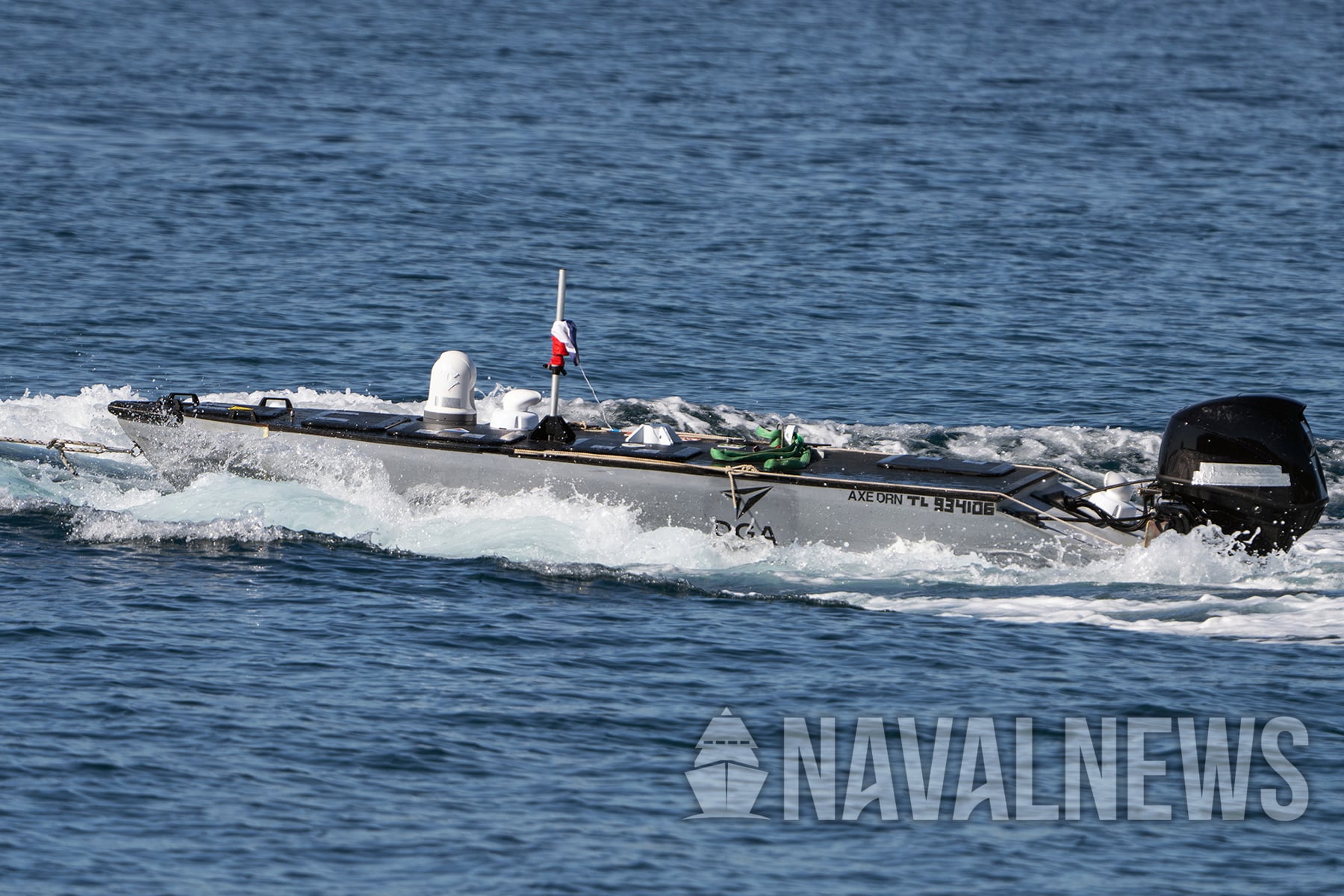
The three finalist designs for DANAE: SIREHNA Seaquest-S (top), Seair "flying USV" (bottom left), and Seaowl NEMEZIS (bottom right). Pictures by Hervé Dermoune.
 

France orders MdCN Mk2 (NCM Mk2), first delivery 2030, apparently also in the submarine tube-launched variant

France to order long-range naval cruise missile from MBDA​

  • The missile has a range of more than 1,000 km
  • Upgrades include greater ⁠stealth, increased lethality, more resistance to satellite navigation jamming and a better ⁠ability to penetrate enemy air defences
  • Mission preparation will use ⁠AI components developed by MBDA teams

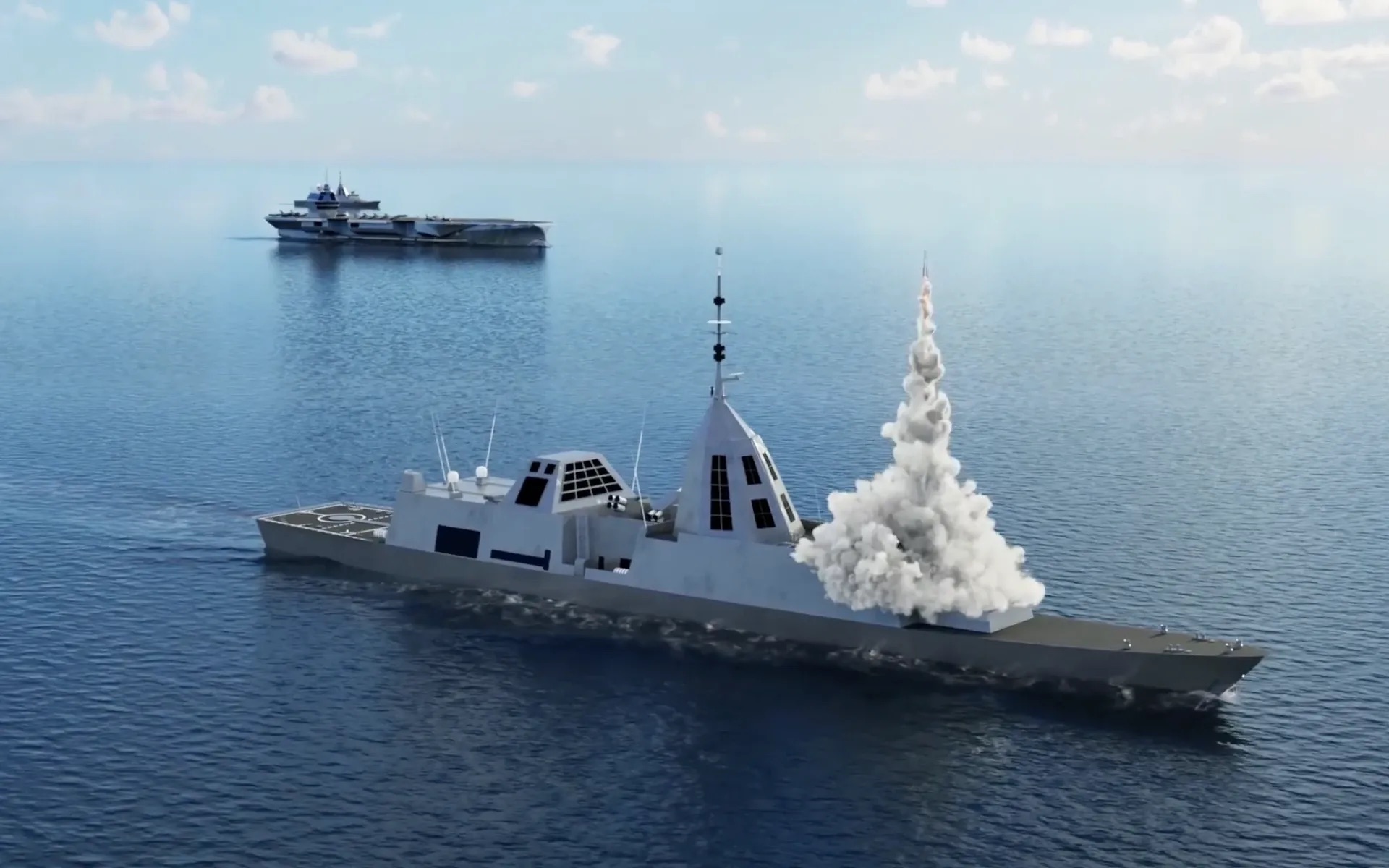
France orders upgraded MdCN Mk2 naval cruise missiles to extend deep strike capabilities of frigates and submarines.​

Unveiled at Eurosatory, the upgraded deep-strike missile preserves complete physical integration with French Navy FREMM frigates and Suffren-class nuclear attack submarines while extending operational range beyond 1,000 kilometers. Modernization features advanced GNSS anti-jamming navigation, reduced radar cross-section, improved electro-optical/infrared guidance, and Fastrike AI mission planning that compresses engagement preparation times from hours to minutes.
 
Last edited:
  • Like
Reactions: Parthu

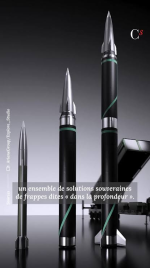
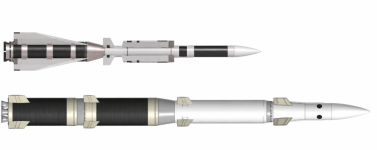
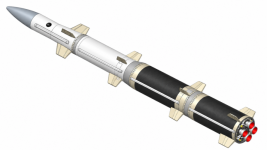
7m long and 24 inches (at 10s). So same width as ATACMS but 3m longer. At that size they could theoretically put 7 inside an M51-derived submarine model. Interesting that it can hit moving targets too - referred to as anti-ship (at 24s).

Also to note is that the B-Strike 2500 appears to be the same diameter, at least in models, and that the first stage may employ the same engine as the 1000, which will likely save money.

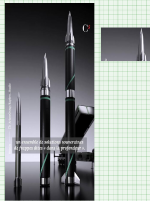
Glider dimensions - nearly 2m long (20 small squares per metre, B-Strike 1000 is 140 small squares - second image). Diameter at base is about 7.5 small squares, so 375mm. Warhead therefore probably around 250kg or less. Mk82 is 2.29m x 273mm for reference.

1794059081461.png1794059911243.png
 
Last edited:
  • Like
Reactions: Parthu
Multi-national but I'll put it here:

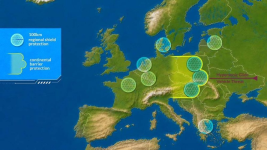
HYDIS: MBDA unveils the final configuration of its hypersonic anti-missile system

The goal is to develop an interceptor capable of engaging threats with very different flight profiles using a single missile. Specifically, it must be able to engage medium- and intermediate-range ballistic missiles (over 3,000 kilometers), as well as hypersonic glide vehicles (HGVs) and hypersonic cruise missiles (HCMs). The latter present a particular challenge, as they can operate at very high speeds while performing significant maneuvers, notably at altitudes between 30 and 45 kilometers in the upper atmosphere. Conversely, ballistic missiles follow largely predictable trajectories, mostly outside the atmosphere, while their atmospheric reentry vehicles can reach speeds of Mach 16 to 17. According to MBDA, no existing interceptor system currently allows a single interceptor to cover all these threats, both endo-atmospheric and exo-atmospheric. In the United States, such a global capability requires the use of two different types of effectors, for example the SM-3 (which also adopts a 4-stage architecture) for exo-atmospheric interception, and the THAAD or the Patriot PAC-3 for interceptions in the atmosphere.

To meet this dual requirement, the consortium selected a four-stage endo-atmospheric missile with very high acceleration capabilities. Its design must allow it to intercept hypersonic threats during their glide or cruise phase, as well as very high-altitude ballistic missiles in the upper atmosphere during their final attack phase. Interception will rely on thermal imaging guidance, a particularly demanding technique, and on direct impact destruction (hit-to-kill). The choice of such high acceleration addresses the need to delay the interceptor's launch as much as possible, in order to obtain a better estimate of the threat's trajectory. To achieve this, the weapon system will need to utilize target behavior models, updated in real time by predictive algorithms that incorporate artificial intelligence.

A70 and Mk41 compatible.

Aster 30 vs Aquila
1794559741143.png
1794559752755.png

1794559987473.png
 
  • Like
Reactions: Parthu

Safran Unveils NGDS HK Rocket Launcher and PASEO Master D at Euronaval 2026​

Building on the two-axis NGDS (New Generation Dagaie System), the NGDS HK expands the launcher’s role from electronic warfare self-protection into multi-domain hard-kill engagement. While retaining compatibility with infrared, radar, and acoustic decoys as well as active off-board countermeasures, the modular mount can carry a one-ton payload of up to four rocket pods—each housing 22 standard 70 mm NATO or 68 mm French rockets, for a total of 88. Designed for single- or dual-mount installation across surface combatants, the fully trainable system delivers a short reaction time, ergonomic loading, and multi-threat processing from any bearing direction.
Speaking to Naval News in our Euronaval 2026 video report, Pierre-Olivier Nougues, VP Sales and Marketing Naval Solutions at Safran Electronics & Defense, noted that the launcher can fire rockets singly or in salvos against unmanned aerial vehicles (UAVs), uncrewed surface vessels (USVs), and small fast craft across anti-air, anti-surface, anti-submarine, and counter-UAS missions.