

High speed / Semi-High speed rail projects of Indian Railways
- Thread starter Ashwin
- Start date
You are using an out of date browser. It may not display this or other websites correctly.
You should upgrade or use an alternative browser.
You should upgrade or use an alternative browser.


Seats:

Automatic couplers:

HVAC vents:

The track trials are scheduled to start by May-June 2027 on a section of the Mumbai-Ahmedabad bullet train corridor. The inaugural run would be in August 2027. Probably around August 15. These are ambitious targets, but the speed of work looks good.
Automatic couplers:
HVAC vents:
The track trials are scheduled to start by May-June 2027 on a section of the Mumbai-Ahmedabad bullet train corridor. The inaugural run would be in August 2027. Probably around August 15. These are ambitious targets, but the speed of work looks good.
Sprakline Automation built BEML's "Aditya" production line used for B28 trainset's construction:


Resistoflex Group built the air suspension for the VB & VB cargo tains:


Resistoflex Group built the air suspension for the VB & VB cargo tains:


Sections of the Japanese media have covered Minister Vaishnaw's visit to the BEML B28 plant.
Google translated, so expect some inaccuracies:
First unveiling of India's 'domestically produced high-speed train'—what is the position of the Shinkansen? Concerns over mixed 'European and Japanese' signals on a single line.
By Naoki Osaka
Toyo Keizai Reporter
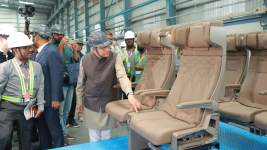
Railway Minister Ashwini Vaishnaw inspecting high-speed trains being manufactured by Indian vehicle manufacturers (Photo: NHSRCL)
You can also see holes that appear to be headrests, reading lights, and power outlets. These are seats for high-speed rail trains being developed by India. On November 1, the Indian High-Speed Railway Corporation (NHSRCL), the main operator of the high-speed rail project, released a report of India's Railway Minister Ashwini Vaishnaw inspecting the rolling stock factory.
India's first high-speed rail plan is under construction along the Mumbai–Ahmedabad section (508 km) in western India. At the Japan-India summit in December 2015, a memorandum of understanding was signed regarding the introduction of the Shinkansen system in Japan, with Japan fully cooperating.
Manufacturing of 'Domestically Produced Vehicles' to Begin Commercial Operation in 2027
The entire section is scheduled for completion by the end of 2030, but ahead of that, some sections are planned to begin operation in August 2027. Initially, the plan was to extend the Surat–Bilimola section (about 50 km), but there are also plans to expand it to the Surat–Vapi section (about 100 km). As the first high-speed train to run on this route, India is rapidly manufacturing its own B28 train.
The B28 is manufactured at the Bengaluru plant of BEML (Bharat Earth Movers Limited), an Indian railway manufacturer. Indian engineers designed it to adapt to the country's unique climate and operational environment.
Its top speed is 280 km/h. In actual commercial operation, it is expected to run at a speed of 249 km/h. The train consists of 8 cars: seven standard cars with 3+2 seating arrangements, and one executive-class car with 2+2 seating arrangements. The capacity is 557 people. It is also possible to couple two 8-car trains into a 16-car formation.
In addition to the seats, several photos have been released showing the Minister of Railways inspecting the structure of the rolling stock. However, what concerns me is that there are no photos of the finished vehicle. Is it still not finished?
In Taiwan, the new high-speed rail train "N700ST" is scheduled to begin operation in July 2027, and the completed train arrived in Taiwan in August this year, undergoing nearly a year of trial runs. In India, since this is the first high-speed railway, sufficient time must be allocated for trial runs. Commercial operation is planned for 2027, but will it be possible in time?
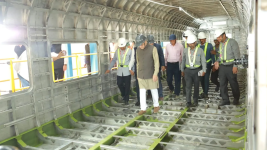
Railway Minister Vaishnaw inspecting the structure of a high-speed train being manufactured by an Indian vehicle manufacturer (Photo: NHSRCL)
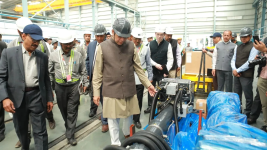
Railway Minister Vaishnaw inspecting Indian vehicle manufacturers producing high-speed trains (Photo: NHSRCL)
Originally planned as the 'E5 Series Shinkansen' trains
The first train was made in India, but the initial plan was to introduce JR East's main train, the 'E5 Series.' The commercialization study report released in July 2015 described vehicle specifications, maintenance processes, and the design and equipment of the train depot assuming the E5 series was the premise.
However, negotiations on the introduction of the E5 series stalled, and from 2023 to early 2024, India shifted its policy to introduce domestically produced vehicles. Although there has been no official announcement about the reason, India has promoted a domestic manufacturing promotion strategy called 'Make in India,' and it is possible that it insisted on using domestically produced trains as the first high-speed train.
Furthermore, in January 2025, India announced a tender for the entire line, assuming a Level 2 European system (ETCS) for signaling and train control systems. ETCS differs from the Shinkansen signaling system "Digital ATC," and once ETCS is adopted, the Shinkansen cannot operate.
The commercialization study report concluded that the adoption of digital ATC was recommended after comparing it with ETCS Level 2. The reasons cited include the safety of Japan's Shinkansen (no train accidents resulting in fatal passengers) and lower maintenance costs compared to ETCS Level 2. Nevertheless, the reason for switching to ETCS has not been announced.
We proposed the introduction of the 'E10 Series' under development, but...
Sensing the trend toward adopting ETCS, Japan implemented various measures to prevent it. First, it was proposed to transfer one E5 series train set and a comprehensive inspection vehicle to India for training and data collection. Additionally, starting January 2025, the company will accept 16 NHSRCL staff for one year and conduct Shinkansen driver training, strengthening its software aspects.
Furthermore, JR East proposed introducing the "E10 series" currently under development to India as a replacement for the E5 series, which had stalled in negotiations. The E10 series is expected to be completed after autumn 2027, and after running tests, it aims for commercial operation in Japan by fiscal year 2030. However, since the E10 series will not be ready for India's first high-speed train in August 2027, some believe the E10 series is being used to shift the logic that "the E10 series was developed domestically because it couldn't make it in time."
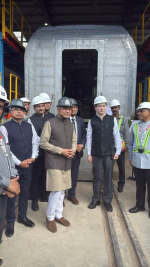
Railway Minister Vaishnaw and others inspecting the high-speed trains being manufactured at an Indian vehicle manufacturer. Part of the structure believed to be the hull can be seen in the rear (Photo: NHSRCL)
As a result, the ETCS bidding was conducted, and it was announced that in June 2025, a consortium of companies including Germany's Siemens won the bid.
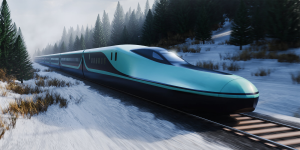
Completed image of the E10 series Shinkansen (Image: JR East)
At the Japan-India summit held in July this year, Prime Minister Takaichi and Prime Minister Modi reaffirmed their targets for introducing the E10 series. While the possibility of introducing the E10 series hasn't disappeared, the vague wording of 'confirmation of goals' remains uncertain. Some people on the Indian side say, "Just make the exterior E10 series and the internal system European-made." But can that really be called a Shinkansen? This is because the Shinkansen achieves safety and reliability through a "total system approach" that optimally integrates hardware such as rolling stock, signals, and tracks with software such as operation systems.
Safety: "Just 'try it first' is not a valid topic."
On October 8, a meeting of the International Association for Rapid Rail (IHRA), which promotes the overseas expansion of the Shinkansen system, was held in Fukuoka City. In a group interview after the meeting, IHRA Chairman Masashi Sukutoshi said, "I do not believe signaling systems must be ATC. If something equivalent or even more emerges through technological development, proves its safety, and is well integrated into the system, then it will be fundamental to our activities," and made the following request.
"However, for combinations that have never been used before, it's important whether their safety has been proven. Just 'try it first' won't make a difference. It is essential to conduct various demonstrations during the development phase, confirm their reliability, and then implement them in society.
Furthermore, after that comment, Chairman Shukutoshi added, "When I visited India at the beginning of October, I received similar questions from Indian media."
Later, upon investigation, I found that an interview article with Chairman Shukutoshi was published on the website of The Indian Express dated October 11. Among them was an exchange like this.
"There is no precedent for two systems coexisting."
— Are there any other countries where two different types of vehicles and signal systems are used together within a single line? Is it safe?
"In my view, there is no precedent for operating high-speed rail on a single line by mixing two different systems. Whether it can operate safely remains to be seen through demonstration. In my view, under conditions of some uncertainty and the existence of two different systems, it is impossible to run a passenger car at 300 km/h.
"How do you confirm that the system is secure? You have to prove that. Eventually, I think one or the other system will be adopted. It is impossible to operate both systems simultaneously. I am not in a position to comment on which one will be adopted, but it will depend on the results of direct consultations between the parties and between the Indian and Japanese governments."
As mentioned in the paper's question, there seems to be a plan between Japan and India to run the E10 series by introducing ATC in addition to ETCS. Chairman Shukutoshi's response to this was again negative. In the first place, adopting two signal systems on one track is a double investment and lacks rationality.
So, what does JR East, the developer of the E10 series, think? At the financial results briefing for the second quarter of fiscal 2026 held on November 2, I asked Executive Officer Takashi Takaoka a question.
Executive Director Takaoka said, "We are responding only at the request of the Japanese government, so which signaling system Indian railway personnel will use depends on discussions between the Japanese government, India, and the railways," adding, "If we want to fully utilize the Shinkansen's functions, it must be a Japanese-style signal. If European-style signals were adopted, Japan's Shinkansen might lose its effectiveness. However, since we are not in a position to tell them to stop, we will only respond to what we can at the government's request," he said.
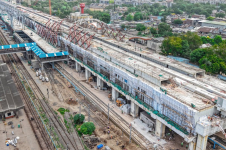
Ahmedabad Station on the Indian High-Speed Railway under construction (Photo: NHSRCL)
Indian Driver Training "Requested Items Completed"
JR East is cooperating with the Japan International Cooperation Agency (JICA) in training for drivers of high-speed rail trains in India. Executive Director Takaoka stated, "We trained those who instruct Shinkansen operation," and added, "From now on, those who receive training will go on to train and train drivers in India. The program implemented at the request of the Japanese government has already been completed." Regarding how the changes in the signaling system will affect the system, he said, "We conducted training to help them acquire the necessary knowledge and skills for operating the Japanese-style Shinkansen. If the way crew train is changed regarding the change in the signaling system, that would be something India could consider. If we can cooperate, we will cooperate."
On October 28, a collision between high-speed trains occurred in Spain, resulting in a major disaster with 69 deaths as of November 5. The cause of the accident is currently under investigation by authorities, but it has been suggested that a combination of a signal system failure and human error may have occurred.
Will the European system be included in the Shinkansen package, or will two different systems be mixed on a single line to operate high-speed rail? Whichever path you choose, its safety has not been demonstrated at all at this point.
インド「国産高速列車」初公開、新幹線の立場どうなる 1つの路線に「欧州式と日本式」信号混在の不安
This article also says the same things:
インド「国産高速列車」初公開、新幹線の立場はどうなる? 1つの路線に「欧州式と日本式」信号混在の不安(東洋経済オンライン) - Yahoo!ニュース
Google translated, so expect some inaccuracies:
First unveiling of India's 'domestically produced high-speed train'—what is the position of the Shinkansen? Concerns over mixed 'European and Japanese' signals on a single line.
By Naoki Osaka
Toyo Keizai Reporter
Railway Minister Ashwini Vaishnaw inspecting high-speed trains being manufactured by Indian vehicle manufacturers (Photo: NHSRCL)
You can also see holes that appear to be headrests, reading lights, and power outlets. These are seats for high-speed rail trains being developed by India. On November 1, the Indian High-Speed Railway Corporation (NHSRCL), the main operator of the high-speed rail project, released a report of India's Railway Minister Ashwini Vaishnaw inspecting the rolling stock factory.
India's first high-speed rail plan is under construction along the Mumbai–Ahmedabad section (508 km) in western India. At the Japan-India summit in December 2015, a memorandum of understanding was signed regarding the introduction of the Shinkansen system in Japan, with Japan fully cooperating.
Manufacturing of 'Domestically Produced Vehicles' to Begin Commercial Operation in 2027
The entire section is scheduled for completion by the end of 2030, but ahead of that, some sections are planned to begin operation in August 2027. Initially, the plan was to extend the Surat–Bilimola section (about 50 km), but there are also plans to expand it to the Surat–Vapi section (about 100 km). As the first high-speed train to run on this route, India is rapidly manufacturing its own B28 train.
The B28 is manufactured at the Bengaluru plant of BEML (Bharat Earth Movers Limited), an Indian railway manufacturer. Indian engineers designed it to adapt to the country's unique climate and operational environment.
Its top speed is 280 km/h. In actual commercial operation, it is expected to run at a speed of 249 km/h. The train consists of 8 cars: seven standard cars with 3+2 seating arrangements, and one executive-class car with 2+2 seating arrangements. The capacity is 557 people. It is also possible to couple two 8-car trains into a 16-car formation.
In addition to the seats, several photos have been released showing the Minister of Railways inspecting the structure of the rolling stock. However, what concerns me is that there are no photos of the finished vehicle. Is it still not finished?
In Taiwan, the new high-speed rail train "N700ST" is scheduled to begin operation in July 2027, and the completed train arrived in Taiwan in August this year, undergoing nearly a year of trial runs. In India, since this is the first high-speed railway, sufficient time must be allocated for trial runs. Commercial operation is planned for 2027, but will it be possible in time?
Railway Minister Vaishnaw inspecting the structure of a high-speed train being manufactured by an Indian vehicle manufacturer (Photo: NHSRCL)
Railway Minister Vaishnaw inspecting Indian vehicle manufacturers producing high-speed trains (Photo: NHSRCL)
Originally planned as the 'E5 Series Shinkansen' trains
The first train was made in India, but the initial plan was to introduce JR East's main train, the 'E5 Series.' The commercialization study report released in July 2015 described vehicle specifications, maintenance processes, and the design and equipment of the train depot assuming the E5 series was the premise.
However, negotiations on the introduction of the E5 series stalled, and from 2023 to early 2024, India shifted its policy to introduce domestically produced vehicles. Although there has been no official announcement about the reason, India has promoted a domestic manufacturing promotion strategy called 'Make in India,' and it is possible that it insisted on using domestically produced trains as the first high-speed train.
Furthermore, in January 2025, India announced a tender for the entire line, assuming a Level 2 European system (ETCS) for signaling and train control systems. ETCS differs from the Shinkansen signaling system "Digital ATC," and once ETCS is adopted, the Shinkansen cannot operate.
The commercialization study report concluded that the adoption of digital ATC was recommended after comparing it with ETCS Level 2. The reasons cited include the safety of Japan's Shinkansen (no train accidents resulting in fatal passengers) and lower maintenance costs compared to ETCS Level 2. Nevertheless, the reason for switching to ETCS has not been announced.
We proposed the introduction of the 'E10 Series' under development, but...
Sensing the trend toward adopting ETCS, Japan implemented various measures to prevent it. First, it was proposed to transfer one E5 series train set and a comprehensive inspection vehicle to India for training and data collection. Additionally, starting January 2025, the company will accept 16 NHSRCL staff for one year and conduct Shinkansen driver training, strengthening its software aspects.
Furthermore, JR East proposed introducing the "E10 series" currently under development to India as a replacement for the E5 series, which had stalled in negotiations. The E10 series is expected to be completed after autumn 2027, and after running tests, it aims for commercial operation in Japan by fiscal year 2030. However, since the E10 series will not be ready for India's first high-speed train in August 2027, some believe the E10 series is being used to shift the logic that "the E10 series was developed domestically because it couldn't make it in time."
Railway Minister Vaishnaw and others inspecting the high-speed trains being manufactured at an Indian vehicle manufacturer. Part of the structure believed to be the hull can be seen in the rear (Photo: NHSRCL)
As a result, the ETCS bidding was conducted, and it was announced that in June 2025, a consortium of companies including Germany's Siemens won the bid.
Completed image of the E10 series Shinkansen (Image: JR East)
At the Japan-India summit held in July this year, Prime Minister Takaichi and Prime Minister Modi reaffirmed their targets for introducing the E10 series. While the possibility of introducing the E10 series hasn't disappeared, the vague wording of 'confirmation of goals' remains uncertain. Some people on the Indian side say, "Just make the exterior E10 series and the internal system European-made." But can that really be called a Shinkansen? This is because the Shinkansen achieves safety and reliability through a "total system approach" that optimally integrates hardware such as rolling stock, signals, and tracks with software such as operation systems.
Safety: "Just 'try it first' is not a valid topic."
On October 8, a meeting of the International Association for Rapid Rail (IHRA), which promotes the overseas expansion of the Shinkansen system, was held in Fukuoka City. In a group interview after the meeting, IHRA Chairman Masashi Sukutoshi said, "I do not believe signaling systems must be ATC. If something equivalent or even more emerges through technological development, proves its safety, and is well integrated into the system, then it will be fundamental to our activities," and made the following request.
"However, for combinations that have never been used before, it's important whether their safety has been proven. Just 'try it first' won't make a difference. It is essential to conduct various demonstrations during the development phase, confirm their reliability, and then implement them in society.
Furthermore, after that comment, Chairman Shukutoshi added, "When I visited India at the beginning of October, I received similar questions from Indian media."
Later, upon investigation, I found that an interview article with Chairman Shukutoshi was published on the website of The Indian Express dated October 11. Among them was an exchange like this.
"There is no precedent for two systems coexisting."
— Are there any other countries where two different types of vehicles and signal systems are used together within a single line? Is it safe?
"In my view, there is no precedent for operating high-speed rail on a single line by mixing two different systems. Whether it can operate safely remains to be seen through demonstration. In my view, under conditions of some uncertainty and the existence of two different systems, it is impossible to run a passenger car at 300 km/h.
"How do you confirm that the system is secure? You have to prove that. Eventually, I think one or the other system will be adopted. It is impossible to operate both systems simultaneously. I am not in a position to comment on which one will be adopted, but it will depend on the results of direct consultations between the parties and between the Indian and Japanese governments."
As mentioned in the paper's question, there seems to be a plan between Japan and India to run the E10 series by introducing ATC in addition to ETCS. Chairman Shukutoshi's response to this was again negative. In the first place, adopting two signal systems on one track is a double investment and lacks rationality.
So, what does JR East, the developer of the E10 series, think? At the financial results briefing for the second quarter of fiscal 2026 held on November 2, I asked Executive Officer Takashi Takaoka a question.
Executive Director Takaoka said, "We are responding only at the request of the Japanese government, so which signaling system Indian railway personnel will use depends on discussions between the Japanese government, India, and the railways," adding, "If we want to fully utilize the Shinkansen's functions, it must be a Japanese-style signal. If European-style signals were adopted, Japan's Shinkansen might lose its effectiveness. However, since we are not in a position to tell them to stop, we will only respond to what we can at the government's request," he said.
Ahmedabad Station on the Indian High-Speed Railway under construction (Photo: NHSRCL)
Indian Driver Training "Requested Items Completed"
JR East is cooperating with the Japan International Cooperation Agency (JICA) in training for drivers of high-speed rail trains in India. Executive Director Takaoka stated, "We trained those who instruct Shinkansen operation," and added, "From now on, those who receive training will go on to train and train drivers in India. The program implemented at the request of the Japanese government has already been completed." Regarding how the changes in the signaling system will affect the system, he said, "We conducted training to help them acquire the necessary knowledge and skills for operating the Japanese-style Shinkansen. If the way crew train is changed regarding the change in the signaling system, that would be something India could consider. If we can cooperate, we will cooperate."
On October 28, a collision between high-speed trains occurred in Spain, resulting in a major disaster with 69 deaths as of November 5. The cause of the accident is currently under investigation by authorities, but it has been suggested that a combination of a signal system failure and human error may have occurred.
Will the European system be included in the Shinkansen package, or will two different systems be mixed on a single line to operate high-speed rail? Whichever path you choose, its safety has not been demonstrated at all at this point.
インド「国産高速列車」初公開、新幹線の立場どうなる 1つの路線に「欧州式と日本式」信号混在の不安
This article also says the same things:
インド「国産高速列車」初公開、新幹線の立場はどうなる? 1つの路線に「欧州式と日本式」信号混在の不安(東洋経済オンライン) - Yahoo!ニュース

Vande Bharat and Gatimaan Express trains connecting Delhi and Agra set for speed upgrade as Kavach installation is completed; services to return to 160 kmph from current 130 kmph after successful safety trials
ET Online
Last Updated: Nov 11, 2026, 08:20:00 AM IST
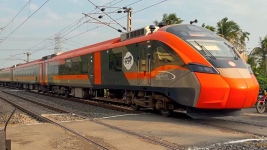
Vande Bharat and Gatimaan Express trains connecting Delhi and Agra set for speed upgrade as Kavach installation is completed; services to return to 160 kmph from current 130 kmph after successful safety trials.
Vande Bharat and Gatimaan Express trains could soon return to their original operating speed of 160 kmph on the Delhi-Agra route, after running at a restricted speed of 130 kmph. The Railways has completed the installation of the indigenous Kavach Automatic Train Protection (ATP) system on the section, with safety trials underway ahead of a possible speed upgrade, reported TOI.
Eight trains currently running at 130 kmph
According to an RTI reply from Indian Railways to TOI, eight services, including Gatimaan Express, Vande Bharat and Shatabdi trains, are currently operating at 130 kmph on the Delhi-Agra section, below their maximum permissible speeds.
Railway Board had restricted train speeds until Kavach became operational
A Railway Board letter dated June 24, 2024, capped the speed of select trains at 130 kmph until the Kavach Automatic Train Protection (ATP) system became operational. The restriction applied to the Hazrat Nizamuddin-Rani Kamalapati and Hazrat Nizamuddin-Khajuraho Vande Bharat services, as well as the New Delhi-Virangana Lakshmibai Jhansi Gatimaan Express.
Kavach installation complete on Delhi-Agra route
Work on installing the indigenous Kavach ATP system on the Delhi-Agra section has been completed, and safety trials are underway. Agra Division DRM Gagan Goyal told TOI that the the Research Designs & Standards Organisation (RDSO) is conducting trials following the installation.
How Kavach ATP system works to improve railway safety
Kavach is an indigenously developed Automatic Train Protection system certified to Safety Integrity Level 4 (SIL-4). It uses RFID tags installed along railway tracks and station areas, stationary control units at stations, and dedicated towers and antennas along the corridor to support safer train operations at higher speeds.
Gatimaan Express launched in 2016 as India's first semi-high-speed train
Introduced in April 2016, Gatimaan Express was India's first semi-high-speed train, connecting Hazrat Nizamuddin in Delhi with Agra Cantt in 100 minutes at 160 kmph. The service now extends up to Jhansi. The two Vande Bharat services also previously operated at 160 kmph on the Delhi-Agra stretch, while the New Delhi-Rani Kamalapati Shatabdi ran at 150 kmph.
Delhi to Agra to get bullet train
Prime Minister Narendra Modi has approved the Northern Corridor of India's proposed bullet train network, which could significantly cut travel times between Delhi and key cities in Uttar Pradesh. Once operational, the Delhi-Agra journey could take just 59 minutes, potentially boosting tourism by making day trips to the Taj Mahal easier for domestic and international visitors.
The proposed bullet train could cover the Delhi-Agra distance in 59 minutes, potentially boosting tourism by making day trips to the Taj Mahal easier for domestic and international visitors.
The proposed bullet train could cover the Delhi-Agra distance in 59 minutes, while Delhi-Kanpur could take 1 hour 45 minutes and Delhi-Lucknow 2 hours 12 minutes. The Lucknow-Varanasi journey is expected to take 1 hour 21 minutes, while Varanasi-Delhi could take 3 hours 35 minutes.
These timings are indicative and may change as the project progresses. The government has not yet released a detailed station-wise timetable for the proposed corridor.
Vande Bharat and Gatimaan Express trains connecting Delhi and Agra set for speed upgrade as Kavach installation is completed; services to return to 160 kmph from current 130 kmph after successful safety trials
ET Online
Last Updated: Nov 11, 2026, 08:20:00 AM IST
Vande Bharat and Gatimaan Express trains connecting Delhi and Agra set for speed upgrade as Kavach installation is completed; services to return to 160 kmph from current 130 kmph after successful safety trials.
Synopsis
Vande Bharat recent news: Gatimaan Express and Vande Bharat services are expected to return to their original speeds of 160 kmph. This enhancement follows the successful installation of the Kavach Automatic Train Protection system on the Delhi-Agra route. Currently, eight trains operate at a reduced speed of 130 kmph due to safety regulations. Safety trials are currently being conducted to ensure the system's effectiveness before the speed increase.
Vande Bharat recent news: Gatimaan Express and Vande Bharat services are expected to return to their original speeds of 160 kmph. This enhancement follows the successful installation of the Kavach Automatic Train Protection system on the Delhi-Agra route. Currently, eight trains operate at a reduced speed of 130 kmph due to safety regulations. Safety trials are currently being conducted to ensure the system's effectiveness before the speed increase.
Vande Bharat and Gatimaan Express trains could soon return to their original operating speed of 160 kmph on the Delhi-Agra route, after running at a restricted speed of 130 kmph. The Railways has completed the installation of the indigenous Kavach Automatic Train Protection (ATP) system on the section, with safety trials underway ahead of a possible speed upgrade, reported TOI.
Eight trains currently running at 130 kmph
According to an RTI reply from Indian Railways to TOI, eight services, including Gatimaan Express, Vande Bharat and Shatabdi trains, are currently operating at 130 kmph on the Delhi-Agra section, below their maximum permissible speeds.
Railway Board had restricted train speeds until Kavach became operational
A Railway Board letter dated June 24, 2024, capped the speed of select trains at 130 kmph until the Kavach Automatic Train Protection (ATP) system became operational. The restriction applied to the Hazrat Nizamuddin-Rani Kamalapati and Hazrat Nizamuddin-Khajuraho Vande Bharat services, as well as the New Delhi-Virangana Lakshmibai Jhansi Gatimaan Express.
Kavach installation complete on Delhi-Agra route
Work on installing the indigenous Kavach ATP system on the Delhi-Agra section has been completed, and safety trials are underway. Agra Division DRM Gagan Goyal told TOI that the the Research Designs & Standards Organisation (RDSO) is conducting trials following the installation.
How Kavach ATP system works to improve railway safety
Kavach is an indigenously developed Automatic Train Protection system certified to Safety Integrity Level 4 (SIL-4). It uses RFID tags installed along railway tracks and station areas, stationary control units at stations, and dedicated towers and antennas along the corridor to support safer train operations at higher speeds.
Gatimaan Express launched in 2016 as India's first semi-high-speed train
Introduced in April 2016, Gatimaan Express was India's first semi-high-speed train, connecting Hazrat Nizamuddin in Delhi with Agra Cantt in 100 minutes at 160 kmph. The service now extends up to Jhansi. The two Vande Bharat services also previously operated at 160 kmph on the Delhi-Agra stretch, while the New Delhi-Rani Kamalapati Shatabdi ran at 150 kmph.
Delhi to Agra to get bullet train
Prime Minister Narendra Modi has approved the Northern Corridor of India's proposed bullet train network, which could significantly cut travel times between Delhi and key cities in Uttar Pradesh. Once operational, the Delhi-Agra journey could take just 59 minutes, potentially boosting tourism by making day trips to the Taj Mahal easier for domestic and international visitors.
The proposed bullet train could cover the Delhi-Agra distance in 59 minutes, potentially boosting tourism by making day trips to the Taj Mahal easier for domestic and international visitors.
The proposed bullet train could cover the Delhi-Agra distance in 59 minutes, while Delhi-Kanpur could take 1 hour 45 minutes and Delhi-Lucknow 2 hours 12 minutes. The Lucknow-Varanasi journey is expected to take 1 hour 21 minutes, while Varanasi-Delhi could take 3 hours 35 minutes.
These timings are indicative and may change as the project progresses. The government has not yet released a detailed station-wise timetable for the proposed corridor.
Vande Bharat and Gatimaan Express trains connecting Delhi and Agra set for speed upgrade as Kavach installation is completed; services to return to 160 kmph from current 130 kmph after successful safety trials