US - Israel - Iran War


The security of the West is being fought over in the mountainous region surrounding the Yemeni city of Taiz, the country’s former prime minister has warned.

If the key city falls to the Iran-backed Houthis, Western security will suffer enormously, said Maeen Abdulmalik Saeed, now adviser to Yemen’s president, The Guardian reported on Friday.

He highlighted the importance of Taiz in the context of control over the Bab Al-Mandab Strait and the road to Aden, the seat of Yemen’s internationally recognized government.

Saeed’s comments came as part of an appeal for help from the West. He said the Houthis’ ambitions are to seize all of Yemen and “help Iran expand the chaos.”

He added that his government is under pressure in part due to the Houthis’ steady acquisition of long-range drone and missile technology, a threat that had not been fully appreciated.

“The battle around Taiz is not just a battle for Taiz, but a broader battle that involves the whole of the Western world, and one of the most important maritime straits,” he said.

“The Houthis know controlling Taiz is controlling the straits and it’s the highlands before the straits and the coastal city of Mokha and the Gulf of Aden.

“If Taiz is lost, access to the strait will be lost. The rest of the country will come later. The Houthi plan is to control the whole of Yemen.”

He added: “The Houthis bleed a lot, they suffer a lot, but they always want quickly to use their gains or any collapse to gain more land.”

It is “a matter of days” before “there will be a full siege” of Taiz, and the Houthis “will try to enter the city,” Saeed said. “It will be much worse than the siege of 2015 — it will be catastrophic.”

He added: “The loss of Taiz would have a very significant symbolic impact on the idea of the modern state in Yemen and of resisting the Houthi project, which relies on tribal networks and extremist religious education.

“I hope now that the knife has come to our neck, and the Houthis represent a critical threat, the priority would be to come together to defeat the Houthis, and then to discuss other demands and guarantees.”

He said the Houthi offensive toward the Red Sea last month was intended to relieve the heavy pressure facing its sponsor Iran.

“Its (Iran’s) airplanes and airports cannot operate; 90 percent of the oil was coming out of Hormuz. That is why they attacked the Saudi East-West pipeline,” he added.

“The Houthis, by talking about a Saudi blockade, have found a reason to hit the Saudi oil installations, airports and they want to do it now because the only thing Iran can do is to keep expanding the consequences of the war for America.”

Saeed spoke of the Houthis’ growing missile and drone capabilities, much of them provided by Iran. “In 2017, the Houthis had nothing but blind missiles to fire at us that missed their targets,” he said.

Highlighting a December 2020 attack on Aden International Airport that killed 28 people, Saeed said the militia has quickly developed missiles capable of precisely striking targets at least 300 km away.

“We thought even then they did not have that many missiles, but since then the Iranians have expanded their manufacturing lines,” he added.

In January 2022, the Houthis attacked Abu Dhabi oil tanker trucks more than 900 miles away using ballistic missiles.

By the time of the US Operation Rough Rider against the militia last year, “it was clear the Houthis had dozens of targeted missiles, land-sea missiles and drones. They had become a unified front with Iran, and developed their missile base,” Saeed said.

“This is a new era of radical terrorism. It is not the old chaotic one of Isis (Daesh) and Al-Qaeda. It is semi-state actors and militias threatening powerful states with cheap technologies, and smuggled third-party components,” he added.

“The way Iran has invested in the Houthis could become a model for threatening navigation elsewhere.

“It is a new model of war, without traditional armies, needing different air defences. Gulf countries have to reshape and rethink their defences.”

Trump has created a huge mess and he needs to fix it and licking Putin's *censored* and trying to divert repsonsibility won't help.
 

Fog of War Deepens in Hormuz as UKMTO Says Most Ship Attacks Go Unreported​

Conflicting traffic figures and competing claims of control are making it increasingly difficult to establish what’s happening in the Strait of Hormuz, even as attacks on merchant shipping intensify.

The true extent of attacks on merchant ships in the Strait of Hormuz remains unclear, with a new report from UK Maritime Trade Operations (UKMTO) acknowledging that most vessels struck in the region are not reporting incidents directly to the maritime security organization.

The admission comes as the United States and Iran offer sharply different accounts of who controls the vital waterway, while conflicting transit figures raise further questions about how much commercial shipping has actually recovered.
 
Last edited:
just put up stuff they are clueless about, it is more expensive than cow's milk


Production & Availability
  • Low Yield: A female donkey produces only about 0.5 to 1.3 liters of milk per day.
  • High Cost: Due to the scarce supply and labor-intensive small-scale farming, it commands a very high price (often ranging significantly higher per liter than standard dairy).
Donkey milk is a rare, nutrient-rich dairy product closely resembling human breast milk in its protein and lactose profile. Valued since ancient times for both infant nutrition and luxury skin care, it is prized for its high levels of whey protein, lysozyme, and gentle anti-inflammatory properties. [1, 2, 3]

Key Nutritional & Health Properties
  • Composition: High in whey proteins (55%–65%), low in total fat and casein, and rich in vitamins (like D3), calcium, and essential fatty acids.
  • Allergy Tolerance: Often better tolerated than cow’s milk by individuals with cow's milk protein allergy (CMPA), though it still contains lactose.
  • Immune Support: Contains natural antimicrobial compounds like lysozyme and lactoferrin. [1, 2, 3]
Yeah, apparently the Egyptian queen Cleopatra exclusively bathed in donkey's milk. That's what made her so radiant. You needn't try it Paddy. Just bathing everyday would help in your case . @BMD
 

Authorities in Saudi Arabia on Wednesday blamed Iran-backed Houthi militants for a new attack on a civilian airport that resulted in casualties, as the U.S. said it was pulling some diplomatic personnel from the country in response to continuing threats from the Yemen-based group.

Saudi Arabia’s General Authority of Civil Aviation said one person was killed and eight others were injured in Wednesday’s attack that hit the international airport in the eastern city of Dammam, an oil-producing area near Bahrain that is home to thousands of the industry’s foreign workers.
 
  • Like
Reactions: Photon Vish
The US needs to act on Yemen before it before it becomes an even bigger problem. The only reason they're not blocking ships already is because they don't have complete control yet, when they do have that they'll block them and then the problem will be very difficult to fix.
 
The US needs to act on Yemen before it before it becomes an even bigger problem. The only reason they're not blocking ships already is because they don't have complete control yet, when they do have that they'll block them and then the problem will be very difficult to fix.


Looks like your wish is about to be granted Paddy !

US has ordered its diplomatic staff out of the ME & has deputed errand boy Munira to Tehran at a last ditch attempt to get the mullahs to accept its terms.

Seems more of optics if you ask me. What that means is both US & Israel will be resuming action against Iran soon & possibly against the Houthis too.

Timing seems curious as Pops will note. Why? Coz Israel goes to the polls shortly & mid term elections are to be held shortly in the US as well .

How does AIPAC report on the chances of Satanyahud being re elected , sweetie ? After all he's delivered spectacular victories one after the other against the enemies of Israel practically neutralizing most of them .

Not since Dāwîd - Nāgîd , Rōʿeh , Māšîaḥ, 'Eḇeḏ YHWH , Melekh Yisra'el have you had such a conqueror .

Quick sweetie! Spill some tea, Ja?

Thank you for your attention to the matter.

@Optimist ; @BMD ; @Innominate
 

“So Much Worse Than People Realize”: Never-Before-Seen Images Reveal Damage at U.S. Bases as Troops Describe Being Abandoned​

Service members, contractors, and military families share photos, videos, and firsthand accounts of the Iran war that they say the Pentagon has kept from the American public

When the United States went to war with Iran in late February, the American public was told little about what was happening to the troops stationed across the Middle East. There were no embedded journalists. Casualty details trickled out slowly. Images of damage to American bases were almost nonexistent.

Now, service members, civilian contractors, and military families are breaking their silence.

MeidasTouch, in coordination with our partner VALOR Media Network, has obtained dozens of never-before-published photos and videos showing damage to U.S. military installations in Saudi Arabia, Jordan, Kuwait, United Arab Emirates, and Bahrain, along with firsthand accounts from people who were there. They describe destroyed aircraft, bombed-out barracks and mess halls, troops digging their own foxholes, and military families hiding in parking garages while Iranian missiles flew overhead.

“It’s so much worse than people realize,” one source said.

The sources spoke on the condition of anonymity because, they said, they have been repeatedly threatened with disciplinary action under the Uniform Code of Military Justice for speaking out or sharing images. The accounts were gathered by VALOR Media correspondents El Powers and What in Clay Nation, who provided their notes and the images to MeidasTouch.

Some of the claims in this report could not be independently verified, and we have noted where that is the case. The Department of Defense has not publicly confirmed several of the losses described below.

“This Is Not a Normal Deployment”​

Many of the people who shared their experiences are not new to war. Several have deployed to combat zones before. And all of them said the same thing: nothing compared to this.

“This is not a normal deployment,” multiple sources said. They described a level of mismanagement they had never seen before.

One service member described being called up in mid-February and told to ship out immediately on what was supposed to be a three-week temporary assignment. After arriving, they were told it would be closer to three months. They ended up staying more than seven.

Several said they had no advance knowledge of Operation Epic Fury, the U.S. campaign against Iran, even though some of them were directly involved in it. They learned that hostilities had begun the same way most Americans did: from the news.

“We are sitting ducks,” one said.

Unlike past wars, the threat came almost entirely from the sky: drones, rockets, and ballistic missiles launched by an enemy they could not see. One service member described the Iranian drones that targeted their base:

“You can’t see them at night. They have no lights and are GPS navigated via coordinates. It sounds exactly like a small Cessna. Looks like a large falcon if it’s about 400 feet up. We had no defense against the drones.”

Saudi Arabia: Prince Sultan Air Base​

Images supplied by U.S. service members and civilian contractors show extensive damage at Prince Sultan Air Base in Saudi Arabia between March and July.

screenshot-2026-10-22-at-6-45-24-am.png

screenshot-2026-10-22-at-6-48-30-am.png

The photos show destroyed dining facilities and workspaces, and damaged dorms where service members were living during the strikes.

screenshot-2026-10-22-at-6-49-52-am.png

​
Other images show aircraft burning on the tarmac after missile strikes.

screenshot-2026-10-22-at-6-50-36-am.png

​
One photo shows a U.S. Air Force E-3 Sentry AWACS surveillance plane, tail number 81-005, damaged in an attack that sources say injured between 10 and 12 service members. According to the sources, the same attack damaged multiple other aircraft, including two KC-135 refueling tankers.

screenshot-2026-10-22-at-6-51-12-am.png

​
A source also provided an image they say shows a fully destroyed C-17 cargo aircraft, which they say was piled up to speed cleanup and limit knowledge of the loss. The Department of Defense has not confirmed the loss of a C-17, and MeidasTouch has not been able to independently verify this claim.

Videos obtained by MeidasTouch show U.S. interceptor missiles engaging Iranian drones and ballistic missiles over the base, and in one case, interceptors failing to stop a ballistic missile that then struck the base.

Jordan: “Surprised There Weren’t More Deaths”​

At Muwaffaq Salti Air Base in Jordan, service members described roughly three months of near-constant incoming fire beginning in March. Alarms often couldn’t keep up.

The article is very long; there are plenty of other images. Anyone interested can view them in the original article by clicking on the post title.
 
  • Like
Reactions: Jarvis

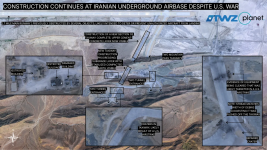
Construction Of Iran’s “Eagle 44” Underground Airbase Hasn’t Stopped Despite War​

Satellite imagery depicts new construction and cleared wreckage after strikes at an Iranian airbase with underground hangars and taxiway tunnels.

1792757903538.png
 

Construction Of Iran’s “Eagle 44” Underground Airbase Hasn’t Stopped Despite War​


View attachment 54516
That's all very fine Paddy but where're the aircraft in the Iranian AF to be parked in the mountain hangar ?!

Seems to me by constructing those runaways the Iranians are taking the Amerimutts for a ride once again . It's a red herring Paddy. No more no less.

This is possibly a strategic C&C cum storage site for their BMs & CMs with the possibility of N warheads being stored here as & when they master full enrichment & the technology to miniaturize warhead design & mfg.
 
  • Like
Reactions: Photon Vish
This is an interesting development, considering that suppliers in the region are currently dealing with an active conflict.


For thirty years, Turkey and Azerbaijan have called themselves “one nation, two states.” Turkey helped Azerbaijan win the 2020 Karabakh war. Azerbaijan supplies about a fifth of Turkey’s gas. Their pipelines, armies and economies are tied together.So why has Azerbaijan’s ruling party now accused Turkey of “hegemonic tendencies” and told Ankara to respect its sovereignty?The trigger was a hijab ban in Azerbaijan’s schools, introduced in September, which drew sharp criticism from officials close to President Erdoğan. Before that came another flashpoint: Azerbaijan’s delegate stayed seated during Israeli Prime Minister Netanyahu’s UN speech while dozens walked out.But the real story runs underground, through a pipeline that carries gas from the Caspian Sea across Turkey into Europe. With the Iran war choking Hormuz and crippling Qatar’s gas exports, Europe needs every pipeline that avoids the Gulf. Azerbaijan now sells gas to 16 countries, including Germany and Austria. And when Europe needs your gas, you can afford to talk back, even to your big brother.
 
OCTOBER 22, 2026

The Art of the Deal: Jared Kushner’s Hacked Phone Revealed His Secret Negotiations—Including More Than $700 Million in Transfers​

Matthew Cole

An exclusive excerpt from Princes and Thieves: Jared Kushner and Mohamed bin Zayed’s Secret Plot to Remake the Middle East examines how bank accounts linked the president’s son-in-law—and former senior adviser—to Israel, the UAE, and Saudi Arabia.

 
  • Haha
Reactions: Asterion Moloc

Aboard USS George Washington as It Rearms for Possible Iran Strikes​

Watch as sailors in the USS George Washington strike group prepare for a possible escalation in fighting on the front lines of the Iran war​

By

Shelby Holliday
and

Eve Hartley
Oct. 24, 2026 5:32 am ET


American warships in the Middle East are preparing for an escalation in fighting in case President Trump opts for a fresh round of attacks against Iran in the coming weeks, according to U.S. officials familiar with the planning.