

US - Israel - Iran War
- Thread starter Shan
- Start date
You are using an out of date browser. It may not display this or other websites correctly.
You should upgrade or use an alternative browser.
You should upgrade or use an alternative browser.
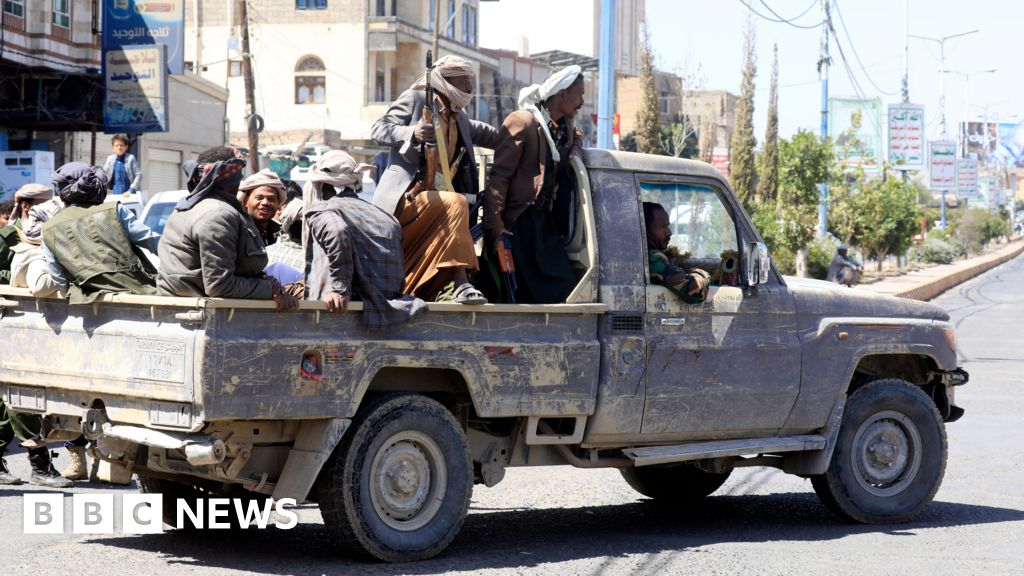
Three people killed in attacks on Saudi Arabia airports, officials say
The Houthis have claimed responsibility for the attacks, which mark an escalation in the conflict.
 www.bbc.com
Three people have been killed in attacks on Saudi Arabia airports over two days, authorities said, as flare-up of fighting spilled across the Yemen border into the kingdom.
Two people were killed and 28 wounded in an attack at Abha International Airport, Saudi Arabia's General Authority of Civil Aviation (Gaca) said in a statement on Wednesday.
In a separate incident, one person was killed and eight were wounded in an attack on King Khalid International Airport in Riyadh, Saudi Arabia's capital, it added.
The attacks, which the Houthis have claimed responsibility for, mark an escalation in the renewed war between the Saudi-backed government forces and the Iran-backed Houthis in Yemen.
The two airports were attacked on 6 and 7 October, according to Gaca, which did not specify when each airport was hit.
Two women, of Moroccan and Algerian nationalities, were killed during the Abha airport attack, near the Yemen border, according to Gaca.
Meanwhile, a male resident of Sudanese nationality was killed at King Khalid airport, it added.
The country's civil aviation authority did not name who was responsible for the attacks, but Houthi military spokesperson, Yahya Saree, said its armed forces had attacked both Saudi Arabia airports with ballistic missiles and drones.
The Houthi military spokesperson also said the Houthis attacked Aden's International Airport in Yemen on Wednesday. The airport is a main international gateway for parts of Yemen outside of Houthi control and has been repeatedly targeted when fighting erupts in the country.
Saree said the two attacks on Saudi Arabia's airports were in "response to the Saudi aggression against our country" which saw "60 airstrikes and missile attacks in the past 24 hours".
The civil war in Yemen has worsened in recent weeks, after the Houthis, who control most of the country's north-west, seized strategically important stretches of the Red Sea coast in a rapid offensive.
That included the port of Mokha on the Bab al-Mandab Strait, which is the narrowest point of the Red Sea and a chokepoint for global shipping.
But Yemeni pro-government forces backed by Saudi Arabia have since said they had "secured" the Bab al-Mandab Strait at the southern end of the Red Sea.
They also declared an all out war in an effort to take all territory held by the Houthis.
In a statement issued late on Wednesday, the official spokesperson for the Saudi-led coalition said the Houthis' attacks on Saudi Arabia's airports "will not go unpunished".
The spokesperson said the Saudi coalition had targeted more than 80 Houthi military sites across "governorates of Saada, Al Hudaydah, Al Jawf and Ma'rib".
The Saudi-led coalition formed in 2015 after Arab countries joined forces to stop the Houthis taking over Yemen from the country's internationally recognised government.

President Donald Trump said Thursday that he will not order a resumption of military strikes on Iran before the Nov. 3 midterm elections in the United States.
Trump, while stumping for Republicans this week, has hinted that he was confident that an endgame to the war could come in the days before or after the election, while also hinting that he remained open to resuming full-scale military operations against Iran.
For weeks, Trump has been threatening that a post-midterm election escalation in the seven-month-old war remains a viable option, despite his initial promises to Americans of a military campaign that would last a matter of weeks.
But Trump in a social media post on Thursday said the U.S. “will not be attacking Iran at any time prior to the Midterm Elections to be held in the United States on November 3rd.”
Trump added that his team has been “having productive discussions with the Islamic Republic of Iran.”
The U.S. and Iran signed a short-lived interim agreement in June, intended to establish a 60-day ceasefire and framework for a permanent peace deal.
The deal signed by Trump and Iranian President Masoud Pezeshkian collapsed within weeks amid renewed military actions and disputes over control of the Strait of Hormuz, the critical water which one-fifth world’s oil flowed through before the war.
Negotiations had appeared at a standstill since Trump late last month publicly rejectedIran’s proposal to reopen the strait within seven days if the U.S. met certain conditions.
Let's see if the pace of the conflict exceeds the one from over a decade ago. KSA is already showing signs of having their AD stockpile getting eroded quickly. From what I know PAC series is running low and it will be difficult to replace them in the short term.
The Turks staying out makes it clear that the PA will be the only lot fighting alongside mercenaries/militias whenever the need arises. PA is obligated to fight for KSA due to the sheer debt that they happen to be in.
Donald Trump has announced Vladimir Putin has agreed to supply the US "immediately" with 300,000 tons of diesel.In a Truth Social post, the US president added that millions more tons of the fuel would be released by Russia.


Donald Trump has announced Vladimir Putin has agreed to supply the US "immediately" with 300,000 tons of diesel.In a Truth Social post, the US president added that millions more tons of the fuel would be released by Russia.
Next step from here on is Dolund sanctioning the US for purchasing Russian diesel. Weren't you crowing Russian drilling & refining capacities were severely depleted by Slava Ukraini , Paddy?
What happened to that? Moreover where did you get this information from ? From your regular drinking hole at O'Shea or the Irish Intelligence Review itself named after an oxymoron?
See this is what terminal Paddyitis looks like! @BMD

Next step from here on is Dolund sanctioning the US for purchasing Russian diesel. Weren't you crowing Russian drilling & refining capacities were severely depleted by Slava Ukraini , Paddy?
Both US and Russia follow Bipolar world order. For them what matters is their country's interest and nothing else. No rules no trade rules, whenever wherever necessary go for it. Weak nations follow the orders.
At least 12 people are dead and more than 300 injured in a major attack on Riyadh's international airport. It is one of several attacks on the facility in recent days. Although no group has claimed responsibility, Saudi Arabia is blaming Yemen's Houthis. The recent spate of deadly strikes by the Houthis has exposed vulnerabilities in Saudi Arabia's ability to defend itself as it backs the Yemeni government against the Iran-backed rebels. We ask Yemen researcher Hannah Porter for her assessment.
This is a repeat of the earlier strike at the very airport that was previously targeted.
 www.bbc.com
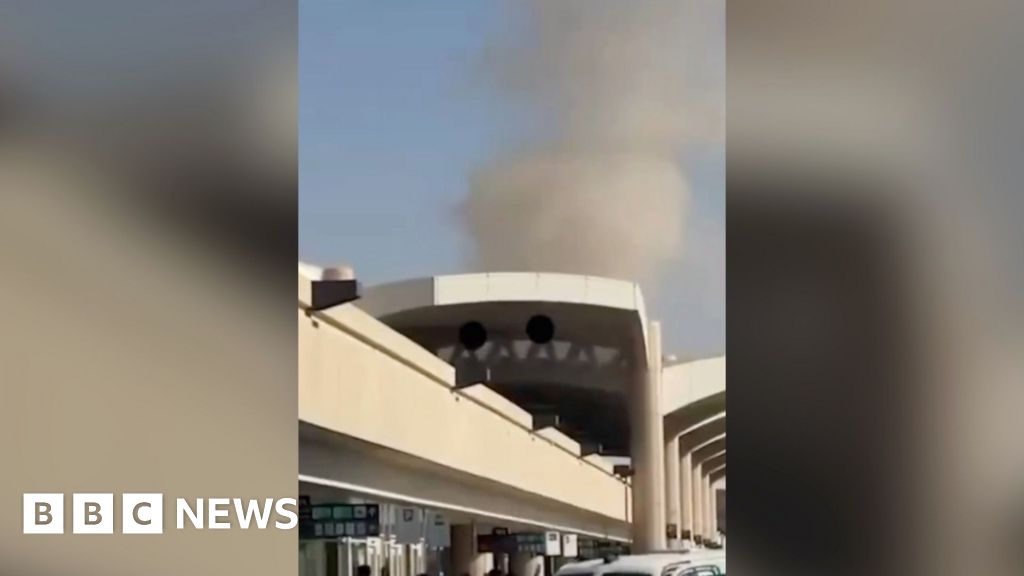
Saudi Arabia's Riyadh airport hit by second Houthi strike in two days
The Saudi capital has been hit by multiple attacks from the Iran-backed Yemeni group over the weekend.
www.bbc.com
One person has been killed and 11 injured in a second strike on the international airport in the Saudi capital Riyadh, officials have said.
A Saudi military spokesman said a projectile had hit King Khalid International Airport on Sunday, causing a fire in one of its passenger halls. Saudi Arabia's civil aviation authority said in a statement on X that one person, a Pakistani resident, had been killed in the attack.
It comes a day after a strike on the same airport killed 13 people and injured 308 others, following similar strikes earlier this week.
The Houthis in Yemen said they were behind the attacks and warned airlines and passengers against using Saudi Arabian airports and airspace.
The group said they had targeted the airport with a mix of ballistic and cruise missiles, as well as drones in the past 24 hours.
They also attacked oil facilities and Dammam airport in eastern Saudi Arabia, their military spokesman Brig Gen Yahya Saree said.
He vowed to continue the "escalating operations deep inside Saudi Arabia", warning that all Saudi airports were potential targets apart from those in the holy cities of Mecca and Medina.
The Houthis have said they are targeting Saudi Arabia over its support for government forces in Yemen's civil war, as well as an air strike on the airport in Sanaa.
On Sunday Maj Gen Turki al-Maliki, spokesman for the Saudi-led military coalition, said air defences had intercepted a missile near the airport in Riyadh, while authorities were dealing with the fire caused by an "unknown projectile" that hit Passenger Hall No 4.
US President Donald Trump has said the US would "make a decision" and "move very quickly" on whether to strike the Houthis, while UK Defence Secretary Wes Streeting suggested the UK could "potentially" provide more support for Saudi Arabia.

Insufficient: Iran rejects US response to 7 conditions for reopening Strait of Hormuz
Iran has rejected the US response to its seven conditions for reopening the Strait of Hormuz. The deadlock keeps pressure on global energy flows while nuclear and regional tensions remain unresolved.
Iran is turning the Strait of Hormuz into a test of how far the United States is willing to go for a deal. Tehran has rejected Washington's response to its seven conditions for reopening the strategic waterway, saying some of its demands remain unresolved. With global energy shipments at stake, the diplomatic impasse threatens to prolong one of the conflict's most consequential flashpoints.
Mohsen Rezaei, Iran's security chief and secretary of the Supreme National Security Council, described the US response as "insufficient", according to Iranian state media on Sunday. He said Washington must clarify its position on issues that remain unclear to Tehran before any progress can be made.
"We presented seven conditions to the Americans and clearly stated that the Strait of Hormuz would not be opened to them, and no negotiations would take place, until these conditions are met," Rezaei said. He added that Iran was "no longer in the process of responding to the Americans".
"In their response, they have accepted some of our conditions, while others remain unclear," he said.
The disagreement threatens to prolong uncertainty over the strategic waterway, which carried about a fifth of the world's oil and liquefied natural gas supplies before the war began in late February with US and Israeli attacks on Iran.
The US responded through Qatari intermediaries, who have been relaying messages between the two sides as part of efforts to end the conflict and restore shipping. Iranian officials have said the proposal is intended to rebuild trust and return the two countries to an enhanced version of an interim memorandum of understanding reached in June. That agreement helped secure a brief ceasefire and included provisions concerning both the strait and Iran's nuclear programme.
An official briefed on the discussions told news agency Reuters last week that the main disagreement concerned the order in which the proposed steps should be implemented, rather than the components of the plan itself.