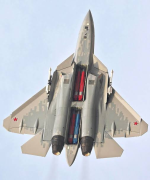
India eyes 6th generation FCAS, looks at tying up with France for possible collaboration

You've failed to address all my original points and still haven't addressed it so far btw and accuse me of the very thing you were accused of in the first place?

You're actually making my point for me. The F-22 was designed as the successor to the F-15C/D, but it never replaced the F-15C/D fleet as intended. That's not my interpretation, the US Congressional Budget Office explicitly says the Air Force planned to replace its F-15A-Ds with F-22s, but because F-22 procurement was reduced, it had to continue operating roughly 240 F-15C/Ds.

Whether F-15C production had already ended is completely irrelevant. Replacing an aircraft means replacing the aircraft in service, not replacing its production line. The F-15Cs continued serving for decades precisely because there weren't enough F-22s to replace them.

And here's the amusing part: when those surviving F-15Cs finally became too old, what did the USAF buy to replace them? Another F-15, the F-15EX. The USAF itself told Congress that it had begun replacing the F-15C/D fleet with the F-15EX, and DoD describes the EX as recapitalizing the divesting F-15C/D fleet.
Because they reduced to mere 189 from planned 700+ due to the fact that the country it meant to fight no longer existing. When you stop producing the F22 in midway, you will be needing to continue operate the aircraft which meant to be retired to cop up with the number game. Its not a rocket science.

Can i ask one thing, when Russia producing su35,why they still olerating su27?
 
You've failed to address all my original points and still haven't addressed it so far btw and accuse me of the very thing you were accused of in the first place?

You're actually making my point for me. The F-22 was designed as the successor to the F-15C/D, but it never replaced the F-15C/D fleet as intended. That's not my interpretation, the US Congressional Budget Office explicitly says the Air Force planned to replace its F-15A-Ds with F-22s, but because F-22 procurement was reduced, it had to continue operating roughly 240 F-15C/Ds.

Whether F-15C production had already ended is completely irrelevant. Replacing an aircraft means replacing the aircraft in service, not replacing its production line. The F-15Cs continued serving for decades precisely because there weren't enough F-22s to replace them.

And here's the amusing part: when those surviving F-15Cs finally became too old, what did the USAF buy to replace them? Another F-15, the F-15EX. The USAF itself told Congress that it had begun replacing the F-15C/D fleet with the F-15EX, and DoD describes the EX as recapitalizing the divesting F-15C/D


Going to ignore the part where US looked to restart the production but couldn't because it would've been proved to be extremely expensive due to tooling being destroyed?
Because they reduced to mere 189 from planned 700+ due to the fact that the country it meant to fight no longer existing. When you stop producing the F22 in midway, you will be needing to continue operate the aircraft which meant to be retired to cop up with the number game. Its not a rocket science.

Can i ask one thing, when Russia producing su35,why they still olerating su27?
Forgot to mention why they're still producing SU35 when SU57 is available
 
The Rafale unlike the FA 50 encounter was that it was specifically a repeated 1v1 WVR engagement where the Rafale did beat the F22 and no need to be fixated on that point, I merely provided one example regarding my primary point.
Well that was BS
As I have previously said, If the Rafale was half as good as its fanboys and PR department, It would indeed be a good plane

This is what the well-respected French pilot ATE had to say about the F-22 vs Rafale
Worth looking at the whole video


1:50 Ate says the F-22 reverses its turn making it easy for the Rafale. which fires an IR , which cannot be claimed as it is guns only. (In actual fact, I think the F-22 was maneuvering to wash off speed to let the Rafale come within range for the dogfight.)
4:00 R calls Fox 2. (That really excited the fanboys) ..It's a practice shot, Ate said he called it out of habit and doesn't count as it is guns only.
5:00 Ate says he switches to guns.
6:00 Ate says about HMS and HOBS, The f-22 and Rafale doesn't ...(but just about everything else does.)

6:40 Ate says Rafale doesn't have the nose authority to follow the F-22. the f-22 can move.
9:00 Ate says the Rafale is at 80kts and below the 100kts minimum.
( the Rafale stalled out and was sitting there like a duck.)


11:40 Ate says the F-22 outperforms the Rafale and closes the door. ( Of course it does.)
12:20 Ate says: "Not enough energy for the Rafale, missing a few kts"..... (The Rafale can't regain energy quickly. The F-22 most certainly can .)

12:40 The F-22 stops the fight and retreats. The Rafale is below the stall speed at 80 kts ( again, the thing is a slug.)

14:00 Rafale continues and picks up speed, has a good position on the F-22, the Rafale does not trigger. (The F-22 has already called the fight and is just flying straight. )

17:30 Ate, repeat that the F-22 called the fight at 12:40 (and why the F-22 did not maneuver.)
 
Rafale a 4th gen delta canard which are known for great manuverbility was fighting against clean raptor in BFM, and that's the argument people use for claiming Raptor is a bad jet.
Even a F4 scored a kill in training against F22 !
An average pilot, or a good one making a mistake, in the best jet can loose a fight.

F22 is the best air dominance fighter at this time.
 
While I agree with what you said, every dog has his day
BS, the Rafale did no such thing, unless you are talking about another time and I will need a credible link
A growler fluked a kill on a F-22, I don;t remember if it was guns, but I think it was in an exercise and a missile
and F-35 does it regularly, said a pilot interview

1787294804081.png
 
Last edited:
Today was Electronic Awareness Warfare Appreciation Day at Andrews AFB. The base hosted a sort of petting zoo for high-tech jamming systems. I noticed a Boeing EA-18G parked on the side, and struck up a conversation with the pilot.
As we chatted about interference cancellation systems, I couldn't help but notice an odd decal decorating the side of the fuselage. I asked the pilot: What's that aircraft decal on the fuselage?

"That's an F-22," he said.

Well, why is it there?

"Because this is the EA-18G that killed an F-22," he explained.

Um, really?

Alas, after that bombshell, the conversation quickly dried up. I did learn the EA-18G kill was courtesy of a well-timed AIM-120 AMRAAM shot. And I learned the simulated combat exercise took place at Nellis AFB. How the EA-18G escort jammer got the shot, and whether its jamming system played a role in the incident were not questions the pilot was prepared to answer.

For the spotters, the aircraft pictured above is EA-1, the first of two Lot 27 F/A-18Fs converted into flying prototypes for the EA-18G program.
http://www.flightglobal.com/blogs/the-dewline/2009/02/growler-power-ea-18g-boasts-f-.html
 
0:19
don't like red flag in a lot of ways, but I love giant large Force exercises in the F-35, like that's when you find other f-35s, you know, you don't really get a feel for like how dominant it can be in a red flag scenario, where you're fighting a bunch of 4th gen and even some Legacy 5th gen (F-22) no offense uh you can Dominate and it feels good

 
5gen, 6gen or beyond, when 2 supposed stealth jets approach across border, provided they both have same level good LPI radars, the 1st thing which matters is their own visibility. The more visible jet will be fired upon 1st & more difficult it'll be to break lock. 🤷‍♂️

Although theoretically Su-57 has 5gen stuff but practical implementation has taken way too long.
Its +ve points are DIRCM, levcons, IWB for AGMs, IRST, side X-band radar, L-band radar.
Its -ve points are bad RCS due to combined effect of certain surface features + RAM + RAS + EW (although it has more flat geometry), incomplete TVC, pending HMDS, etc.
Doctrine of Russians have been to use big powerful radars & bcoz Russians are behind in RCS hence they decided to put LBR in Su-57.
But doctrine of USA with F-22 has been passive RF detection.

- Su-57 uses low frequency L-Band Radar (LBR) bcoz stealth jets are optimized for shorter frequencies like X band.
But limit of LBR is that it gives general location of something & then X-Band Radar (XBR) has to point a beam to refine & try to find what's that object.
LBR emission can be picked up.
- Limit of IRST is that it cant see through clouds & heavy rain. So it can't be always treated as primary sensor or savior, but in clear weather.
- Unless notional diagrams of F-22's liquid cooling & slides of F-35's PAO cooling, HX, etc were released, the general public didn't have idea that such things exist or expected in 5gen.

- USA has pioneered most computing tech, protocols, standards, regulations, earned global revenue, funded its R&D. F-22 also has L-band capability but after showing in diagrams also some people have sworn to god not to admit. :LOL: 🙏 However passive listening was default step.
Band-2 are low-mid freq. UHF-L band for surveillance, early warning.
Band 3 are S-C bands for target acquisition, tracking.
Band 4 are high freq. C,X,Ku,Ka bands for fire control.
- Trick is to use LPI - freq. hopping, min.power, random pulses looking like background noise.
- Test pilot Paul Metz said in 1990s documentaries that F-22 can know what weapons are hanging under wings of 4gen jets, which is done by short frequency LPI beam sharpening.

- 5 < 5.5 < 6, so in era of 6gen, the 5gen F-22 is obsolete........ in front of F-47 NGAD.
After 11 Bn US$ ARES MLU with stealthy pods of IRST, etc, stealthy EFTs also, the 6gen NGAD is supposed to be better.
- Similarly, it is speculated that Russians are making 6gen, they won't sit idle against GCAP, FCAS, NGAD, Chinese jets.
Hence Su-57 (Su-75 too) is also obsolete even after all pending features are completed.
- But nations with none or lagging R&D would procure 5gen-ish, 5gen, 5.5gen jets s per their budget & operating capability.

Every gen needs MLU. Now after MLU to 5.5gen, F-22 got IRST, leveled with any IRST jet globally.
- JDAM has become powered.
- AIM-260 JATM is tested.
- MUMT has been tested.
- That's it, beyond this the NGAD will take over.

- Any assets production depends on changing political, financial, geopolitical, technological situations.
So the F-22 got limited numbers bcoz -
- fall of USSR
- sluggish Su-57 project
- capitalist economy, where private firms try to exploit, but govt. puts a cap.
- business continuity to next gen.
- latest gen acts as tip of spear, followed by previous gen to broom/mop.

Why 4gen jets still made by USA -
- global market of weak, lagging nations who either can't afford F-35 or any 5gen or don't need it due to their weaker neighbors.
- USA is blessed & protected by 2 oceans, Canada in collaboration, weaker southern nations.
- Russia, China don't have bases near USA like Guam, Hawai, Diego Garcia, etc. If they try to use southern nations then it takes lot of time to mobilize fighters, bombers, which in response will move the DEFCON # of USA upwards.
- Russia is close to Alaska which is isolated, then comes Canada, then mainland USA, not easy at all to attack but suicidal.

- If any spy balloon floats over any nation then same action of shooting down will be taken by whatever jet that nation has.
4gen jets have seen enough action, so let F-22 have some live firing fun.

Now we should really get back to thread's agenda. 4.5-4.9 jets are giving headache 🤕:sick:🤒
 
According to LM it is a stealthy jet that can supercruise, as agile as an early F16, with sensor fusion, affordable. The sole west jet with all these assests is F22 (except affordability). Even F-35 is short on supercruise and agility.
Very Low Observability in all aspects.
Supercruise
Supermanuverability
Sensor fusion
Low Probablity of Intercept radar

Only jet in the world that has all of them in numbers is F-22. Even J-20 does not have all aspect stealth. And its TVC(supermanuverability) equipped engine was tested in 2024 or similar.
 
Last edited:
  • Informative
Reactions: Bon Plan
In many Anglo-Saxon programs, one often gets the impression that the starting point is a list of performance metrics to be maximized individually: high thrust, a large radar, advanced stealth, a powerful electronic warfare system, ambitious networking capabilities, and so on. Each subsystem may be excellent, but the final aircraft becomes merely the sum of these excellences—running the risk that weight, cooling, software, maintenance, and costs become the variables adjusted to make it all fit.

The French tradition favors an optimized, holistic compromise. Each subsystem is not necessarily required to be the world's best in isolation; the goal is for the system as a whole to accomplish the mission with minimal cross-penalties.

The Rafale is a prime—and successful—example of this approach. The M88 is not the highest-thrust engine. The RBE2 did not always feature the largest radar antenna. The airframe is not VLO (Very Low Observable) in the F-35 sense. The Rafale is not huge, does not carry the most internal fuel, and was not designed for Mach 2.5.

But these choices fit together seamlessly:

compact airframe → reduced weight and drag → lower thrust requirement → smaller engines → reduced fuel consumption and volume → more space and weight allowance available elsewhere;

close-coupled canards + delta wing → lift, high-alpha control, and low-speed handling compatible with aircraft carrier operations → same airframe for both Air Force and Navy;

SPECTRA integrated from the outset → no need for an entire fleet of specialized jamming aircraft to support every mission;

omnirole capability → same aircraft, same crews, and same logistics chain for nuclear deterrence, air-to-air combat, deep penetration, reconnaissance, strike missions, and naval operations;

maintenance designed alongside the aircraft → availability and operating costs become inherent features of the weapon system rather than problems left to the support organization to solve.

This is what I would call functional integration, rather than merely physical integration. This also explains why comparing the Rafale based on individual subsystems can sometimes be misleading. One might find claims such as:

"the Typhoon has more thrust";
"the F-35 has a lower radar cross-section";
"a certain American radar has a larger antenna";
"a certain aircraft carries more fuel."

Yet, when you put it all together, you discover that the Rafale climbs almost as fast as the Typhoon, performs both air defense and strike missions in a single sortie, operates from an aircraft carrier, carries a 9.5-ton external payload, and maintains excellent operational availability.

In other words, the sum of rankings based on individual characteristics does not necessarily predict the quality of the overall system.

This is likely where the DGA (French Defense Procurement Agency) played a crucial role: it does not merely order hardware; it manages the interfaces between components. The goal is a complete weapon system, not just an aggregation of products from various manufacturers.

This is also why the F5-plus-drone concept strikes me as quintessentially French in its design. Instead of saying, "Let's build a massive, even more powerful fighter with more antennas, more fuel, more cooling capacity, and more computing power," the solution appears to be:

keep the Rafale doing what it does best, and offload to the drone the capabilities that would be too costly or dangerous to include on the manned aircraft.

It is a matter of integration: the focus shifts from simply improving the aircraft to enhancing the combat capability itself.

And this is likely where the most profound difference lies compared to a mere "juxtaposition of qualities": in France, the traditional question is less about

"what performance specifications should our next aircraft have?"

and more about

"how should we organize the entire system to accomplish the mission?"

When this method works, the result may seem less spectacular on a brochure—at least until you start looking at what the system is actually capable of achieving.
 
India gets ‘dialogue partner’ status in sixth-generation jet project
India has joined as a ‘dialogue partner’ in the sixth- generation fighter jet programme being run jointly by the UK, Japan and Italy.

India and the UK had held detailed discussions on the matter, and India was nominated as one of the countries for a 'dialogue partner' status, UK officials said.
 
India gets ‘dialogue partner’ status in sixth-generation jet project
India has joined as a ‘dialogue partner’ in the sixth- generation fighter jet programme being run jointly by the UK, Japan and Italy.

India and the UK had held detailed discussions on the matter, and India was nominated as one of the countries for a 'dialogue partner' status, UK officials said.
Respectable position by Incompetent Airforce standards