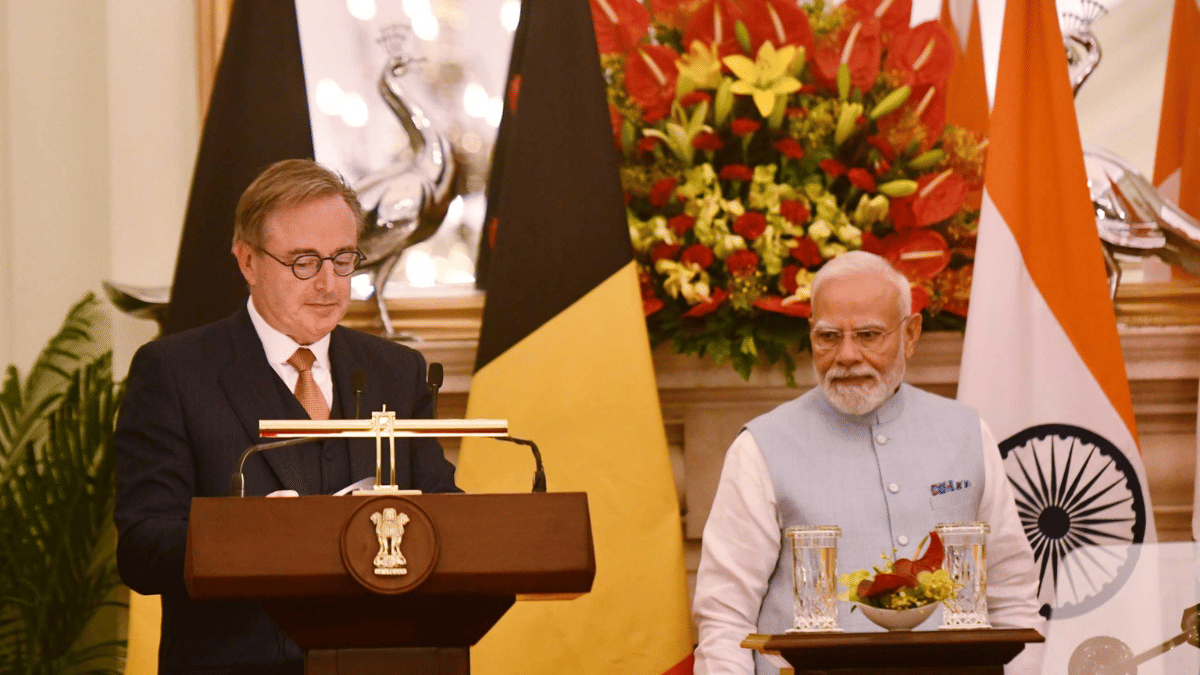
The two countries also signed a Letter of Intent providing a framework for structured cooperation between their armed forces.

theprint.in
Belgium Thursday assured India that it will not extend defence equipment or technology cooperation to Pakistan, even as Brussels and New Delhi move to deepen military and defence-industrial ties.
Belgian and Indian companies have signed a series of agreements ranging from ammunition and helicopter rockets to mine-countermeasure systems, counter-drone technology and tank turrets.
The agreements were signed as Prime Minister Narendra Modi held talks with the visiting Belgian Prime Minister Bart De Wever, while Defence Minister Rajnath Singh separately met Belgian Defence and Foreign Trade Minister Theo Francken.
The two sides reviewed the entire spectrum of defence and industrial cooperation, with an agreement to expand military ties through a dedicated defence cooperation dialogue, high-level visits, training and capacity building, the defence ministry said.
The two countries also signed a Letter of Intent providing a framework for structured cooperation between their armed forces. It envisages training and exchanges between officers, research and development, seminars, joint exercises and cooperation in maritime security.
The two sides also plan to draw up an industrial roadmap for defence cooperation. The Belgian Defence College will organise its World Study Trip in India in 2027.
The visit comes as Belgium seeks to position its defence industry more firmly within India’s expanding military-industrial ecosystem, while India is increasingly looking at European companies not merely as suppliers but as partners for local production, technology transfer and access to global markets.
Fifteen Belgian companies accompanied the two leaders during the visit, with 10 agreements signed between Belgian and Indian defence companies.
The agreements cover a wide range of technologies, including ammunition, rockets, autonomous maritime systems, mine warfare, weapons, electro-optics, drones, counter-drone systems, air-defence software and armoured-vehicle systems.
Ammunition production
Liège-based machinery manufacturer New Lachaussée has tied up with Tembo Classic Engineering to supply a complete production line for two ammunition calibres, along with tooling for two additional calibres.
The facility will have a production capacity of approximately 100 million rounds a year, with the project valued at around €50 million.
Installation and delivery are scheduled for 2028 and 2029. New Lachaussée will also provide spare parts, maintenance and modernisation support, potentially creating a long-term industrial relationship between the two companies.
Belgian rockets to be made in India
In another significant agreement, Thales Belgium and Kalyani Strategic Systems will cooperate to assemble Thales Belgium’s 70 mm rockets in India.
The first rocket produced entirely in India is expected in early 2027. The arrangement will give Thales an additional production base for its international orders while allowing India to build domestic capability for the manufacture of the weapon system, the Belgium government noted.
FN Herstal explores Indian production
Belgian small-arms major FN Herstal has signed an agreement with Kalyani Strategic Systems to explore establishing a joint production centre in India.
The proposed facility could manufacture FN weapons, integrated weapon systems and counter-drone systems.
Belgian counter-drone technology
Belgian company Sol.One has partnered with DGVK Enterprises to introduce its Saboteur drone and Buzzkill and Hitchhiker interceptors to the Indian market.
The Indian armed forces have sought information on the systems and are expected to conduct trials. If the systems meet military requirements, the Belgian government said this could lead to larger orders.
Belgian tech in air-defence network
Belgian company Octave already provides visualisation software used in several Indian air-defence programmes, including Akash Teer, ARUDHRA, IPSS and IACCS.
The company is now looking at deeper cooperation with Bharat Electronics Limited to expand its presence within India’s air-defence architecture.
Marine engines
Belgian marine-engine manufacturer Anglo Belgian Corporation (ABC) is also in discussions with Kirloskar Oil Engines. Kirloskar has been commissioned to develop India’s first fully indigenous 6 MW marine diesel engine and is looking at ABC’s expertise to support the programme, the Belgium side said.
Mobile barriers
The Brussels-based Pitagone, which manufactures mobile barriers designed to protect against vehicle attacks, is establishing the Pitagone India joint venture together with Krishna Allied. As per the plans, Pitagone Belgium will retain a 51 percent majority stake. The new company will manufacture and sell its products locally. Pitagone also intends to use India as a base from which to serve other markets in Southeast Asia.
A broader strategic partnership
For Belgium, the India relationship is increasingly about moving beyond traditional areas of economic engagement towards defence, advanced technology and industrial cooperation.
“The visit is reaping the benefits of what we have built over the past year—access to major programmes, industrial cooperation and tangible results,” Francken said. “Every project that connects our technology with India’s growing defence industry strengthens both our security and our economic position.”