Medium Transport Aircraft (MTA) for IAF

Who will win MTA Tender?


  • Total voters
    49
The PS-90A-76 (often referred to as PS-90A) is designed for service life of 30,000 flight hours.

The aircraft il-76md-90a itself is Designed for a service life of 30 years.


for comparison
The Russians claim a lot & then flatter to deceive . The IAF may have its own mechanisms to verify if whatever the Russians are claiming is genuine .
Modern military transport engines( though in service ones) Typically operate in demanding environments (short fields, high throttle for takeoff) can last 15,000 to over 20,000 hours with proper maintenance.


Russia has made leaps in its jet engine tech in recent decades.
Answered this one above.
C-17 production line is closed.
Need to order at least ~50 for production to start again.
Used planes if need be thanks to MoD & IAF we kept dilly dallying & LM shut down that line.
The A400M aircraft itself is designed for a service life of approximately 30,000 flight hours or 30 years


Its alteast worth it to take a look to confirm if those claims hold true, if were hypothetically going for heavy lift
Yes of course but Western countries & their firms have a reputation to live up to. Their institutional mechanisms are more robust as compared to a Russia or China . I wouldn't even put us in the above category.

Which is to say if there are short comings in a product chances are there'd be voices from within that country to call it out since first & foremost these products are built primarily to cater to domestic requirements before exports .

That said it's obvious we'd be evaluating all such products rigorously be it of western or Russian origin.
 
  • Like
Reactions: YoungWolf
These are not tactical transports.

Of course not. But leveraging B767MMTT for routine cargo (palletized) can literally 'take the pressure off the IAFs IL-76 fleet'. With the new infra coming up along the LAC, last mile connectivity should be less of a problem. That should keep the Gajraj going a bit longer.

Great option for HADR and military exercise logistics support missions too which are currently flown by C-17s.

Btw, the IAF has been using the 6 ex-Air India A321s for transport ops while they await conversion to the AWACS role.
 
Of course not. But leveraging B767MMTT for routine cargo (palletized) can literally 'take the pressure off the IAFs IL-76 fleet'. With the new infra coming up along the LAC, last mile connectivity should be less of a problem. That should keep the Gajraj going a bit longer.

Great option for HADR and military exercise logistics support missions too which are currently flown by C-17s.

Btw, the IAF has been using the 6 ex-Air India A321s for transport ops while they await conversion to the AWACS role.

Sure, but it's not necessary. During wartime or emergencies, we requisition civilian aircraft anyway, and we only pay per use, so there's no need to spend capex on jetliners.

One of the main reasons why we use jetliners for AWACS is 'cause it can use civilian air routes and can be hidden within civilian traffic instead of dedicated aircraft. It's a whole lot cheaper and reliable too.

But it's not a replacement for dedicated transports.

And yes, we use MoD-owned jetliners as transport, but all that's temporary for peacetime use. During emergencies and wartime, they go back to their original configurations, like refueler, and stay that way. Once modified, ELINT and AWACS cannot be retasked for transport. Refuelers come with the retasking option, but that's not a common occurence.
 
  • Like
Reactions: screambowl
Sure, but it's not necessary. During wartime or emergencies, we requisition civilian aircraft anyway, and we only pay per use, so there's no need to spend capex on jetliners.

One of the main reasons why we use jetliners for AWACS is 'cause it can use civilian air routes and can be hidden within civilian traffic instead of dedicated aircraft. It's a whole lot cheaper and reliable too.

But it's not a replacement for dedicated transports.

And yes, we use MoD-owned jetliners as transport, but all that's temporary for peacetime use. During emergencies and wartime, they go back to their original configurations, like refueler, and stay that way. Once modified, ELINT and AWACS cannot be retasked for transport. Refuelers come with the retasking option, but that's not a common occurence.

Single role refuellers like Il-78M can be used in the transport role too with the cabin fuel tanks removed. But as you can imagine the turnaround time is much higher.

In contrast, new gen MRTT are dual role by design. In fact, KC-46 is also equipped for C2/comms relay in addition to refuelling + cargo. Look at this way. If there is spare capacity on an ac, why would the IAF not want to use it?
 
TIL jetliners for AWACS are used coz it can use civilian air routes and can be hidden within civilian traffic instead of dedicated aircraft.

And here we were under the impression that converting transporters into AEW / AWACS was much more expensive given military transporters are by their very nature specially built for the task & hence are expensive making it logical for civilian airliners to take on the task of conversion to AEW / AWACS as it doesn't have to be mounted on a specially modified platform hence civilian airliners for they're easily available & more economical given the scale at which they're built obviously coz they cater to civil aviation where demand is higher & so on .

Besides most military transporters are turboprops which may not suit the requirements of all AWACS / AEW systems.

Furthermore how many nations actually indulge in such risky activities as flying AEW / AWACS with civilian traffic especially during war time or even otherwise in a hostile environment such as ours of no war no peace , as things stand.

I must bookmark this post as another learning. There's so much to learn from Strat Front that I can't even begin to describe where to begin & how much reading certain samples has contributed to my edification.

I remain eternally grateful ..
 
TIL jetliners for AWACS are used coz it can use civilian air routes and can be hidden within civilian traffic instead of dedicated aircraft.

And here we were under the impression that converting transporters into AEW / AWACS was much more expensive given military transporters are by their very nature specially built for the task & hence are expensive making it logical for civilian airliners to take on the task of conversion to AEW / AWACS as it doesn't have to be mounted on a specially modified platform hence civilian airliners for they're easily available & more economical given the scale at which they're built obviously coz they cater to civil aviation where demand is higher & so on .

Besides most military transporters are turboprops which may not suit the requirements of all AWACS / AEW systems.

Furthermore how many nations actually indulge in such risky activities as flying AEW / AWACS with civilian traffic especially during war time or even otherwise in a hostile environment such as ours of no war no peace , as things stand.

I must bookmark this post as another learning. There's so much to learn from Strat Front that I can't even begin to describe where to begin & how much reading certain samples has contributed to my edification.

I remain eternally grateful ..
turbopros are perfectly fine for AWACS, china uses the KJ500/kj600 and the US uses the E2D(although this is more to do with the fact that it has to be catapult launched)
 
turbopros are perfectly fine for AWACS, china uses the KJ500/kj600 and the US uses the E2D(although this is more to do with the fact that it has to be catapult launched)
Turbo prop awacs can be done depending of various situations/factors, but turboprop platforms are less optimal than turbofan ones( speed, altitude limitations)
 
  • Agree
Reactions: Shan
Single role refuellers like Il-78M can be used in the transport role too with the cabin fuel tanks removed. But as you can imagine the turnaround time is much higher.

In contrast, new gen MRTT are dual role by design. In fact, KC-46 is also equipped for C2/comms relay in addition to refuelling + cargo. Look at this way. If there is spare capacity on an ac, why would the IAF not want to use it?

Converting a refueler to cargo is an option when the refueling system is undergoing maintenance, or else it would be a waste of an important capability. We don't have the numbers. So it's not something we would do regularly. The cargo space is used for fuel tanks.

The Americans have 500 tankers, they can afford to do that.
 
Operating in civilian traffic allows for secretly positioning before hostilities commence while remaining hidden within civilian traffic.

Knowing these things requires thinking, so it's a good thing some know their place and allow others to do the thinking for them.

Military transports are easier to convert for AWACS. But operating it is expensive. Jetliners simply meet that requirement at a cheaper cost when one considers LCC. For some cases, jetliners come in larger sizes than transports. And the connection to civilian infra allows for easier global or at least regional operations.

The Americans don't have AWACS on a C-17 'cause the C-17 cannot use civilian air routes. And they don't have anything else in that size.

So the only advantage of a jetliner is it's cheaper to operate and is much more easily maintained. Its overall performance at different altitudes is inferior, and has much larger vulnerable areas, insufficient to survive an AAM warhead from distances that military transports can.
 
Converting a refueler to cargo is an option when the refueling system is undergoing maintenance, or else it would be a waste of an important capability. We don't have the numbers. So it's not something we would do regularly. The cargo space is used for fuel tanks.

That would be true of the IL-78. The fuel tank takes up too much of cabin space for a worthwhile cargo load. However, in case of B767/A330/KC-46 or even the older KC-135, the fuel tanks are are carried in the cargo hold, wings, etc. So they can accommodate cargo + pax much more easily.

It's why most AFs prefer converted airliners over mil airlifters for conversion into refueling platforms. More tactical flexibility + lower opex.
 
That would be true of the IL-78. The fuel tank takes up too much of cabin space for a worthwhile cargo load. However, in case of B767/A330/KC-46 or even the older KC-135, the fuel tanks are are carried in the cargo hold, wings, etc. So they can accommodate cargo + pax much more easily.

It's why most AFs prefer converted airliners over mil airlifters for conversion into refueling platforms. More tactical flexibility + lower opex.

Yeah, the upper main deck can be used for cargo, troops, and medevac on American planes and pretty much entirely on A330. But this comes largely at the cost of refueling missions. If we have six of these, and we are using it to haul cargo instead, that's a problem.

Overall, yeah, it is as you said.
 
Yeah, the upper main deck can be used for cargo, troops, and medevac on American planes and pretty much entirely on A330. But this comes largely at the cost of refueling missions. If we have six of these, and we are using it to haul cargo instead, that's a problem.

Overall, yeah, it is as you said.

Depends on the mission. Ro ro fuel tanks can be used to augment the integral fuel capacity of MMTT/MRTT ac too. IL-78 is more limited on comparison.
 
Depends on the mission. Ro ro fuel tanks can be used to augment the integral fuel capacity of MMTT/MRTT ac too. IL-78 is more limited on comparison.

The IL-78 we operate have tanks permanently fixed. The Russians are making them removable on IL-78M.

The A330 doesn't come with extra tanks. The KCs do. We are yet to see what we do with modified 767s.

What is the tactical take off and landing distance for Emb C390 and A400M?

Both can land below 800 m. But takeoff varies with payload, C-390 is inferior here at max payload, 1500 m, whereas A400M can carry 30+T from 1000 m. Or 800 m when carrying 26T.
 
  • Like
Reactions: YoungWolf
Iirc, our IL-78MKIs have bolt on tanks that can be removed if required. But they are not ro-ro capable as on other ac like USMC KC-130Js.

They are not removable for operational use, as you said, ro-ro. They are removed during maintenance. The Russians are making ro-ro tanks for the successor.
 

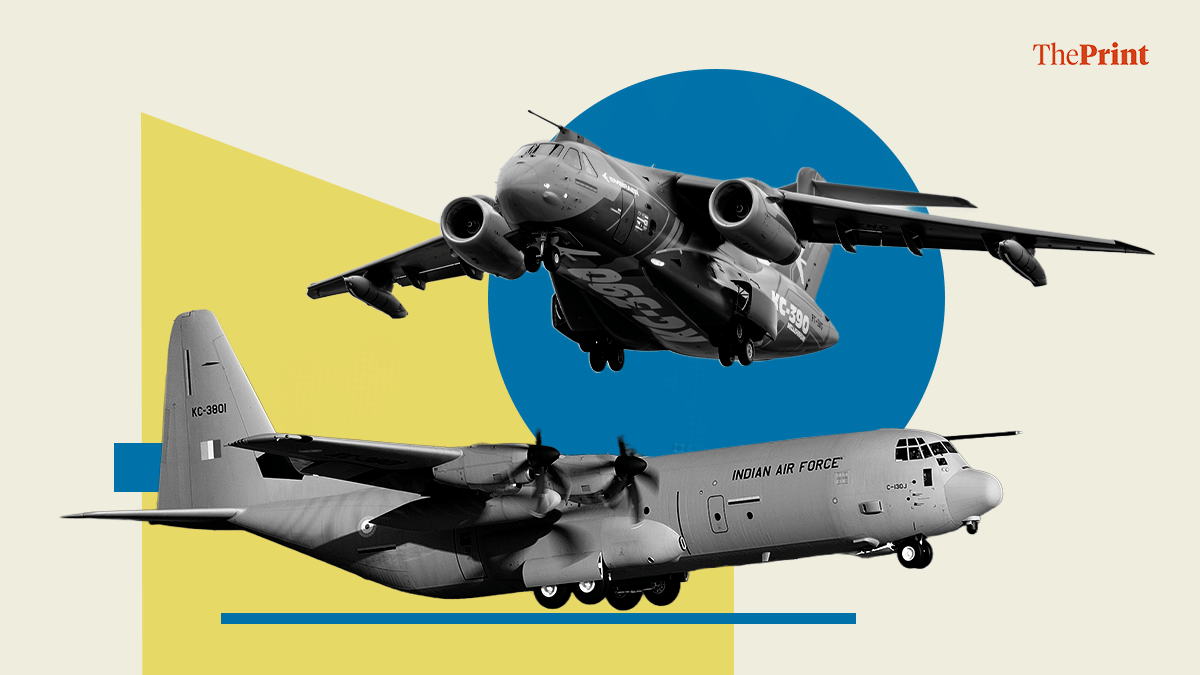
Speaking to ThePrint, Caetano Spuldaro Neto, Vice President for Sales and Business Development for the Middle East and Asia Pacific at Embraer Defence & Security, also said the KC-390 was the “cheapest” option in terms of both operational and life-cycle costs, while also being the platform best aligned with India’s requirements.

“We are competing with traditional players. Of course, we respect them and their heritage, but we are positioning ourselves in India to offer the best aircraft available in the market nowadays. And why we believe so is because our airplane has been designed in the 21st century,” he said.

Neto added that the aircraft, which made its maiden flight in 2015 and already has 12 customers with orders for around 60 aircraft, was developed by factoring in lessons from older transport platforms, their shortcomings, and areas needing improvement.

The Indian Air Force is expected to issue a Request for Proposal (RFP) later this year for the MTA project.

The IAF is seeking an aircraft with a payload capacity between 18 and 30 tonnes, and had issued a Request for Information in 2021. Initially it was looking at a 18-27 tonne capacity which was then revised to 18-30 tonnes.

“We designed an aircraft that offers a lower operational cost,” Neto said. Asked whether he was comparing the cost with the larger A400M, Neto clarified: “Our head-to-head competitor is the C-130J. But in this market, other players also play a role. A400M is also a competitor, although it’s a slightly bigger airplane. We almost consider the A400M to be in another category.”

“But even with the C-130, when you think we offer 26 tonnes of payload while they offer 19 tonnes, and while we offer a dual-jet engine aircraft that flies faster and therefore completes the mission quicker, it still offers around a 30 per cent reduction in operational cost per mission,” he said.

Asked specifically whether this meant a 30 per cent lower operating cost compared to the C-130J, Neto replied in the affirmative. “Yes, and with modern avionics, modern mission equipment, a full self-protection system and a modern cargo handling system. So it is the aircraft for the next 50 years. It’s not the aircraft from the past 50 years,” he said

One issue that the IAF is expected to closely examine is high-altitude operational capability. While the IAF’s C-130J has already landed at the Daulat Beg Oldie Advanced Landing Ground at an altitude of nearly 17,700 feet, the KC-390 is currently certified for operations up to 14,000 feet.

“We have operated above 13,000 feet in South America with no issues and we are confident we can operate above that level as well,” Neto said.

Another point of debate is the choice of engines. While both the C-130J and the A400M are turboprop aircraft, the KC-390 uses jet engines. Critics argue that turboprops are better suited for sandy, unpaved forward airstrips.

“You can see we have been flying this airplane across all continents. Recently, we conducted a full harsh-environment campaign in the Middle East. That helped us secure the order in the United Arab Emirates. It’s hot and sandy, and has unpaved runways that require short take-off and landing capability,” he added.

Neto further said the aircraft had also operated in extreme winter conditions in Europe at temperatures touching minus 30 degrees Celsius.

Speaking on other aspects of the aircraft, he said that the KC-390 was meant for a multi-mission role. He said that the transport aircraft can be converted into a mid-air refueller through a plug-and-play system in under four hours.

Neto also stressed on the fact that if India selects its aircraft, the country will not only become the second manufacturing hub for the Brazilian firm but will also become the regional MRO destination.

Embraer is in talks with Indian companies and has signed Memoranda of Understanding (MoUs) with some with regard to the project. Embraer has teamed up with Mahindra group for the manufacturing of the military transport plane in India while it has tied up with Adani for the civil versions of the aircraft. It has also signed an MoU with Hindalco Industries to conduct exploratory activities to assess potential business opportunities in India.

Neto claimed that the sourcing from India by Embraer has gone up but refused to get into specifics.