

French Navy upgrade and discussion
- Thread starter Picdelamirand-oil
- Start date
You are using an out of date browser. It may not display this or other websites correctly.
You should upgrade or use an alternative browser.
You should upgrade or use an alternative browser.

Hello Sir
With AUKUS Deal Going Nowhere at present ,
Can France offer its Nuclear Submarines to Australia
Hello,Hello Sir
With AUKUS Deal Going Nowhere at present ,
Can France offer its Nuclear Submarines to Australia
No "Sir", please

No way. Forget it. Not only will the Australians not ask us to, but, after the legitimate resentment we may have felt after the Australian "betrayal," it's now such fun to watch the soap opera "Aukus" (pillar: submarines) while munching on chips and sipping a good Burgundy wine.
But, deep down, we feel sorry for the Australians, who remain allies.
As I've said before, There are going to be many clickbait articles before 2032, Both the Virginia and SSN-AUKUS are progressing fine

Don't bet against self interest---
Yet I recall at the time, France did offer to change over to nuclear subs and Australia, said no, We said on a sovereignty ground, They needed refueling and we would be too reliant, We couldn't manufacture the rods to do it, The US and ssn-aukus comes with lifetime and doesn't need refueling,
Would France offer nuclear subs again? Of course they would
Will France use our sub facilities and continue joint exercises, Of course they will
Although not a lot is public, Indian sub facilities are used a lot by its allies, Including Australia
No need to, but--- Would you like me to quote what is said on the French forum? To show how sorry for us you areBut, deep down, we feel sorry for the Australians,
Don't bet against self interest---
Yet I recall at the time, France did offer to change over to nuclear subs and Australia, said no, We said on a sovereignty ground, They needed refueling and we would be too reliant, We couldn't manufacture the rods to do it, The US and ssn-aukus comes with lifetime and doesn't need refueling,
Would France offer nuclear subs again? Of course they would
Will France use our sub facilities and continue joint exercises, Of course they will
Although not a lot is public, Indian sub facilities are used a lot by its allies, Including Australia
Last edited:
indian Sub facilities and indian nuclear sub facilities are 2 entirely different things...As I've said before, There are going to be many clickbait articles before 2032, Both the Virginia and SSN-AUKUS are progressing fine
No need to, but--- Would you like me to quote what is said on the French forum? To show how sorry for us you are
Don't bet against self interest---
Yet I recall at the time, France did offer to change over to nuclear subs and Australia, said no, We said on a sovereignty ground, They needed refueling and we would be too reliant, We couldn't manufacture the rods to do it, The US and ssn-aukus comes with lifetime and doesn't need refueling,
Would France offer nuclear subs again? Of course they would
Will France use our sub facilities and continue joint exercises, Of course they will
Although not a lot is public, Indian sub facilities are used a lot by its allies, Including Australia
Gentlemen, please, let's try to confine our discussion here to the French navy. Thank you in advance for your kind understanding.
@Mods: thx
@Mods: thx

Classical subs, a direct drivative of the Barracuda sell to Nethelands, why not.Hello Sir
With AUKUS Deal Going Nowhere at present ,
Can France offer its Nuclear Submarines to Australia
No way for Nuc Barracuda as the production of the 6 for France is near the end, the lead time to purchase the long lead time components (nuc machinery) is long and unanticipate, and the yard will now built the 4 SNLE 3G deterrence subs for French navy.


French Navy Receives 18th and Final Upgraded ATL2 MPA

French Navy Receives 18th and Final Upgraded ATL2 MPA - Naval News
The French Defense Procurement Agency DGA handed over the eighteenth Atlantique 2 (ATL2) maritime patrol aircraft (MPA) upgraded to standard 6 to the French Navy (Marine Nationale) on February 17, 2026.
 www.navalnews.com

Historic first: French Aircraft Carrier 'Shows the Flag' in Sweden - Naval News
In a high profile naval diplomacy push by France, the aircraft carrier Charles de Gaulle arrived in Malmö, Sweden on February 24.
www.navalnews.com

Most beautiful & deadly SSN in Western Hemisphere.
De Grasse (S638) the 4th suffren class SSN
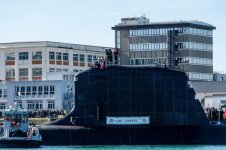
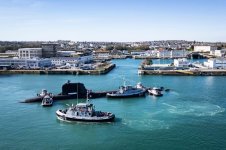
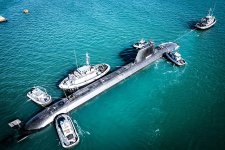
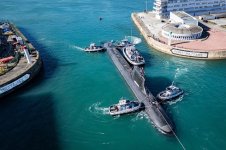
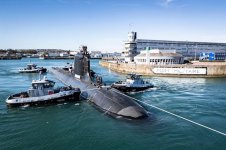
De Grasse (S638) the 4th suffren class SSN

Future French Ballistic Missile Submarines will be named Invincible-class

Future French Ballistic Missile Submarines will be named Invincible-class - Naval News
Speaking from the Île Longue ballistic missile submarine (SSBN) base in Brittany, French president Emmanuel Macron revealed that the first of the next generation SSBNs will be known as "Invincible". The announcement came as part of a highly anticipated address during which the head of state...
www.navalnews.com
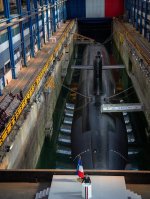
French SSBNs have the most streamline hulls ever, no hump nothing despite being single hulled. Russians using double hull & still can't build their sub's as refined as this. Based Aura farming though.

This is a future design I would like to see in the IN. New hull design, unicorn mast, multi mission stations

The aircraft carrier France Libre has a secret: its electromagnetic catapults might not be American
Porte-avions France Libre : le plan B français sur les catapultes - OpexNews
Pierre SAUVETON March 20, 2026
On March 18, Emmanuel Macron visited the Naval Group site in Indret, near Nantes, to mark the start of construction of the future French aircraft carrier, which will be named France Libre. He left having announced, among other things, that France is now studying the manufacture of its own electromagnetic catapults, because it can no longer guarantee that its American supplier will be available by 2038. Charles de Gaulle said that "France, without a great Navy, cannot remain France." The question today is slightly different: to what extent can a great navy remain sovereign when its most critical equipment depends on an unpredictable ally?
One flat deck can hide another
To understand the issue, one must first understand what distinguishes a true aircraft carrier from a ship that only superficially resembles one. Not all flat decks are created equal, and the difference lies in three letters: CAT, STO, or STV, depending on whether the ship catapults its aircraft, launches them from a ski-jump, or allows them to take off and land vertically under their own power.
CATOBAR (Catapult Assisted Take-Off But Arrested Recovery) aircraft are launched by catapult and recovered using arresting wires: this was the configuration of the Charles de Gaulle, and it would later be that of the Free French. STOBAR aircraft forgo the catapult and rely on a ski-jump at the end of the deck: this is the Russian doctrine, and the former Chinese doctrine. STOVL aircraft, finally, do without both catapults and arresting wires: the British Queen Elizabeth class and the Italian Cavour class are the best-known examples, forced to rely entirely on the F-35B, the only combat aircraft capable of short takeoff and vertical landing. Three families, three levels of power, and a difference measured in tons of weaponry, kilometers of range, and the types of aircraft that can or cannot be embarked.
Behind these acronyms lie significant differences in military power. A Rafale Marine launched from the Charles de Gaulle can carry 9.5 tons of payload and project a range of 1,300 kilometers. A Sukhoi Su-33 launched from a STOBAR aircraft, as the Admiral Kuznetsov was, is limited to 6.5 tons, almost a third less capacity. A British F-35B must conserve fuel for its vertical landing: its range is limited to 950 kilometers. And some aircraft, like the E-2C Hawkeye forward airborne early warning aircraft, essential for detecting long-range threats and coordinating the air group, are simply incapable of taking off without a catapult: their power-to-weight ratio doesn't allow it. An aircraft carrier without a catapult is therefore blind at long range, and its fighter jets arrive on scene with half their fuel reserves.
The United States, France, and now China with its Fujian: three countries currently master catapult launches from aircraft carriers. But for nuclear propulsion, the club is reduced to two. And one of these two members is beginning to doubt the other.
The Charles de Gaulle cannot do two things at once.
The Charles de Gaulle has two American C-13-3 steam catapults, as is fitting. 75 meters long, capable of launching a 25-ton aircraft at 270 km/h in two seconds, with an acceleration of 4 to 5 g. One aircraft every thirty seconds, in theory. Its three hydraulic arresting wires bear the names Athena, Aphrodite, and Andromeda. The French Navy has always had a flair for mythological imagery.
But this configuration presents a major, and little-publicized, operational constraint: because the two catapults extend beyond the angled flight deck, it is impossible to launch and land simultaneously. In practical terms, while one aircraft is landing, another cannot be launched. The aircraft carrier Free France will be designed to perform both operations at the same time. In a high-intensity conflict, this simultaneity can mean the difference between overwhelming the adversary and being outflanked.
With three electromagnetic catapults instead of two steam catapults, the embarked air group could carry out up to sixty sorties per day: twice as many as the Charles de Gaulle aircraft carrier under optimal conditions. The third catapult also provides redundancy: in high-intensity situations, a failure no longer grounds the entire ship. And unlike steam systems, EMALS (ElectroMagnetic Aircraft Launch Systems) allow for precise modulation of launch power according to the weight of each aircraft, reducing mechanical stress on the airframes and thus extending their lifespan.
On the logistics side: 140 cubic meters of fresh water saved per day, a start-up in minutes without pressure build-up, and a significantly reduced footprint.
Twenty years of development, billions in cost overruns, and a first operational deployment postponed five times. That's what this revolution cost the Americans.
"You have to be Albert Einstein to understand that."
In 2017, when the Gerald R. Ford was delivered to the US Navy after years of delays and billions in cost overruns ($12.9 billion in total, compared to $8.5 billion for previous aircraft carriers), Donald Trump paid a brief visit to the Newport News shipyard in Virginia. His conclusion, delivered during an interview with Time magazine after a tour of the ship: the system is "bad," too expensive by "hundreds of millions of dollars," and the Navy should go back to "that damn steam system." "Digital. They have digital. What is digital? It's very complicated, you have to be Albert Einstein to understand that." Then, upon learning that the US Navy planned to equip all its future aircraft carriers with EMALS, he said, “I said no. You’re going back to the damn steam system.” The Pentagon responded diplomatically that the president may have spoken “without having all the information in front of him.” An anonymous officer added, more bluntly, that Trump “either had outdated information or incorrect information.” The engineers continued.
But the exchange already revealed something useful: an American president is perfectly capable of calling into question, on a whim, a technological choice that is fundamental to the world’s leading navy and, by extension, to all those who depend on it.
But Trump wasn’t entirely wrong about the observation, even if he was mistaken about the conclusion. In June 2018, the Pentagon’s Test Evaluation Office published a scathing report: the Ford’s EMALS systems were failing on average every 455 launches. Nine times more often than the threshold set by the Navy. A 70% chance of completing a day without incident. And when it did malfunction, the crew had to wait an hour and a half for the systems to shut down before they could even begin to investigate the problem. The report concluded that the vessel would be "unlikely to conduct high-intensity wartime operations." The Advanced Arresting Gear (AAG) system was hardly more reliable.
The rest is history: General Atomics eventually corrected the problems, the Ford completed its first operational deployment in the Mediterranean in 2022, and has since amassed over 30,000 successful launches. The technology delivered on its promises, albeit five years late. Which, for a program slated to deliver the Free French in 2038, is something to consider.
General Atomics’ only competitor is China.
Last fall, Donald Trump once again raised the specter of a return to steam catapults, this time citing dependence on China. The argument rests on one specific point: the permanent magnets that form the core of the EMALS linear motors require rare earth elements (neodymium, dysprosium), of which China holds a near-monopoly across the entire chain, from extraction to refining. These magnets wear out and must be replaced. With each replacement, the dependence is renewed.
What Donald Trump failed to mention is that while Washington was debating its own contradictions, Beijing was quietly building its own catapults. In September 2025, Chinese state television broadcast for the first time complete footage of an electromagnetic catapult launch from the Fujian: China's third aircraft carrier, 316 meters long, equipped with three EMALS (Electromagnetic Launching Systems) developed entirely independently by domestic industry. J-35s, J-15Ts, and a KJ-600 airborne early warning aircraft took off one after another. The Fujian became the second aircraft carrier in the world to operationally master this technology.
The situation is therefore quite ironic: France depends on an American supplier whose supply chain is itself dependent on a country that now produces the same catapults completely independently. General Atomics is currently the only Western producer of these systems. China is the other. This duopoly, in the current context, should give more than one planner at the Ministry of the Armed Forces and the Directorate General of Armaments sleepless nights.
Plan B exists. On paper
It is in this context that Indret's announcement takes on its full meaning. For the first time since the program's inception, France is publicly stating that it is exploring a domestic alternative. The studies could be entrusted to Alstom, Cegelec, and Schneider Electric: three groups with expertise in power electronics, linear drive systems, and large-scale energy management. Alstom with its linear motors for high-speed rail, Schneider in energy conversion, Cegelec in complex electrification systems: the technological foundation is not fictitious.
But let's be realistic. Accelerating a 25-ton fighter jet to 250 km/h in two seconds, repeatably and reliably, in sea spray and vibrations, is nothing like propelling a TGV. The Americans took two decades to achieve this, with vastly superior resources. France doesn't have that kind of time and probably not that kind of budget either. The PANG program is already tightly calibrated, and grafting a technological development of this magnitude onto such a tight schedule would represent a considerable industrial gamble.
This is precisely why the current approach is presented as a feasibility study, not a development program. The primary objective is to mitigate risk: to determine if it is technically feasible, at what cost, in what timeframe, and with which raw materials. And to reassess, in parallel, over the years, the actual level of risk associated with the American supply chain, so as to only activate the alternative if it becomes truly necessary.
Accepted Dependence Has Its Limits
Between the lines, this announcement conveys something that diplomacy forbids from stating aloud: Paris no longer considers Washington a reliable long-term supplier. For decades, France accepted a form of willing dependence on certain critical military equipment, in the name of budgetary pragmatism and allied solidarity. It was a rational calculation in a predictable world. That world is now disappearing.
The AUKUS affair in 2021 already served as a warning: even between close allies, American national interests can override contractual commitments without notice. Since then, Donald Trump has returned, and with him, unpredictability has become a method of governance. To find oneself in 2035 or 2036, just months before the delivery of the French Navy's flagship, having to negotiate the delivery of critical components with an administration that uses everything as a bargaining chip: this scenario is no longer science fiction.
France is building a nuclear-powered aircraft carrier, one of the most complex objects humanity knows how to manufacture, and it finds itself considering taking on the responsibility for one of its key components itself because it can no longer trust its long-standing supplier to deliver it on time. There is something rather dizzying about this, and something quite consistent with the name chosen for the ship.
Free France certainly lives up to its name.
Porte-avions France Libre : le plan B français sur les catapultes - OpexNews
Pierre SAUVETON March 20, 2026
On March 18, Emmanuel Macron visited the Naval Group site in Indret, near Nantes, to mark the start of construction of the future French aircraft carrier, which will be named France Libre. He left having announced, among other things, that France is now studying the manufacture of its own electromagnetic catapults, because it can no longer guarantee that its American supplier will be available by 2038. Charles de Gaulle said that "France, without a great Navy, cannot remain France." The question today is slightly different: to what extent can a great navy remain sovereign when its most critical equipment depends on an unpredictable ally?
One flat deck can hide another
To understand the issue, one must first understand what distinguishes a true aircraft carrier from a ship that only superficially resembles one. Not all flat decks are created equal, and the difference lies in three letters: CAT, STO, or STV, depending on whether the ship catapults its aircraft, launches them from a ski-jump, or allows them to take off and land vertically under their own power.
CATOBAR (Catapult Assisted Take-Off But Arrested Recovery) aircraft are launched by catapult and recovered using arresting wires: this was the configuration of the Charles de Gaulle, and it would later be that of the Free French. STOBAR aircraft forgo the catapult and rely on a ski-jump at the end of the deck: this is the Russian doctrine, and the former Chinese doctrine. STOVL aircraft, finally, do without both catapults and arresting wires: the British Queen Elizabeth class and the Italian Cavour class are the best-known examples, forced to rely entirely on the F-35B, the only combat aircraft capable of short takeoff and vertical landing. Three families, three levels of power, and a difference measured in tons of weaponry, kilometers of range, and the types of aircraft that can or cannot be embarked.
Behind these acronyms lie significant differences in military power. A Rafale Marine launched from the Charles de Gaulle can carry 9.5 tons of payload and project a range of 1,300 kilometers. A Sukhoi Su-33 launched from a STOBAR aircraft, as the Admiral Kuznetsov was, is limited to 6.5 tons, almost a third less capacity. A British F-35B must conserve fuel for its vertical landing: its range is limited to 950 kilometers. And some aircraft, like the E-2C Hawkeye forward airborne early warning aircraft, essential for detecting long-range threats and coordinating the air group, are simply incapable of taking off without a catapult: their power-to-weight ratio doesn't allow it. An aircraft carrier without a catapult is therefore blind at long range, and its fighter jets arrive on scene with half their fuel reserves.
The United States, France, and now China with its Fujian: three countries currently master catapult launches from aircraft carriers. But for nuclear propulsion, the club is reduced to two. And one of these two members is beginning to doubt the other.
The Charles de Gaulle cannot do two things at once.
The Charles de Gaulle has two American C-13-3 steam catapults, as is fitting. 75 meters long, capable of launching a 25-ton aircraft at 270 km/h in two seconds, with an acceleration of 4 to 5 g. One aircraft every thirty seconds, in theory. Its three hydraulic arresting wires bear the names Athena, Aphrodite, and Andromeda. The French Navy has always had a flair for mythological imagery.
But this configuration presents a major, and little-publicized, operational constraint: because the two catapults extend beyond the angled flight deck, it is impossible to launch and land simultaneously. In practical terms, while one aircraft is landing, another cannot be launched. The aircraft carrier Free France will be designed to perform both operations at the same time. In a high-intensity conflict, this simultaneity can mean the difference between overwhelming the adversary and being outflanked.
With three electromagnetic catapults instead of two steam catapults, the embarked air group could carry out up to sixty sorties per day: twice as many as the Charles de Gaulle aircraft carrier under optimal conditions. The third catapult also provides redundancy: in high-intensity situations, a failure no longer grounds the entire ship. And unlike steam systems, EMALS (ElectroMagnetic Aircraft Launch Systems) allow for precise modulation of launch power according to the weight of each aircraft, reducing mechanical stress on the airframes and thus extending their lifespan.
On the logistics side: 140 cubic meters of fresh water saved per day, a start-up in minutes without pressure build-up, and a significantly reduced footprint.
Twenty years of development, billions in cost overruns, and a first operational deployment postponed five times. That's what this revolution cost the Americans.
"You have to be Albert Einstein to understand that."
In 2017, when the Gerald R. Ford was delivered to the US Navy after years of delays and billions in cost overruns ($12.9 billion in total, compared to $8.5 billion for previous aircraft carriers), Donald Trump paid a brief visit to the Newport News shipyard in Virginia. His conclusion, delivered during an interview with Time magazine after a tour of the ship: the system is "bad," too expensive by "hundreds of millions of dollars," and the Navy should go back to "that damn steam system." "Digital. They have digital. What is digital? It's very complicated, you have to be Albert Einstein to understand that." Then, upon learning that the US Navy planned to equip all its future aircraft carriers with EMALS, he said, “I said no. You’re going back to the damn steam system.” The Pentagon responded diplomatically that the president may have spoken “without having all the information in front of him.” An anonymous officer added, more bluntly, that Trump “either had outdated information or incorrect information.” The engineers continued.
But the exchange already revealed something useful: an American president is perfectly capable of calling into question, on a whim, a technological choice that is fundamental to the world’s leading navy and, by extension, to all those who depend on it.
But Trump wasn’t entirely wrong about the observation, even if he was mistaken about the conclusion. In June 2018, the Pentagon’s Test Evaluation Office published a scathing report: the Ford’s EMALS systems were failing on average every 455 launches. Nine times more often than the threshold set by the Navy. A 70% chance of completing a day without incident. And when it did malfunction, the crew had to wait an hour and a half for the systems to shut down before they could even begin to investigate the problem. The report concluded that the vessel would be "unlikely to conduct high-intensity wartime operations." The Advanced Arresting Gear (AAG) system was hardly more reliable.
The rest is history: General Atomics eventually corrected the problems, the Ford completed its first operational deployment in the Mediterranean in 2022, and has since amassed over 30,000 successful launches. The technology delivered on its promises, albeit five years late. Which, for a program slated to deliver the Free French in 2038, is something to consider.
General Atomics’ only competitor is China.
Last fall, Donald Trump once again raised the specter of a return to steam catapults, this time citing dependence on China. The argument rests on one specific point: the permanent magnets that form the core of the EMALS linear motors require rare earth elements (neodymium, dysprosium), of which China holds a near-monopoly across the entire chain, from extraction to refining. These magnets wear out and must be replaced. With each replacement, the dependence is renewed.
What Donald Trump failed to mention is that while Washington was debating its own contradictions, Beijing was quietly building its own catapults. In September 2025, Chinese state television broadcast for the first time complete footage of an electromagnetic catapult launch from the Fujian: China's third aircraft carrier, 316 meters long, equipped with three EMALS (Electromagnetic Launching Systems) developed entirely independently by domestic industry. J-35s, J-15Ts, and a KJ-600 airborne early warning aircraft took off one after another. The Fujian became the second aircraft carrier in the world to operationally master this technology.
The situation is therefore quite ironic: France depends on an American supplier whose supply chain is itself dependent on a country that now produces the same catapults completely independently. General Atomics is currently the only Western producer of these systems. China is the other. This duopoly, in the current context, should give more than one planner at the Ministry of the Armed Forces and the Directorate General of Armaments sleepless nights.
Plan B exists. On paper
It is in this context that Indret's announcement takes on its full meaning. For the first time since the program's inception, France is publicly stating that it is exploring a domestic alternative. The studies could be entrusted to Alstom, Cegelec, and Schneider Electric: three groups with expertise in power electronics, linear drive systems, and large-scale energy management. Alstom with its linear motors for high-speed rail, Schneider in energy conversion, Cegelec in complex electrification systems: the technological foundation is not fictitious.
But let's be realistic. Accelerating a 25-ton fighter jet to 250 km/h in two seconds, repeatably and reliably, in sea spray and vibrations, is nothing like propelling a TGV. The Americans took two decades to achieve this, with vastly superior resources. France doesn't have that kind of time and probably not that kind of budget either. The PANG program is already tightly calibrated, and grafting a technological development of this magnitude onto such a tight schedule would represent a considerable industrial gamble.
This is precisely why the current approach is presented as a feasibility study, not a development program. The primary objective is to mitigate risk: to determine if it is technically feasible, at what cost, in what timeframe, and with which raw materials. And to reassess, in parallel, over the years, the actual level of risk associated with the American supply chain, so as to only activate the alternative if it becomes truly necessary.
Accepted Dependence Has Its Limits
Between the lines, this announcement conveys something that diplomacy forbids from stating aloud: Paris no longer considers Washington a reliable long-term supplier. For decades, France accepted a form of willing dependence on certain critical military equipment, in the name of budgetary pragmatism and allied solidarity. It was a rational calculation in a predictable world. That world is now disappearing.
The AUKUS affair in 2021 already served as a warning: even between close allies, American national interests can override contractual commitments without notice. Since then, Donald Trump has returned, and with him, unpredictability has become a method of governance. To find oneself in 2035 or 2036, just months before the delivery of the French Navy's flagship, having to negotiate the delivery of critical components with an administration that uses everything as a bargaining chip: this scenario is no longer science fiction.
France is building a nuclear-powered aircraft carrier, one of the most complex objects humanity knows how to manufacture, and it finds itself considering taking on the responsibility for one of its key components itself because it can no longer trust its long-standing supplier to deliver it on time. There is something rather dizzying about this, and something quite consistent with the name chosen for the ship.
Free France certainly lives up to its name.

That's a nice fluff piece, No mention of a budget or estimated cost, No mention of France's GDP to debt percent, or defence budget
Are we taking bets on France developing its own? Don't forget that there are patents on existing technology
"The development of the Electromagnetic Aircraft Launch System (EMALS) for the U.S. Navy has been marked by significant costs and overruns, with reports indicating that cost overruns alone were roughly $900 million to $993 million"
A quick google puts the total around 3 billion
Are we taking bets on France developing its own? Don't forget that there are patents on existing technology
"The development of the Electromagnetic Aircraft Launch System (EMALS) for the U.S. Navy has been marked by significant costs and overruns, with reports indicating that cost overruns alone were roughly $900 million to $993 million"
A quick google puts the total around 3 billion
Last edited:
So I'm going to answer not for @Optimist, because he's beyond redemption, but for the other readers. First, France's debt: it's one of the parameters that financiers look at to assess the risk France represents for a lender.That's a nice fluff piece, No mention of a budget or estimated cost, No mention of France's GDP to debt percent, or defence budget
Are we taking bets on France developing its own? Don't forget that there are patents on existing technology
"The development of the Electromagnetic Aircraft Launch System (EMALS) for the U.S. Navy has been marked by significant costs and overruns, with reports indicating that cost overruns alone were roughly $900 million to $993 million"
A quick google puts the total around 3 billion
The larger the debt, the higher the interest rate to compensate for the risk, but it's not the only indicator considered, and for France, we must believe that the other indicators are excellent, certainly much better than Australia's, because France can borrow for 10 years at a rate of 3.745%, while Australia borrows under the same conditions at a rate of 4.588%.
So I don't see any reason for an Australian to worry about France. Let them sort out Australia's problem first, and if in the next century they can finally compare themselves to France, then we can talk.
Then he criticizes a French military program worth 11 billion euros, or 12.86 billion US dollars, while Australia accepts a program for its submarines worth 368 billion Australian dollars, or 243 billion US dollars—20 times more—even though Australia's budget is three times smaller than France's, and all this to order submarines from countries that lack the industrial capacity to produce them. So who's the craziest?

That's a nice fluff piece, No mention of a budget or estimated cost, No mention of France's GDP to debt percent, or defence budget
Are we taking bets on France developing its own? Don't forget that there are patents on existing technology
"The development of the Electromagnetic Aircraft Launch System (EMALS) for the U.S. Navy has been marked by significant costs and overruns, with reports indicating that cost overruns alone were roughly $900 million to $993 million"
A quick google puts the total around 3 billion
Don't see the problem. India's developing EMALS too. Development eventually gets cheaper over time for existing tech.
Your argument is more suitable for funding larger programs like SCAF instead.
US spent $3b development and it will be used on multiple carriers
France is building one carrier and all costs will be on one boat, It's a pipe dream, they will go as planned and get the US one
I don't know how many carriers India intends to have, but it may be developed at less cost than the US
France is building one carrier and all costs will be on one boat, It's a pipe dream, they will go as planned and get the US one
I don't know how many carriers India intends to have, but it may be developed at less cost than the US