
You are using an out of date browser. It may not display this or other websites correctly.
You should upgrade or use an alternative browser.
You should upgrade or use an alternative browser.





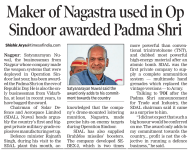

Saurav Jha has started Deep Propulse Aerospace Private Limited with Dr V. Ramanujachari (Former Project Director of Scramjet Engine). Company is incubated at IIT Madras, and mentored by former DRDO Chairman Dr. V. K. Saraswat.


A pvt. sector company that reaches in house trials soon with such a weapon system should be able to sell it to the forces (even if in less than ideal nos.). However, if the company does not have substantial funding, I do not know if they will be able to have the same commitment when it comes to developing a V2 of the said system. The same goes for LMs with higher payload capacity.
 www.svayatt.co.in
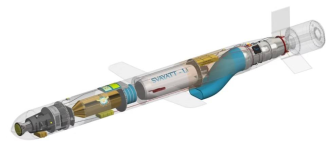
(This particular company seems to be one the few that seem to have achieved some traction when it comes to funding and partnerships. Let's see if they can deliver).
Sound finances, funding, and a userbase that tends to lean towards EP quite often are some bottlenecks that are preventing certain startups and MSMEs from breaking into the def. sector. There is some movement by various states to support such organisations. Let's see how things progress.
Svayatt L1 | Paninian Svayatt Portal
(This particular company seems to be one the few that seem to have achieved some traction when it comes to funding and partnerships. Let's see if they can deliver).
Sound finances, funding, and a userbase that tends to lean towards EP quite often are some bottlenecks that are preventing certain startups and MSMEs from breaking into the def. sector. There is some movement by various states to support such organisations. Let's see how things progress.
Last edited:
Adding this article for the post above:
 www.orfonline.org
Leveraging Tech Startup Investment for India's War Readiness
India’s war readiness hinges on defence-tech startups. With global supply chains strained, indigenisation is no longer optional but imperative.
www.orfonline.org
There exists a very naive group of Indians who believe that buying some arms from a country will actually aid you when it comes to conflict management. Please check who spoke out in your favour openly or provided diplomatic aid after spending tens of billions of dollars over the years. Let me know how that has turned out. Yes, they will help you but it is up to them if they wish to do so openly and how far they are willing to go. Most will have their own set of priorities. So, before you start waving the flag of some x or y OEM/nation take a moment to think.
Underrated dependancy.
Smokeless Oil for Armed Forces produced by Guwahati Refinery


Need Make in India for software too now.
iDex+PLI scheme to promote startups with infusion of capital from big money. From what I can infer, our problem related to software industry is lack of cohesion and targeted approach.
While so called IT giants produce talent. They don't provide any product, only the talent as service. And I doubt that they can overhaul their internal Beauracracy, culture and approach to become product centric now. Back when the industry was envisioned in 1990s and early 2000s.. it was purely for job creation. As long as they could show that they hired thousands upon thousands of graduates, everyone was happy. Now they are stuck. They are already under pressure due to AI and still trying to provide talent only.
Maybe a startup that utilises India's own service industry to get the talent, hire people who have gone to work in the very firms that make high end software and focus on one or two product for start that can replace our software dependency.
But we are talking about India. Where an entire ecosystem got active for a bit job against ZOHO and discredit in the name of Caste, brahmin etc. Pathetic bunch of people.
I can only hope that GOI is serious about ZOHO and replaces foreign services with Zoho wherever applicable in its own working. So, that Zoho can learn, adapt and build ecosystem to compete with others in the market.

Well our companies certainly don't lack the talent to make such software suite. What you are saying about our companies is right. But, think from their perspective as well why would they provide a product when your own government shows no interest? There is also the issue of institutional inertia, both within government procurement systems and public-sector organisations. The prevailing mindset is essentially “if it works, why change it?” As long as there is no visible disruption, no sanctions risk, and no geopolitical pressure, there is little incentive for bureaucratic systems to reassess long-term strategic dependencies. Not something unique to us, even countries like France were perfectly comfortable relying on American software stacks until recent geopolitical tensions forced a rethink. Structural change only happens when there is a strong push to the shove.Need Make in India for software too now.
iDex+PLI scheme to promote startups with infusion of capital from big money. From what I can infer, our problem related to software industry is lack of cohesion and targeted approach.
While so called IT giants produce talent. They don't provide any product, only the talent as service. And I doubt that they can overhaul their internal Beauracracy, culture and approach to become product centric now. Back when the industry was envisioned in 1990s and early 2000s.. it was purely for job creation. As long as they could show that they hired thousands upon thousands of graduates, everyone was happy. Now they are stuck. They are already under pressure due to AI and still trying to provide talent only.
Maybe a startup that utilises India's own service industry to get the talent, hire people who have gone to work in the very firms that make high end software and focus on one or two product for start that can replace our software dependency.
But we are talking about India. Where an entire ecosystem got active for a bit job against ZOHO and discredit in the name of Caste, brahmin etc. Pathetic bunch of people.
I can only hope that GOI is serious about ZOHO and replaces foreign services with Zoho wherever applicable in its own working. So, that Zoho can learn, adapt and build ecosystem to compete with others in the market.
Until such pressure emerges, Indian government bodies will continue to rely on foreign software suites simply because they are already embedded into workflows, certifications, and procurement norms. Bureaucratic processes are designed to avoid risk, not to anticipate it.
In case of French Dassault Systemes always had the ability to make such software suite to replace Microsoft product suite but they never made one until there was demand from the french high command... Companies often always look for some kind of assurance or certainty especially Indian companies because at the end they have to give answers to their shareholders.
Hopefully, our government realise this sooner and go for a PLI for software products.
Last edited:
You need to zoom out and look at things historically.
The result you see today is because of the choice of institutional building by the leadership after independence. They created a single civilian entity, the Defense Research and Development Organization (DRDO), in 1958 to oversee military-related research and development. The key word here is "civilian". The services role is very limited to provide support not more than that. If we compare it with USA, its a mix of Department of Defense Agencies like DARPA and Service Research Laboratories like Air Force Research Laboratory (AFRL), Naval Research Laboratory (NRL) etc. They work with defense contractors to prototype and build any weapon system.
Now, why do we have a design bureau for the navy but not for the air force? This is because of two reasons. First, there was no civilian entity that could perform that job. As for the air force, they had HAL, which had good enough design and development expertise. Secondly, it was within their reach. The air force cannot easily do that; the design and development of a fighter are far more challenging compared to a warship. Even in the USA, NRL was the pioneer in service-specific labs; every other lab came after. The inspiration of naval inhouse design was royal navy Corps of Naval Constructors which overtime evolved into Directorate of Naval Design (DND). It was a visionary decision for the navy to undertake. They had very small budget comparitivly so they had to make the most out of it.
At the same time, it is unfair to place blame on the air force and army because the design of our institutions was flawed. The innovation of the structure by the navy is an aberration, not the norm.
Services dont run development programs. They are just there to assist. They dont have any leverage over development of a project.
These responsibilities lie with either DRDO or the industry. Only with the recent DPP do we have involvement of services working with the industry as such.
No where in the world airforces design and develop platforms like you mentioned. Its out of their reach and mandate.
Services cannot directly fund projects under DRDO or DPSU like HAL. I don't know where these assumptions come from.
Correct, in my opinion, if DRDO had prioritized the testing infrastructure in the 1980s and 1990s, we could have been on a different trajectory. But again we were a poor country. We have a scarcity mindset. Why build an advanced wind tunnel for LCA or a high-altitude test facility for Kaveri when we can do it more cheaply outside?. We didnt plan for long term.
Also, as you pointed out, CEMILAC is another hurdle for the Air Force that naval platforms don't have to face.
Footnote:
During the time of Antony, there was an attempt to establish a civilian agency called the National Institute for Research and Development in Defence Shipbuilding (NIRDESH) to reduce the workload of the Directorate of Naval Design (DND).
About sad story of NIRDESH.