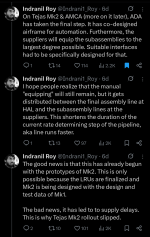
Thanks for your insights sir, IMO there must be a plan B for Tejas MK2 engine (like a derivative of M-88) if GE engine delivery timeline goes same like 404 engines. You can't totally depend on only one engine that too which brings so much uncertainty & can sabotage whole MK2 project.
There were reports that India considering M-88 engine derivative for MK2. Do you have any inside information on that ?
Actually, I don’t have any inside information.
That said, the main work to obtain the
M88 T-REX engine has already begun, since it must be available before 2030 for the first flights of the Rafale F5.
Furthermore, to convert a standard
M88 into an
M88 T-REX, only a few modules will need to be changed — I believe it’s around
three modules, while the M88 has about
21 modules in total. The M88 was designed as a
family of engines sharing the same core, with growth potential. The family was originally intended to cover roughly
7.5 tons to 11.5 tons maximum thrust.
Now, the technological step brought by T-REX basically shifts these capabilities upward by about
20%, while keeping the same overall dimensions and weight.
To replace the
F414, we would need an engine in the
6-ton class (dry). With the T-REX technology on the current M-88 we can reach around
6 tons, and with afterburner we can obtain about
9 tons without any major redesign.
If we want around
10 tons with afterburner, we need to ingest a bit more air, meaning a slightly larger fan diameter. But we have margin here: the
F414 fan diameter is about 89 cm, while the
M88 is only about 69 cm. A fan diameter around
79 cm would already be more than sufficient.
So, in theory, it would be possible to create an engine with the final integration characteristics suitable for Tejas Mk2, even without the full T-REX technology at first. Such an “intermediate” engine could deliver around
5.5 / 8 tons (dry / afterburner), and later it could accept the three upgraded T-REX modules, bringing it up to around
6.5 / 10 tons.
It would also have the advantage of allowing early studies and tests for the integration of an M88-derivative into the Tejas Mk2.