Indian Space Industry : Updates & Discussions

Indian space startup "EtherealX" is building a fully re-usable medium lift rocket. They are getting funded from Indo-US technology fund (INDUS-X):
View attachment 42258

The Stallion engine shown above will be a "closed gas generator cycle". I am not sure what that means. Gas generator cycles by their very nature are open cycles. As in fuel & oxidizer is used to turn the main turbopump & feed the combustion chamber. The propellant used in running the turbopump is dumped overboard. Since we are losing this propellant, it is called an open cycle. A closed gas generator cycle is called an expander cycle. Why not just call it that? We will have to wait for more updates on this.

View attachment 42265
Anyway, the Stallion is their lower stage engine. Thus, it is more powerful & more challenging. They are starting off their engine development with the smaller upper stage engine called "Pegasus".

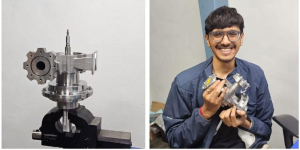
They have 3D printed a prototype of the Thrust Chamber Assembly (TCA) of the "Pegasus" upper stage semi-cryogenic engine:
View attachment 42260
View attachment 42261
The spaces of the engine are as follows:

Propellant: RP-1/LOX
Thrust: 40 kN (sea level)
Isp: 293 sec (sea level)
Cooling: Regenerative

The engine feed cycle is rather interesting. The company describes it as "A proprietary, all-new, indigenously developed rocket engine feed cycle: the Full Flow Segregated Cooling Cycle (FSCC)". But also says this TCA is the "The world’s first RP-1/LOX engine TCA that can also run on an expander cycle".

It seems to me that this FSCC is a modified variant of the dual expander cycle. If it is genuinely an all-new engine cycle, this would be the 1st by any Indian organization/company. We will have to wait & see on that front.

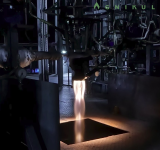
They are getting ready to test the Pegasus TCA:


Video if the Pegasus TCA test rig:

View attachment 42266

It going to be very very tough, but I hope they can make this work. Can you imagine having reusable rocket with payload similar to the LVM3. It will be a game changer for our military & civilian needs.

Can EtherealX Become India’s SpaceX with Its Fully Reusable Rocket?

09 Jun'25 | By Tapanjana Rudra
View attachment 44308

SUMMARY
  • Spacetech startup EtherealX claims to have learned from the failures of SpaceX's Falcon launch and built its own technology to make medium-lift rockets fully reusable
  • EtherealX has built its own re-entry algorithm, which is being tried out not only in its own test vehicles but also in test launches
  • EtherealX has a $130Mn order book in place from satellite operators in the US, Japan, and some European countries

Late-winter frost was in full spell when a sleepy Polish town woke up to mysterious fireballs lighting up the obsidian sky on a February night.

Neither Helios was on an errand, nor a mythical dragon was on a recce of the Polish skies that night. Experts confirmed the next day that those were the wrecks of the upper stage of Falcon 9’s reusable launch vehicle that had failed to deorbit on time, malfunctioned, broke into pieces, and crashed down on earth like fireballs.

Elon Musk’s SpaceX grounded Falcon 9 rockets multiple times last year following anomalies in the recovery of their second stage or upper stage. From a liquid oxygen leak to a malfunction while grounding, the company has faced multiple failures while bringing the upper stage of its reusable rockets back to Earth.


"As California-headquartered SpaceX tries to comprehend the rocket science behind the failures, Bengaluru-based spacetech startup EtherealX claims to have learned from the Falcon fallacies. Lessons that the startup is using to build medium-lift fully reusable launch vehicles or rockets."


While deep-pocket giants like SpaceX, Blue Origin, and Rocket Lab have cracked the code of recovering the first stage or the booster stage of their medium-lift launch vehicles, but failed to make their satellite launch vehicles (SLVs) fully reusable for various tech constraints, EtherealX claims to be a pioneer in the Indian spacetech system to make rockets that can be reused fully.

EtherealX says it has built advanced hardware and software stacks, and worked around with the existing laws of physics to build its flagship Razor Crest Mk-1 that can be brought back to the launch pad after it docked a satellite into Low Earth Orbit (LEO), Geostationary Transfer Orbit (GTO), or following a trans-lunar injection (TLI).

With an eye on global markets, EtherealX plans its first commercial launch in 2027 to capture a major share of the Indian spacetech market that’s set to surpass $44 Bn by 2030.

The Making of EtherealX: From Vedas to Falcon Fallacies

As a child, Manu Nair was deeply inspired by the Vedas and was intrigued by celestial matters. He wanted to grow up to explore the mysteries of the cosmos. After his graduation in engineering from the BML Munjal University, he interned at the Human Space Flight Centre of the Indian Space Research Organisation (ISRO) in late 2019. He met Shubhayu Sardar there.

Before the ISRO assignment, Nair had the opportunity to work closely with commercial space flight planning as a part of NASA-supported Project PoSSUM (Polar Suborbital Science in the Upper Mesosphere). By late 2020, he joined Indian spacetech startup Manastu Space’s executive team and met Prashanth Sharma, who was heading propulsions in the company.

Nair introduced Sharma to Sardar at a dinner a year later. That’s where the entire game changed for the trio. Sharma turned down an offer from the US-based Rocket Lab, Sardar quit ISRO, and Nair called off his plans to join an American company.

The three space enthusiasts teamed up and the seed of EtherealX germinated in 2022.

View attachment 44310

“That night at the dinner, the fundamental question we asked was why we still did not have resilient or multi-polar launch infrastructure. Even as launch costs had come down over the last few decades, mathematically, there should have been an oversupply of launch vehicles, but that was not the case. Launch was not a solved problem at all. It was an extremely polarised market where over 80% of all launches were being done by one vehicle, one company, and one demography,” Nair, the CEO of the spacetech startup, shared with Inc42.

They realised that most companies were not operating in the right segment of launch vehicles or did not follow the right approach, which was causing trouble for the satellite operators who had to wait long for launches. The idea was also to solve for unit economics.


"The answer was reusability. That was the core idea of the spacetech startup."


It wasn’t anything novel. The first reusable rocket, the Space Shuttle, was developed by NASA. Since 1981, the Space Shuttle fleet undertook 135 missions, inspiring generations of scientists.

The Space Shuttle comprised an external tank, two solid rocket boosters on the sides, and an orbiter. Only the external tank could not be recovered after launch. The solid rocket boosters landed in the ocean that NASA retrieved, inspected, refurbished, and reused, while the orbiter returned to Earth and landed like an airplane after completing its space mission.


"SpaceX created history in 2015 when it became the world’s first to bring back its Falcon 9 rocket in a soft touchdown during an orbital launch. “SpaceX too has had multiple failures. The company goes public stating the cause of the failure, but never discloses how they fixed it. We spotted the errors and framed our strategy based on what not to do. At EtherealX, we started off with the mitigation strategies for the issues SpaceX was facing,” Nair said."


It was almost impossible to replicate the SpaceX model, given that the company has a vertically integrated business. The EtherealX founders started building proprietary technology from the ground up that could recover both the booster stage and upper stage of the rockets – going one step ahead of what SpaceX has achieved so far, according to the CEO.

EtherealX has so far carried out a few private tests of its launch vehicle engine, while its fully reusable launch vehicle is still under testing and designing. It has recently signed an agreement with In-Space for facilitating the testing of its engines with ISRO. Its first hot fire will be done at its own facility in November, when the engine will be fired up and operated in a controlled environment for its performance and safety checks.

The company raised $5 Mn in a seed round last year from YourNest VC, BIG Global Investments, BlueHill Capital, and Golden Sparrow Ventures, to proceed with the final tests and qualification of the vehicle engine.

The Tech Edge: Spotting SpaceX Gaps

A two-stage-to-orbit (TSTO) launch vehicle has two main parts – the first or the booster stage and the upper or the second stage. Whether it’s SpaceX’s Falcon 9 or Blue Origin’s New Glenn or EtherealX’s Razon Crest – all medium-lift rockets have the same architecture.

After a rocket blasts off, there is the main engine cut off (MECO) stage, which SpaceX typically performs at an altitude of 80 km above the ground. It provides the initial acceleration and lift for the rocket. After MECO, the upper stage engine does the firing, and with enough velocity already built in it, the stage reaches the desired orbit for a satellite launch.


"Nair explained that the hardware capabilities can be reimagined in building these stages to achieve complete reusability. Technical challenges, however, stay on in bringing back the booster – a problem that lies in realigning the algorithm in flight software."

EtherealX has built its own re-entry algorithm, which is being tried out not only in its own test vehicles but also in test launches. “During every launch done by SpaceX, because it’s public information, we run our algorithm during relanding and predict before the launch when the booster is going to turn over, when it’s going to come back, when the boost back burn is going to happen,” Nair said.

He claimed that in the fourth run of its algorithm, its predictions reached a 100% perfection. The startup is collecting more data and polishing its existing algorithm each day.

Most vehicles face hardware issues due to the engine heat while re-entering the Earth’s atmosphere, often causing damage to the rockets. EtherealX has built a rocket engine feed cycle that would use the heat generated by the vehicles during their re-entry to the Earth’s atmosphere as the source to again run the engines.

The company will use a ‘source-sink mechanism’ to channel the re-entry heat for re-use. Nair did not elaborate on the mechanism further because the technology is proprietary and awaits patent approval.


"Most companies are still struggling with the technology that can recover the upper stage. EtherealX claims that it has solved that problem with a ballistic plus skip atmospheric re-entry. “For the upper stage to come back, it will be a free fall with some controlled direction till a certain altitude, and then we will power the engines to perform a cross range manoeuvre for the last bit,” Nair said, without explaining it further."


He, however, accepted that this was only in theory so far. While EtherealX is confident of the safe recovery of its booster stage, the credibility of its biggest value proposition, the upper stage recovery, remains dicey until a few flights are successful.

This USP is also directly linked to its business model, and hence, revenue and profitability. In case of a failure to recover the upper stage its margins will be hit. “But it won’t stop us from making money, and we’re confident that even if by the third or fourth launch we can achieve a full recovery level, it’s going to be a win-win for us and the end user.”

Razon Crest can carry 24.8 tonnes of payload in the non-reusable configuration. As a fully reusable vehicle, it can carry 8 tonnes in LEO and 1.6 tonnes in GTO. In a partially reusable configuration, the rocket can carry 22.8 tonnes in LEO, 8.3 tonnes in GTO, and 4.2 tonnes during trans-lunar injection.

View attachment 44311
Mapping The Skies: From Stargazing To A $130 Mn Order Book

EtherealX has a $130 Mn order book in place from satellite operators in the US, Japan, and some European countries.


"The startup plans to charge anywhere between $350 and $2,000 per kg, based on various configurations. If things pan out as planned, it is expected to see revenue coming in by early 2027 ahead of the planned launches."


From here on, the company is taking steady steps to reach its commercial launch target on time. To ensure the tests are done as planned, EtherealX is working towards the completion of its 16-acre test facility in Tamil Nadu within a few months. It is also aiming to carry out an upper stage cycle testing next year.

As the sky gets crowded with an increasing number of spacetech ventures vying for a slice of the $466.1 Bn global market, EtherealX is trying to stand out from US startup Stoke Space, which is also working on building fully reusable launch vehicles, or homegrown Agnikul, working in this broader domain of launch vehicles for small to medium satellite launches, with its technology edge that allows a much higher payload.

Dreaming it big – taking on giants like SpaceX and Blue Origin – EtherealX has reached a crucial point where its ability to raise more capital and succeed in on-ground tests will decide both the fate of the company as well as that of the country’s burgeoning spacetech ecosystem.

[Edited By Kumar Chatterjee]

Can EtherealX Become India’s SpaceX With Its Fully Reusable Rocket?


View attachment EtherealX_Pegasus_2.mp4
 

Indian rockets in ‘great demand’, we are short of manufacturing capacity: Former ISRO chairman Somanath

“If you want to make a rocket engine in India, you still have to rely on organisations like Godrej for manufacturing. But they can’t put it all together themselves. The final assembly still comes back to ISRO,” Somanath added.

“We have good designers, but not enough people who understand manufacturing itself, tooling, processes, thermal design, or materials,” said Dr. Somanath.
 

Xovian Aerospace raises $2.5 Mn led by Piper Serica and TurboStart

Spacetech startup Xovian Aerospace has raised $2.5 million in a pre-seed funding round led by Piper Serica and TurboStart, with participation from Inflection Point Ventures (IPV) and Eaglewings Ventures.

The proceeds will be used to support the development of AI-native radio frequency (RF) satellite infrastructure and enable space trials planned by year-end.

Xovian is building a constellation of RF nanosatellites that offer real-time signal intelligence by capturing and decoding dynamic signals unlike traditional satellites that rely solely on optical data.

Its platform serves industries such as maritime, aviation, defence, oil & gas, and weather forecasting by providing continuous RF data fused with AI-powered decision intelligence.

With pilot discussions underway in Southeast Asia and the Middle East, Xovian’s vertically integrated model offers low-latency, high-fidelity insights, claiming to generate up to six times more data value per dollar than conventional systems.

According to data from intelligence platform TheKredible, more than a dozen spacetech startups have collectively raised around $21 million in 2025. The list includes names like OrbitAid, InspeCity, and Sisir Radar, among others.
 
  • Like
Reactions: Ironhide

Pixxel, PierSight, Satsure & Dhruva to build India’s first PPP-led EO network of 12 satellites


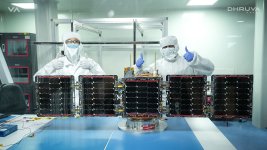
BENGALURU: In a first, a private consortium from India will design, build and operate and Earth Observation (EO) satellite network comprising 12 satellites under a public–private partnership PPP model.

More than a year after it first issued an expression of interest for the same, India’s space regulator-cum-promoter Indian National Space Promotion and Authorisation Centre (IN-SPACe), Tuesday selected a consortium comprising Pixxel Space, Piersight Space, Satsure Analytics India, and Dhruva Space to operate the country’s first EO Satellite System (EOSS) under PPP.

Over the next four to five years, the consortium is expected to invest more than Rs 1,200 crore to create a constellation of 12 satellites in low-Earth orbit. The project is designed to enhance India’s data sovereignty and reduce dependence on foreign imagery. All satellites will be manufactured in India, launched on Indian rockets, and controlled from ground infrastructure within the country.IN-SPACe described the programme as a paradigm shift in India’s space policy – one that places private enterprise at the heart of building national capability.

“Each satellite will carry a mix of panchromatic, multispectral, hyperspectral, and microwave sensors, capable of delivering high-resolution, analysis-ready geospatial data for both national and global users,” IN-SPACe said.

The data will be used for applications ranging from climate change monitoring and disaster response to agriculture, infrastructure planning, maritime operations, and national security. In addition to meeting India’s own needs, the consortium will be free to sell analysis-ready data and value-added services commercially.

The selection process began with an expression of interest that drew responses from 20 firms, eventually narrowing to four techno-commercial bids. After a detailed evaluation, three consortia — Astra Microwave with Bharat Electronics Ltd (BEL), Sisir Radar & Spectragaze Systems; GalaxEye Space with CoreEL, and PixxelSpace with Piersight Space, Satsure Analytics India, and Dhruva Space — qualified technically.

The PixxelSpace, Piersight Space, Satsure Analytics India, and Dhruva Space consortium emerged as the final choice. Under the PPP model, the govt will provide financial and technical support, but the majority of funding will come from the private side — a deliberate move to ensure operational independence and commercial viability.

IN-SPACe chairman Pawan Goenka said: “This initiative signals the coming of age of India’s private space industry in the space sector.”

“...It demonstrates the capability and confidence of Indian companies to lead large-scale, technologically advanced, and commercially viable space missions that serve both national and global markets. The EO-PPP model fosters an ecosystem where public and private capabilities reinforce each other to drive growth, innovation, and self-reliance,” he added.

The constellation is expected to be fully deployed in four years, with satellites launched in phases to progressively expand coverage.
 

Pixxel, PierSight, Satsure & Dhruva to build India’s first PPP-led EO network of 12 satellites


BENGALURU: In a first, a private consortium from India will design, build and operate and Earth Observation (EO) satellite network comprising 12 satellites under a public–private partnership PPP model.

More than a year after it first issued an expression of interest for the same, India’s space regulator-cum-promoter Indian National Space Promotion and Authorisation Centre (IN-SPACe), Tuesday selected a consortium comprising Pixxel Space, Piersight Space, Satsure Analytics India, and Dhruva Space to operate the country’s first EO Satellite System (EOSS) under PPP.

Over the next four to five years, the consortium is expected to invest more than Rs 1,200 crore to create a constellation of 12 satellites in low-Earth orbit. The project is designed to enhance India’s data sovereignty and reduce dependence on foreign imagery. All satellites will be manufactured in India, launched on Indian rockets, and controlled from ground infrastructure within the country.IN-SPACe described the programme as a paradigm shift in India’s space policy – one that places private enterprise at the heart of building national capability.

“Each satellite will carry a mix of panchromatic, multispectral, hyperspectral, and microwave sensors, capable of delivering high-resolution, analysis-ready geospatial data for both national and global users,” IN-SPACe said.

The data will be used for applications ranging from climate change monitoring and disaster response to agriculture, infrastructure planning, maritime operations, and national security. In addition to meeting India’s own needs, the consortium will be free to sell analysis-ready data and value-added services commercially.

The selection process began with an expression of interest that drew responses from 20 firms, eventually narrowing to four techno-commercial bids. After a detailed evaluation, three consortia — Astra Microwave with Bharat Electronics Ltd (BEL), Sisir Radar & Spectragaze Systems; GalaxEye Space with CoreEL, and PixxelSpace with Piersight Space, Satsure Analytics India, and Dhruva Space — qualified technically.

The PixxelSpace, Piersight Space, Satsure Analytics India, and Dhruva Space consortium emerged as the final choice. Under the PPP model, the govt will provide financial and technical support, but the majority of funding will come from the private side — a deliberate move to ensure operational independence and commercial viability.

IN-SPACe chairman Pawan Goenka said: “This initiative signals the coming of age of India’s private space industry in the space sector.”

“...It demonstrates the capability and confidence of Indian companies to lead large-scale, technologically advanced, and commercially viable space missions that serve both national and global markets. The EO-PPP model fosters an ecosystem where public and private capabilities reinforce each other to drive growth, innovation, and self-reliance,” he added.

The constellation is expected to be fully deployed in four years, with satellites launched in phases to progressively expand coverage.
If these satellites can provide the Maxar type of high-resolution imagery solution, it will be wonderful.
 
Last edited:

Pixxel, PierSight, Satsure & Dhruva to build India’s first PPP-led EO network of 12 satellites


BENGALURU: In a first, a private consortium from India will design, build and operate and Earth Observation (EO) satellite network comprising 12 satellites under a public–private partnership PPP model.

More than a year after it first issued an expression of interest for the same, India’s space regulator-cum-promoter Indian National Space Promotion and Authorisation Centre (IN-SPACe), Tuesday selected a consortium comprising Pixxel Space, Piersight Space, Satsure Analytics India, and Dhruva Space to operate the country’s first EO Satellite System (EOSS) under PPP.

Over the next four to five years, the consortium is expected to invest more than Rs 1,200 crore to create a constellation of 12 satellites in low-Earth orbit. The project is designed to enhance India’s data sovereignty and reduce dependence on foreign imagery. All satellites will be manufactured in India, launched on Indian rockets, and controlled from ground infrastructure within the country.IN-SPACe described the programme as a paradigm shift in India’s space policy – one that places private enterprise at the heart of building national capability.

“Each satellite will carry a mix of panchromatic, multispectral, hyperspectral, and microwave sensors, capable of delivering high-resolution, analysis-ready geospatial data for both national and global users,” IN-SPACe said.

The data will be used for applications ranging from climate change monitoring and disaster response to agriculture, infrastructure planning, maritime operations, and national security. In addition to meeting India’s own needs, the consortium will be free to sell analysis-ready data and value-added services commercially.

The selection process began with an expression of interest that drew responses from 20 firms, eventually narrowing to four techno-commercial bids. After a detailed evaluation, three consortia — Astra Microwave with Bharat Electronics Ltd (BEL), Sisir Radar & Spectragaze Systems; GalaxEye Space with CoreEL, and PixxelSpace with Piersight Space, Satsure Analytics India, and Dhruva Space — qualified technically.

The PixxelSpace, Piersight Space, Satsure Analytics India, and Dhruva Space consortium emerged as the final choice. Under the PPP model, the govt will provide financial and technical support, but the majority of funding will come from the private side — a deliberate move to ensure operational independence and commercial viability.

IN-SPACe chairman Pawan Goenka said: “This initiative signals the coming of age of India’s private space industry in the space sector.”

“...It demonstrates the capability and confidence of Indian companies to lead large-scale, technologically advanced, and commercially viable space missions that serve both national and global markets. The EO-PPP model fosters an ecosystem where public and private capabilities reinforce each other to drive growth, innovation, and self-reliance,” he added.

The constellation is expected to be fully deployed in four years, with satellites launched in phases to progressively expand coverage.
Pixxel - 5 VHR , 2 hyperspectral satellite
Satsure - 2 multispectral satellite
PierSight - 2 SAR satellite


Gy9PKPkWYAAEp9_.jpeg

Indian Startup Plans to Build Ultra-Low Orbit Satellite

The spacecraft could support high-resolution imaging and 6G networks

By Edd Gent
03 Oct 2024
less-than-p-greater-than-bellatrix-aerospaces-new-ultra-low-earth-orbit-satellite-will-be-pow...webp
Bellatrix Aerospace's new ultra-low Earth orbit satellite will be powered by a novel air-based electric propulsion system. Bellatrix Aerospace.

Satellites with extremely low orbits could lower launch costs and improve sensing and communication capabilities. Indian start-up Bellatrix Aerospace has unveiled plans for a spacecraft that will orbit at altitudes below 200 kilometers, and the company says it aims to launch its first satellite by 2026.

Anything below 1,200 kilometers is considered a low Earth orbit (LEO), but satellites that can fly even closer to Earth’s surface have a host of benefits, says Rohan Ganapathy, CEO of Bengaluru-based Bellatrix. For starters, ultra-LEO satellites can achieve comparatively higher resolution imaging for Earth observation applications such as climate modeling, agriculture, and mapping. Low orbits also reduce the latency of communication with ground stations, which Ganapathy says could make them attractive for supporting 6G telecom networks.

At these altitudes, satellites also experience significant atmospheric drag. So their orbits are “self-cleaning,” meaning they rapidly fall back to Earth at the end of their lifetimes, reducing the problem of space debris. On the other hand, keeping ultra-LEO satellites aloft is much harder than conventional satellites. Fighting drag entails carrying large amounts of propellant to power the spacecraft’s engines, which can increase the bulk and weight of the vehicle and can seriously limit how long they can operate.

Air-Breathing Propulsion—in Space

Bellatrix says they have resolved this challenge by developing a novel air-intake electric propulsion system, which collects air particles from the upper atmosphere and uses them as propellant. The company recently displayed the technology at the Space Expo 2024 in Bengaluru following successful ground testing. “It’s like an airplane with an unlimited supply of fuel, you can sustain as long as you want,” says Ganapathy. “This is going to open up a lot of new opportunities, especially for 6G, Internet of Things and hyperspectral imaging.”

Bellatrix, founded in 2015, specializes in developing propulsion systems for satellites and earlier this year completed space qualification of two of its engines. The Arka 200 is a Hall-effect thruster, which uses electric fields to turn a propellant into an ionized plasma before accelerating it to provide thrust. And the company’s Rudra engine replaces the toxic hydrazine normally used in satellite propulsion systems with a proprietary, environmentally friendly propellant.

But Ganapathy says the company’s long-term goal has always been to develop an ultra-low-earth orbit satellite, and they’ve been working on this project since the company’s inception. “We wanted to do satellites from before we were building engines,” he says. “But we didn’t want to enter an already crowded segment where there are a lot of players building satellites for higher altitudes.”

The vehicle the company is developing will be roughly 2 meters long and can carry a payload of between 50 and 70 kilograms. It will produce more than 1 kilowatt of power from a solar panel array and is designed to operate between 180 km and 200 km. Flying at such low orbits requires the resolution of two interrelated challenges, though, says Ganapathy–how to use air as a propellant and how to gather enough of it in the rarefied atmosphere found at those altitudes.

Hall thrusters normally use gases like xenon as a propellant, because it’s easy to ionize as well as chemically inert and capable of being stored at high densities and pressures. By contrast, using nitrogen and oxygen in air as propellant requires significantly more energy to ionize into a plasma than xenon. So, Ganapathy says, the company has created a hybrid engine that uses radio waves to ionize the gas before a Hall-effect thruster accelerates it.

The Innovations Required for Air Propulsion

Collecting—and then compressing and storing—substantial enough amounts of nitrogen and oxygen propellant from the upper atmosphere required some innovations, Ganapathy says. Collecting more nitrogen and oxygen generally means increasing the size of the intake on the satellite. But a larger intake also increases the satellite’s drag, and higher drag adds to satellite’s overall fuel requirements. So the company had to carefully optimize the size and shape of the satellite and its intake to balance these competing tensions.

Although Ganapathy says the company’s exact resolution of the optimization problem is a trade secret, he did note that part of the secret was using a combination of passive and active compression.

The company has carried out ground tests of the engine, demonstrating that it can efficiently ionize air and provide sufficient thrust for a satellite in orbit. But testing the compression system is more complicated, says Ganapathy, due to the scarcity of data on the density of the upper atmosphere.

So, next year, the company is planning a demonstration mission with a scaled-down version of their satellite. As well as testing out a prototype of the engine and compression system, the mission will carry various probes to collect data on the atmospheric conditions at 200 km. The company is also building a dedicated testing facility that will simulate particles flying into the intake at orbital velocities, which Ganapathy says will be crucial for validating their simulations.

While the engine is validated, there is still work to be done on the spacecraft itself. One of the main outstanding challenges is developing an inertial navigation system capable of dealing with the increased jitter caused by atmospheric drag—a particular concern for imaging applications. “You want the satellite to be as stable as possible, so it poses a lot of challenges on your guidance, navigation and control system” to accomplish that, says Ganapathy.

Bellatrix is aiming for a full-scale demonstration in 2026, the CEO says, but it isn’t the only company targeting this emerging segment in the space industry. Florida-based Redwire Space, California-based Skeyeon, and New Orbit in the UK are all actively developing satellites that also aim to operate at very low orbits.

Indian Startup Developing Ultra-Low Orbit Satellite
 

View attachment 46078

Indian Startup Plans to Build Ultra-Low Orbit Satellite

The spacecraft could support high-resolution imaging and 6G networks

By Edd Gent
03 Oct 2024
View attachment 46079
Bellatrix Aerospace's new ultra-low Earth orbit satellite will be powered by a novel air-based electric propulsion system. Bellatrix Aerospace.

Satellites with extremely low orbits could lower launch costs and improve sensing and communication capabilities. Indian start-up Bellatrix Aerospace has unveiled plans for a spacecraft that will orbit at altitudes below 200 kilometers, and the company says it aims to launch its first satellite by 2026.

Anything below 1,200 kilometers is considered a low Earth orbit (LEO), but satellites that can fly even closer to Earth’s surface have a host of benefits, says Rohan Ganapathy, CEO of Bengaluru-based Bellatrix. For starters, ultra-LEO satellites can achieve comparatively higher resolution imaging for Earth observation applications such as climate modeling, agriculture, and mapping. Low orbits also reduce the latency of communication with ground stations, which Ganapathy says could make them attractive for supporting 6G telecom networks.

At these altitudes, satellites also experience significant atmospheric drag. So their orbits are “self-cleaning,” meaning they rapidly fall back to Earth at the end of their lifetimes, reducing the problem of space debris. On the other hand, keeping ultra-LEO satellites aloft is much harder than conventional satellites. Fighting drag entails carrying large amounts of propellant to power the spacecraft’s engines, which can increase the bulk and weight of the vehicle and can seriously limit how long they can operate.

Air-Breathing Propulsion—in Space

Bellatrix says they have resolved this challenge by developing a novel air-intake electric propulsion system, which collects air particles from the upper atmosphere and uses them as propellant. The company recently displayed the technology at the Space Expo 2024 in Bengaluru following successful ground testing. “It’s like an airplane with an unlimited supply of fuel, you can sustain as long as you want,” says Ganapathy. “This is going to open up a lot of new opportunities, especially for 6G, Internet of Things and hyperspectral imaging.”

Bellatrix, founded in 2015, specializes in developing propulsion systems for satellites and earlier this year completed space qualification of two of its engines. The Arka 200 is a Hall-effect thruster, which uses electric fields to turn a propellant into an ionized plasma before accelerating it to provide thrust. And the company’s Rudra engine replaces the toxic hydrazine normally used in satellite propulsion systems with a proprietary, environmentally friendly propellant.

But Ganapathy says the company’s long-term goal has always been to develop an ultra-low-earth orbit satellite, and they’ve been working on this project since the company’s inception. “We wanted to do satellites from before we were building engines,” he says. “But we didn’t want to enter an already crowded segment where there are a lot of players building satellites for higher altitudes.”

The vehicle the company is developing will be roughly 2 meters long and can carry a payload of between 50 and 70 kilograms. It will produce more than 1 kilowatt of power from a solar panel array and is designed to operate between 180 km and 200 km. Flying at such low orbits requires the resolution of two interrelated challenges, though, says Ganapathy–how to use air as a propellant and how to gather enough of it in the rarefied atmosphere found at those altitudes.

Hall thrusters normally use gases like xenon as a propellant, because it’s easy to ionize as well as chemically inert and capable of being stored at high densities and pressures. By contrast, using nitrogen and oxygen in air as propellant requires significantly more energy to ionize into a plasma than xenon. So, Ganapathy says, the company has created a hybrid engine that uses radio waves to ionize the gas before a Hall-effect thruster accelerates it.

The Innovations Required for Air Propulsion

Collecting—and then compressing and storing—substantial enough amounts of nitrogen and oxygen propellant from the upper atmosphere required some innovations, Ganapathy says. Collecting more nitrogen and oxygen generally means increasing the size of the intake on the satellite. But a larger intake also increases the satellite’s drag, and higher drag adds to satellite’s overall fuel requirements. So the company had to carefully optimize the size and shape of the satellite and its intake to balance these competing tensions.

Although Ganapathy says the company’s exact resolution of the optimization problem is a trade secret, he did note that part of the secret was using a combination of passive and active compression.

The company has carried out ground tests of the engine, demonstrating that it can efficiently ionize air and provide sufficient thrust for a satellite in orbit. But testing the compression system is more complicated, says Ganapathy, due to the scarcity of data on the density of the upper atmosphere.

So, next year, the company is planning a demonstration mission with a scaled-down version of their satellite. As well as testing out a prototype of the engine and compression system, the mission will carry various probes to collect data on the atmospheric conditions at 200 km. The company is also building a dedicated testing facility that will simulate particles flying into the intake at orbital velocities, which Ganapathy says will be crucial for validating their simulations.

While the engine is validated, there is still work to be done on the spacecraft itself. One of the main outstanding challenges is developing an inertial navigation system capable of dealing with the increased jitter caused by atmospheric drag—a particular concern for imaging applications. “You want the satellite to be as stable as possible, so it poses a lot of challenges on your guidance, navigation and control system” to accomplish that, says Ganapathy.

Bellatrix is aiming for a full-scale demonstration in 2026, the CEO says, but it isn’t the only company targeting this emerging segment in the space industry. Florida-based Redwire Space, California-based Skeyeon, and New Orbit in the UK are all actively developing satellites that also aim to operate at very low orbits.

Indian Startup Developing Ultra-Low Orbit Satellite
Could this be an alternative to HAPS, esp if deployed in swarm mode?
 
Looks like Agnikul is finally ready for its suborbital test flight:


Integration check started on 15th August. It should be launch ready with in a week or so. We are probably going to see a launch by next week, if weather permits.
View attachment 29830
View attachment 29831
View attachment 29832
View attachment 29833

6 months back they posted a video of the 6kN KEROLOX engine that will power this rocket:


This engine is a scaled down version of their 20-25kN electric pump-fed Agnilet engine. Their full-scale orbital rocket Agnibaan's 1st stage will be powered by a clustered stage of 7 of the 20-25kN Agnilet engines.

This sub-orbital flight would be the 1st flight of an Indian kerolox engine. ISRO doesn't have any KEROLOX engine in use yet.

It should be noted that Agnikul's competitor Skyroot has already completed the sub-orbital flight test of their Vikram-S rocket some 8 months ago.


Skyroot is now in the process of building their 1st commercial grade orbital satellite launcher called Vikram 1. Vikram 1 is currently at an advanced stage of manufacturing & testing.
Agnilet engine being tested:

1755954249635.png

Could this be an alternative to HAPS, esp if deployed in swarm mode?
Both have different use cases. HAPS provides 24x7 persistent surveillance of a target for months. HAPS provides very high dwell time on target but has limited range. HAPS can only be used to keep an eye on the near neighborhood.

Whereas as a low altitude satellite offers a very small dwell time of target (a few minutes) with multiple revisitations daily. But the range of this system would be global. These satellites would also be quite a bit more expensive than HAPS.

Ideally, we would need both. HAPS for regional surveillance & satellite swarms for global surveillance.
 
  • Like
Reactions: Speedster1
Indian startup conducts drop test on capsule designed to bring cargo from space

The REX capsule is being developed as an orbital re-entry system, purpose-built to carry customer payloads in orbit and ensure their safe recovery on the planet's surface.

India Today Science Desk
New Delhi, UPDATED: Sep 2, 2025, 13:41 IST
1756835456698.png
Catalyx Space dropped the capsule from an altitude of 14,000 ft. (Photo: X/@riftron_)

Indian space startup Catalyx Space has successfully conducted the second drop test of its innovative REX capsule, a step forward in India's quest for affordable, reliable solutions to transport cargo from space back to Earth.

The REX capsule is being developed as an orbital re-entry system, purpose-built to carry customer payloads in orbit and ensure their safe recovery on the planet’s surface.

For this critical test, Catalyx Space dropped the capsule from an altitude of 14,000 ft (about 4,270 meters) to evaluate the parachute recovery system’s effectiveness.


The capsule, measuring 0.5 meters in diameter with a blunt body design, is engineered to fly with an ablative thermal protection system (TPS) capable of surviving the extreme heat of atmospheric re-entry.

This mission focused specifically on validating the Recovery and Entry-Descent-Landing (EDL) subsystems under real-world conditions.

Testing for the Toughest Scenarios

In a bid to simulate worst-case scenarios, engineers intentionally made the capsule unstable to observe drogue chute deployment and apex separation when conventional dynamics don’t apply.

As part of the test protocol, Catalyx strapped the full EDL system to a skydiver for preliminary trials, demonstrating that the capsule’s onboard computer (OBC), sensors, and real-time communications can function as planned even under highly dynamic circumstances.

Catalyx Space aims to democratise access to low-cost orbital returns for scientific, commercial, and technology payloads, giving experiments and hardware an alternative to expensive, large satellites or the limited pathways to established orbital stations.

The startup has also set up a satellite manufacturing unit in Gujarat to ramp up deployment and serve a global customer base.

The successful second drop test marks a significant milestone in maturing India’s in-space infrastructure and cargo recovery capabilities.

Catalyx Space, which recently shifted its base to Ahmedabad, now plans an orbital demonstration mission, moving closer to making reliable cargo return from space as routine as deploying “apps in the cloud” for a new generation of users and innovators.

Indian startup conducts drop test on capsule designed to bring cargo from space
 
Indian startup conducts drop test on capsule designed to bring cargo from space

The REX capsule is being developed as an orbital re-entry system, purpose-built to carry customer payloads in orbit and ensure their safe recovery on the planet's surface.

India Today Science Desk
New Delhi, UPDATED: Sep 2, 2025, 13:41 IST
View attachment 46263
Catalyx Space dropped the capsule from an altitude of 14,000 ft. (Photo: X/@riftron_)

Indian space startup Catalyx Space has successfully conducted the second drop test of its innovative REX capsule, a step forward in India's quest for affordable, reliable solutions to transport cargo from space back to Earth.

The REX capsule is being developed as an orbital re-entry system, purpose-built to carry customer payloads in orbit and ensure their safe recovery on the planet’s surface.

For this critical test, Catalyx Space dropped the capsule from an altitude of 14,000 ft (about 4,270 meters) to evaluate the parachute recovery system’s effectiveness.


The capsule, measuring 0.5 meters in diameter with a blunt body design, is engineered to fly with an ablative thermal protection system (TPS) capable of surviving the extreme heat of atmospheric re-entry.

This mission focused specifically on validating the Recovery and Entry-Descent-Landing (EDL) subsystems under real-world conditions.

Testing for the Toughest Scenarios

In a bid to simulate worst-case scenarios, engineers intentionally made the capsule unstable to observe drogue chute deployment and apex separation when conventional dynamics don’t apply.

As part of the test protocol, Catalyx strapped the full EDL system to a skydiver for preliminary trials, demonstrating that the capsule’s onboard computer (OBC), sensors, and real-time communications can function as planned even under highly dynamic circumstances.

Catalyx Space aims to democratise access to low-cost orbital returns for scientific, commercial, and technology payloads, giving experiments and hardware an alternative to expensive, large satellites or the limited pathways to established orbital stations.

The startup has also set up a satellite manufacturing unit in Gujarat to ramp up deployment and serve a global customer base.

The successful second drop test marks a significant milestone in maturing India’s in-space infrastructure and cargo recovery capabilities.

Catalyx Space, which recently shifted its base to Ahmedabad, now plans an orbital demonstration mission, moving closer to making reliable cargo return from space as routine as deploying “apps in the cloud” for a new generation of users and innovators.

Indian startup conducts drop test on capsule designed to bring cargo from space
Love this energy in Indian space startups!! That's what a successful ISRO means. A torchbearer with govt acting as a catalyst for nurturing dreams through schemes.

ISRO is under PMO too. If other agencies like DRDO or PSUs were like this.. startups would've been more open to participate but DRDO has rusted itself in politics and give n take mechanism with big industry people.
Seldom promoting startups for research.
 
ASTROPHEL AEROSPACE, another Indian space start up, have recently tested their 2.8kN "Potentia" semi-cryogenic engine:


The engine is a pressure fed & uses LOX/Ethanol propellant. The engine can produce up to 5kN with a full-size C/D nozzle. They are currently getting a sea-level specific impulse of 285 sec.

Indian Rocket Startup Astrophel Aerospace Successfully Test Fires Prototype Cryogenic Engine

Pune-based rocket startup, Astrophel Aerospace has successfully tested its prototype cryogenic engine, said one of the founders.

IANS | Aug 17, 2023 05:44 PM IST
View attachment 29845

Chennai, Aug 17: Pune-based rocket startup, Astrophel Aerospace has successfully tested its prototype cryogenic engine, said one of the founders. “The prototype Potentia C1 cryogenic engine was test fired on August 14. The firing was a success as the engine achieved all the parameters,” Co-Founder and COO, Immanuel Louis told IANS.

The engine was fuelled by a mix of ethanol and liquid oxygen and was fired for eight seconds and achieved a thrust of 2.8kN, he said. Astrophel Aerospace is promoted by three young persons -- Suyash Bafna, Founder and CEO, Taj Baba, Co-Founder and CTO and Louis.

Bootstrapped or running their startup with their own funds, the 'Amar, Akbar, Anthony' of the Indian space sector had earlier told IANS that they would first test the rocket’s cryogenic engine and then approach the investors for funds.

The company is planning to build a three staged rocket with a carrying capacity of about 200kg for low earth orbit, Louis said. According to Louis, their Astra series rocket can even have all the stages powered by cryogenic engines or a mix of liquid and solid powered engines.

He said the company would be needing about $1.5 – 2 million to increase its headcount and also improve the testing facilities. “We will first test our rocket with a sub-orbital launch and then go for a full-fledged launch three years from now,” Louis remarked.

Indian Rocket Startup Astrophel Aerospace Successfully Test Fires Prototype Cryogenic Engine | 📝 LatestLY

Few months back they also conducted a cryogenic cold flow test of the same engine:


They are developing these engines to use in their 2-stage small satellite launcher named "ASTRA".
View attachment 29846
This launcher will be capable of launching 300kg to LEO. That would make it a direct competitor of the Skyroot's Vikram 1 launcher & the ISRO's SSLV.

The ASTRA launcher would use the same engine on both the stages. The 9 units of the Potentia C-1 METHALOX engine are going to power the 1st stage. Each engine would produce a sea-level thrust of 24kN with a sea-level Isp of 300 sec. The 9 engines combined would produce 200kN of lift-off thrust.
View attachment 29847
The 2nd stage will have 1 vacuum optimized Potentia C-1 engine with peak thrust of 25kN & vacuum Isp of 330 sec.
View attachment 29848
The last kick stage will have some hypergolic reaction control thrusters:
View attachment 29849
We don't know if the engine is going to be throttleable or if the launcher is planned to be partially re-usable. Given it's their 1st engine & 1st launcher the answer is probably no.

Small satellite launch market is going to have a lot of new players in a decade or so.


1757534224986.png