People's Liberation Army Air Force : News & Discussions

It's from Feb 2020, it's been more than 5 years since then.
5 years 4 months 11 days to be exact.
There's no prototype of anti awacs varient brahmos.
Safe to say it's not in works anymore.
It's the same as brahmos 2 they show every year.

There's still time for the vanilla Brahmos M. 2026 test flight. Future variants will depend on the success of the original.
 
It's from Feb 2020, it's been more than 5 years since then.
5 years 4 months 11 days to be exact.
There's no prototype of anti awacs varient brahmos.
Safe to say it's not in works anymore.
It's the same as brahmos 2 they show every year.
We're probably looking at a modification of the Brahmos NG for the AAM role once it passes initial tests for validation of technology.

It's an old proposal by BAPL to the IAF from 2017-18 if I'm not mistaken .

Wonder when are we going to focus on Hypersonic tech for AAM & SAM . That's the next frontier. Whoever gets a Hypersonic AAM for a distance of 800-1000 kms with guidance from space based ISR assets travelling at speeds between Mach 8-10 will have a winner.

Then all these lumbering 5th Gen > FAs will think ten times before being air borne. Funny when you think of it - while speed was one of the most important & sought after design characteristics of a FA which is the reason the MiG-21 was prized by the late1970s top speed was no longer a huge differentiator & now the top speed of FAs is < Mach 2 or Mach 1.8 in many cases.

6th Gen FAs are going back to the 1960s model of emphasis on top speed with reported design speeds of NGAD & J-36 being in the vicinity of Mach 3. Still not enough for a Hypersonic AAM travelling at Mach 8 able to take out a target at 800 kms . It's the same way anti tank warfare has outpaced development of defences in tanks leading to speculation in the Ukraine war of tanks being obsolete or an avoidable necessity in the absence of any suitable alternative . Why do you think so ?
 
Chinese Rainbow series of drones

https://www.janes.com/images/default-source/news-images/bsp_90707-jdw-31851.jpeg?sfvrsn=a06116c8_2
 

China’s J-35 Naval Stealth Fighter Looks Set For Service​

There are signs that the J-35 has now entered limited series production, with carrier trials the likely next step.
Thomas Newdick | Jul 19, 2025 3:03 PM EDT​


new photo suggests that China’s Shenyang J-35, its next-generation carrier-based fighter, may now have entered limited series production and could possibly be in service with the People’s Liberation Army Navy (PLAN). The photo joins a succession of imagery showing some of China’s latest military aircraft in great detail, including previous views of the same type of jet, although still in prototype form, as you can see in our previous coverage here.


The new photo, which seems to have originally been posted on the Chinese Weibo microblogging website, is an air-to-air study of two J-35s in close formation. It appears to be an official PLAN release, and the fact that it includes aircraft construction numbers — 0011 and 0012 — strongly suggests that these are low-rate initial production (LRIP) aircraft. At the same time, we cannot totally rule out a disinformation effort, with LRIP-conforming numbers applied to existing prototype aircraft, for example.

cn-numbers.png

A close-up view of the construction numbers, apparently 0011 and 0012.
via X

At the same time, the J-35s wear prominent new shark markings, as well as national insignia, on their tailfins, which might point to them being in service with the PLAN. Another shark motif appears on the tail fins of the J-15 carrier-based fighters that the PLAN also operates.

shark.jpg

The shark motif that appears on the tail fin of the J-35. via X


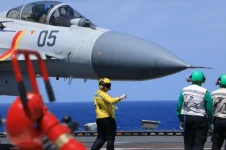
This picture taken on an undisclosed date in December 2016 shows a Chinese J-15 fighter jet preparing to take off from the deck of the Liaoning aircraft carrier during military drills in the Bohai Sea, off China's northeast coast. China's Liaoning aircraft carrier battle group has conducted its first exercises with live ammunition, the country's navy said, in a show of strength as tensions with the US and Taiwan escalate. China's first and only aircraft carrier led large-scale exercises in the Bohai Sea, the People's Liberation Army Navy said late on December 15, 2016 in a statement on their website. / AFP PHOTO / STR / China OUT (Photo credit should read STR/AFP via Getty Images)
A similar shark marking on a J-15 fighter preparing to take off from the deck of the Liaoning during military drills in the Bohai Sea in 2016. STR/AFP via Getty Images

Finally, the pilots wear the bright blue helmets that have frequently been seen used by Chinese naval aviators flying the J-15 with frontline units, as seen in the photo below, aboard the carrier Liaoning during a 2021 drill in the South China Sea.

1753038720361.webpPhoto by VCG/VCG via Getty Images VCG

While we have previously gotten good air-to-air views of the J-35, the aircraft seen so far were prototypes, albeit getting increasingly closer to the likely production standard. These aircraft, in contrast, look like they are from the LRIP batch and, as such, represent the initial version of the Shenyang design that will see PLAN service, including carrier operations.


A navalized variant of the land-based FC-31, the first flying J-35 prototype appears to have made its initial flight in October 2021. The second known flying J-35 prototype was subsequently spotted in July of 2022, now sporting a low-visibility gray tactical paint scheme. There was speculation that a third was pictured in flight in September 2023, although, as we noted at the time, the quality of the imagery made it difficult to ascertain whether the aircraft was indeed a navalized J-35 or a land-based FC-31 variant. Now it appears that significantly more examples of the J-35 have been completed, perhaps including the first limited-production aircraft.

carrier-j-35.webp
One of the prototypes of the navalized derivative of the J-35, serial 3503.
Chinese Internet

TWZ spoke to Andreas Rupprecht, a Chinese aviation expert and contributor to this website, for his assessment of the new J-35 photo. He said the fact that the LRIP version of the aircraft had broken cover at this point would not necessarily be a huge surprise, especially since the production version of the J-15B fighter (an enhanced carrier-based Flanker) had also appeared out of the blue, late last year. Very quickly, almost two-dozen J-15Bs were identified as being in service. Until this point, there had been no confirmation of J-15B series production, and the same may turn out to be true of the J-15.


The appearance of the apparent LRIP J-35s also comes amid a flurry of other new developments in Chinese military aviation, including indications of the J-20S two-seat stealth fighter being in People’s Liberation Army Air Force (PLAAF) service, as well as the J-35A (the land-based version of the naval J-35).

j-35-resize.webp
Two prototype J-35s in close formation. Of these, serial 3501 is fitted with a pitot boom for flight tests, while serial 3506 appears to be something closer to a production standard, with its radome likely housing a radar.
via X

At this stage, there is still some confusion about the type of engine used by the J-35s in the new photo. What is clear, however, is that the naval J-35 and land-based J-35A appear to have different powerplants, at least at this stage. Ultimately, the advanced WS-19 was expected to power both versions, but this doesn’t seem to be the case — yet.


There are unconfirmed reports that the J-35A for the PLAAF already uses the definitive WS-19, identified by its characteristic darker exhaust nozzles. Meanwhile, the PLAN’s J-35A, which features lighter-colored nozzles, may be powered by the WS-21, which is a heavily improved version of the earlier WS-13, as found on the first prototypes. At this stage, we don’t know for sure, but there are likely to be further powerplant changes as Shenyang continues to enhance its J-35s for land-based and naval use.


Both J-35s in the photo are fitted with a ventral bolt-on Luneburg lens (radar reflector). This is often used on stealth fighters when low observability is not required, when it can pose a challenge for flying in controlled civilian airspace, or when masking the aircraft’s true signature from foreign intelligence. The naval version seems to be different from the reflectors on the land-based J-35A, which appear to be extendible and not bolted on.


Somewhat surprisingly, there are also rumors that the J-35 has already begun carrier trials from the deck of the Type 003 Fujian, a vessel that is now undergoing pre-service trials. At this point, there is no imagery to confirm this, but with the aircraft apparently now in service, such tests are likely to commence in the not-too-distant future, if they haven’t already. On the other hand, it would seem surprising if the unproven J-35 was the first fighter to be tested aboard the new carrier, rather than the long-established J-15. China has also been using land-based test sites for years to help prepare personnel for catapult-equipped carrier operations.


Perhaps we will learn more about the status of the J-35 in PLAN service in September, when the aircraft is rumored to be making its public debut in a large-scale event to mark the 80th anniversary of Japan’s defeat in World War II.


Whatever the case, there are growing signs that we will see the J-35 operating from a PLAN carrier before too long, although there is still a long way to go before the service can declare any kind of operational capability for the type. As it stands, the J-35, together with the KJ-600 carrier-based airborne early warning and control (AEW&C) aircraft, a type we have profiled in depth in the past, and likely also stealthy combat drones, looks set to provide notable new capabilities for China’s fast-developing carrier aviation branch.

==============================================================================================
Source: The War Zone

I wouldn't be surprised to see these in PAF squads in the next few years. I really would not be surprised to see over 350 of these in service across multiple services by 2030.
 
Last edited:
We're probably looking at a modification of the Brahmos NG for the AAM role once it passes initial tests for validation of technology.

It's an old proposal by BAPL to the IAF from 2017-18 if I'm not mistaken .

Wonder when are we going to focus on Hypersonic tech for AAM & SAM . That's the next frontier. Whoever gets a Hypersonic AAM for a distance of 800-1000 kms with guidance from space based ISR assets travelling at speeds between Mach 8-10 will have a winner.

Then all these lumbering 5th Gen > FAs will think ten times before being air borne. Funny when you think of it - while speed was one of the most important & sought after design characteristics of a FA which is the reason the MiG-21 was prized by the late1970s top speed was no longer a huge differentiator & now the top speed of FAs is < Mach 2 or Mach 1.8 in many cases.

6th Gen FAs are going back to the 1960s model of emphasis on top speed with reported design speeds of NGAD & J-36 being in the vicinity of Mach 3. Still not enough for a Hypersonic AAM travelling at Mach 8 able to take out a target at 800 kms . It's the same way anti tank warfare has outpaced development of defences in tanks leading to speculation in the Ukraine war of tanks being obsolete or an avoidable necessity in the absence of any suitable alternative . Why do you think so ?
Stealth does have a limit with advancement in detection capabilities. I suppose, going forward it will be a mix.
A super non stealthy FA (unmanned possibly) built for Speed+Agility+evasion to penetrate and engage AD. Drones to confuse the AD. A high sortie FA like Tejas Mk2 And small number of ultra stealthy... B-2 level stealth bomber or aircrafts for Strike capability.

Throw in EW, DEW systems, hypersonics.. and mother of all, "The AGI" and you will have fireworks and a sci fi air battles
 
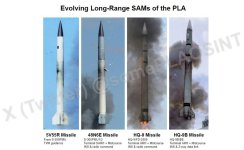
A video made by an Indian-British person, introduces the main features of HQ9/9B
This is the only blogger I have seen who figured out that HQ9 is ARH instead of SARH, and the only blogger who figured out what radar HQ9 uses.
1753012842996.jpeg
 

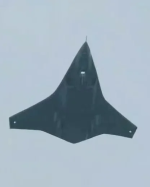
Seems like nobody saw this? Looking like China's NGAD equivalent, this is their THIRD next generation prototype!!!!

@Saaho @Ashwin @Shan @Rajput Lion @Parthu @randomradio @marich01 @_Anonymous_ @Ankit Kumar

I see no way out for the IAF frankly. Such aircraft flying at high altitude with PL17 and their powerful GaN radars will steamroll the IAF. By 2035 the Chinese can likely make the entire PLAAF fleet facing India as 5th and 6th gen while we will barely have 5-10 5th gen AMCA if all goes well. What a pathetic situation we are in. It's going to take 20 years at least for us to be survivable in the air against China imo and that's only if we are mass producing AMCA with new engine by 2040.
 
Last edited:
I see no way out for the IAF frankly. Such aircraft flying at high altitude with PL17 and their powerful GaN radars will steamroll the IAF. By 2035 the Chinese can likely make the entire PLAAF fleet facing India as 5th and 6th gen while we will barely have 5-10 5th gen AMCA if all goes well. What a pathetic situation we are in. It's going to take 20 years at least for us to be survivable in the air against China imo and that's only if we are mass producing AMCA with new engine by 2040.
The PLAAF wants to compete with US MIC. The benchmark was never the IAF. The Chinese have dedicated years to bring its forces upto par, what you see now is the result. They can churn their FAs in numbers that can change the dynamics of aerial warfare. We were asleep at the wheel. The most I can say is that hopefully sometime in the near future the MoD will stop sleeping.
 

Seems like nobody saw this? Looking like China's NGAD equivalent, this is their THIRD next generation prototype!!!!

@Saaho @Ashwin @Shan @Rajput Lion @Parthu @randomradio @marich01 @_Anonymous_ @Ankit Kumar

I see no way out for the IAF frankly. Such aircraft flying at high altitude with PL17 and their powerful GaN radars will steamroll the IAF. By 2035 the Chinese can likely make the entire PLAAF fleet facing India as 5th and 6th gen while we will barely have 5-10 5th gen AMCA if all goes well. What a pathetic situation we are in. It's going to take 20 years at least for us to be survivable in the air against China imo and that's only if we are mass producing AMCA with new engine by 2040.
We have no chance frankly, only option is investing in large number of air defence systems and surface to surface missiles. Chinese already are testing 6th gen carrier borne fighter and we barely have a 4th gen prototype and sabotaged navalised AMCA.

Their combat-UAV fleet, like GJ-11s for example will also be inducted in probably hundreds, while IAF/IN will 100% ignore Ghatak and drool for imports. Importkhors are yet to exploit what we already have but their mouthwatering for anything imported supersedes any domestic capability.
 
We have no chance frankly, only option is investing in large number of air defence systems and surface to surface missiles. Chinese already are testing 6th gen carrier borne fighter and we barely have a 4th gen prototype and sabotaged navalised AMCA.

Their combat-UAV fleet, like GJ-11s for example will also be inducted in probably hundreds, while IAF/IN will 100% ignore Ghatak and drool for imports. Importkhors are yet to exploit what we already have but their mouthwatering for anything imported supersedes any domestic capability.
Gap between China and India is generational, like how it was between China and the US in the early 2000s. If we put complete support and focus for Tejas Mk2, AMCA, Ghatak, and RPSA, then by 2040 our air power will be survivable wtr to China.
 

Seems like nobody saw this? Looking like China's NGAD equivalent, this is their THIRD next generation prototype!!!!

@Saaho @Ashwin @Shan @Rajput Lion @Parthu @randomradio @marich01 @_Anonymous_ @Ankit Kumar

I see no way out for the IAF frankly. Such aircraft flying at high altitude with PL17 and their powerful GaN radars will steamroll the IAF. By 2035 the Chinese can likely make the entire PLAAF fleet facing India as 5th and 6th gen while we will barely have 5-10 5th gen AMCA if all goes well. What a pathetic situation we are in. It's going to take 20 years at least for us to be survivable in the air against China imo and that's only if we are mass producing AMCA with new engine by 2040.
Imo, the Chinese couldn't have started working on these 6G programs all that long ago. They could be leveraging the latest digital design and engineering tech that the US DoD bosses claim can cut dev timeframes by upto 20%. China could just have had better luck than the Americans.


No reason why ADA/DRDO couldn't do the same, given the right resources.
 

Seems like nobody saw this? Looking like China's NGAD equivalent, this is their THIRD next generation prototype!!!!

@Saaho @Ashwin @Shan @Rajput Lion @Parthu @randomradio @marich01 @_Anonymous_ @Ankit Kumar

I see no way out for the IAF frankly. Such aircraft flying at high altitude with PL17 and their powerful GaN radars will steamroll the IAF. By 2035 the Chinese can likely make the entire PLAAF fleet facing India as 5th and 6th gen while we will barely have 5-10 5th gen AMCA if all goes well. What a pathetic situation we are in. It's going to take 20 years at least for us to be survivable in the air against China imo and that's only if we are mass producing AMCA with new engine by 2040.
Check out the developmental T/Ls for the J-20 . It made first flight in 2011 IIRC & got the definitive TF WS-15 somewhere around 2022-23 .

It's still not received its FOC as trials are still on. Possibly the J-20 with the WS-15 TF will be certified FOC by 2027-28. That's 17 years from FF .

While I don't expect their 6th Gen FAs to take as long how long are you prepared to give them to be operationally ready ? 10 years or 12 or more ?

China's a communist country & typical to these nations propaganda forms a very big part of their lives. You'd never find them discussing their failures in public & even then it's for an objective.

They've still not mastered the 170 KN + TF which is supposed to power their J-36 . Work on it is still on & there's zero information in the public domain about details of their existing line of TFs like the WS-10 . What's their MTBO ? What's their estimated TTSL ? Etc.

I'd recommend take note of this development , keep tabs on it & redouble your own indigenous efforts.

In any case this isn't going to be fully operationally ready before the middle of the next decade , if at all . Who knows in what shape the world will be then ?

I'm of the opinion China'd be sorted out one way or another before that time .
 
Imo, the Chinese couldn't have started working on these 6G programs all that long ago. They could be leveraging the latest digital design and engineering tech that the US DoD bosses claim can cut dev timeframes by upto 20%. China could just have had better luck than the Americans.


No reason why ADA/DRDO couldn't do the same, given the right resources.
I've been associated with development programs in a very junior capacity as part of the review team based on my job profile as a service engineer very early on in my career .

The project itself was shut down after 5 years while I was part of it in years 3 & 4 post which I quit for better prospects . It's been a topic which has fascinated me ever since.

For all the cut copy paste China follows there's literally no substitute for trying & failing for the lessons you learn then find their way into successor projects which reverse engineering doesn't lend itself to .

This isn't to say reverse engineering by itself is an easy process or there are no learnings to be had but IMO it's a very different path from straight forward R&D. The difference could possibly be explained by the analogy of counterfeit notes.

Both genuine & counterfeit notes require engraving of plates from which notes are printed. Both involve highly skilled labour. Yet both are different. You may argue the counterfeiter lacks the resources of the official engraver given the former has state support.

However even if the counterfeiter has state backing he'd find it difficult to copy the original plates exactly down to the minutest feature thus leaving his product open to detection & elimination . This is how Paxtan's nefarious attempts to sabotage the Indian economy was taken down.

This is also a function of lacking the pedigree to successfully replicate the original. Something similar is the case with China's attempts to catch up with the west . They'd discover as will the world that you cannot compress decades & centuries worth of institutional knowledge in a few years or even a couple of decades.

There's always some kink or design flaw which will prove to be fatal to the product & God forbid if you're exposed at an inopportune time like a war you must win as the Japanese discovered with their Mitsubishi Zero Carrier based Fighter Aircrafts or PLAN will discover with the armada of Aircraft Carriers they're building.

Construction is one thing , maintaining it & more importantly running the entire unit professionally especially in wartime when you're up against a foe with nearly a century of experience in this domain is something else.
 
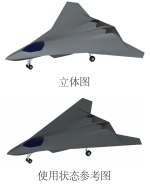
Earlier J-50 was speculated to have rotating rudder but it didn't turn out that way.

Now with this new 3rd jet it is speculated to have variable geometry wing. If true then it leaves very less area for control surfaces, only ailerons, no flaps.

1754593734747.png


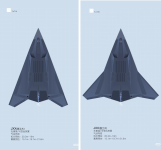
Some diagrams are also being made around guesses.

1754593746357.png
1754593761049.png

If this is for Navy then such high sweep body may need canards for low speed approach.

On belly there seems to be 6 panels to be part of IWB door, probably for BVRAAMs.
And then 5 shorter panels behind, probably for CCMs.
It is unclear how would they open -
- individually
- 1:1
- 2:1 bi-fold
With this design how will it carry longer weapons like PL-17 AAM & AGMs?
 

China also highlighted its expanding naval aviation with four carrier-based fighters, including the stealthy J-35 and the electronic warfare-capable J-15DT. State media said these aircraft mark a transition from “near-sea defence to far-sea defence.”

Supporting platforms included the KJ-500A airborne early warning aircraft and the carrier-based KJ-600, designed for the PLA Navy’s new Type 003 Fujian carrier. The twin-seat J-20S stealth fighter also appeared, touted for its potential role in controlling combat drones.

Meanwhile, the H-6J long-range bomber, fitted with YJ-12 anti-ship missiles, reinforced China’s emphasis on maritime strike capability.