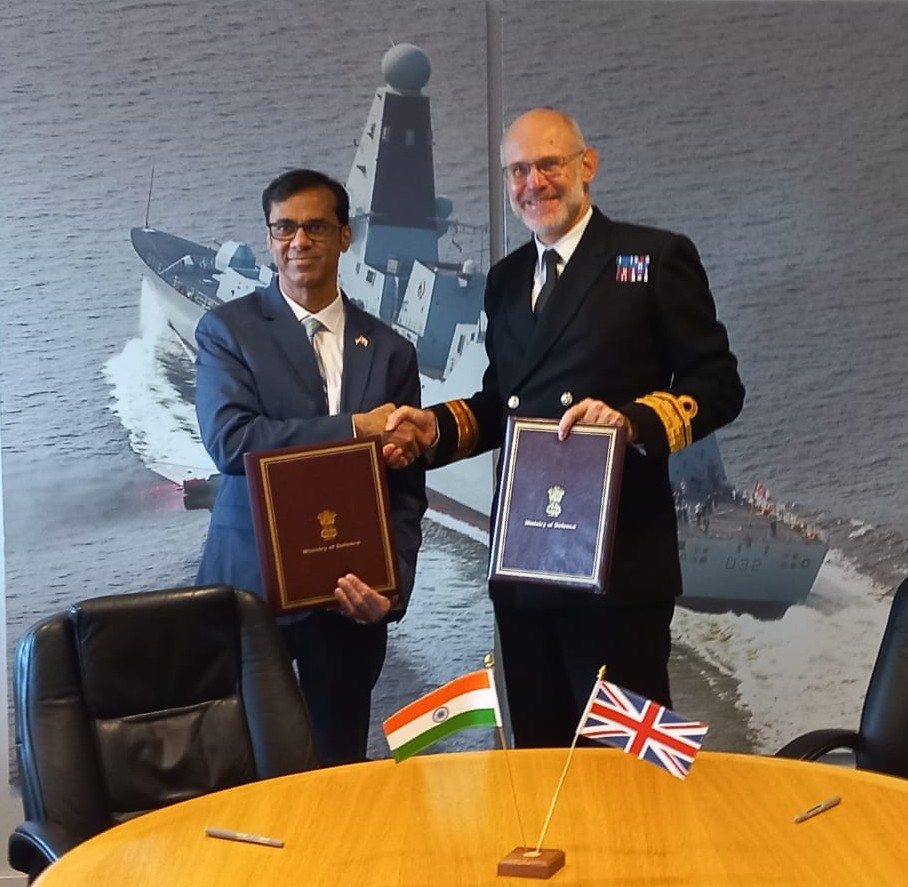
India-UK to work jointly in jet engine development
Post-Brexit, India and the UK are exploring several options for jointly collaborating in defence projects and will soon finalise a government to government format for future defence deals. According to the UK Minister for Defence Procurement James Heappey, “Soon there will be a government to government agreement related to collaboration in developing a jet engine.” Without elaborating further the visiting minister indicated that the announcement will come soon.
Since India prefers a government to government route, the two sides are keen to have the framework for future defence deals soon as the jet engine agreement is expected soon.
The visiting minister also offered joint technology development for the sixth generation fighter aircraft and the same could be used in India’s Advanced Medium Combat Aircraft (AMCA).
Both India and the UK in 2017 had agreed to cooperate in the development of advanced defence projects including the gas turbine engine and air defence missile systems. Also there is a collaborative project between engine maker Rolls Royce and Defence Research and Development Organisation on jet engine technology.
UK-INDIA sign MoU to strengthen defence collaboration
On the sidelines of the DefExpo, to forge closer defence ties between the two countries, the UK India Business Council (UKIBC) and the Society of Indian Defence Manufacturers (SIDM) signed a Memorandum of Understanding (MoU).
The MoU was signed in the presence of the UK Minister for Defence Procurement James Heappey MP, Director of the UK Department for International Trade’s Defence and Security Organisation (DSO) Mark Goldsack.
The MoU is expected to help both sides in building partnerships and capabilities in the Aerospace and Defence sector. Also support and build on the huge opportunities for collaboration that exist between the defence industries of the UK and India. Under the MoU, the collaboration will not only advance India’s defence acquisition process but also foster long-term technology and hardware transfers.
Rolls Royce in India
The British company Rolls-Royce has a strong legacy of 87 years of partnering India with strategic collaborations for technology transfer in engine programmes as well as to ‘Make in India’.
According to Kishore Jayaraman, President, Rolls-Royce India and South Asia, “Today, as India accelerates its rise as an economic and geopolitical force in the global arena, it has the width and weight to invest in co-creation and co-development programmes in strategic areas. The future will be about collaborations with willing global players to ‘Create in India’, where the country co-owns the Intellectual Property (IP).”
At the Expo the company is displaying future-ready defence and naval combat powering capabilities including the “mighty” MT30, the world’s most power-dense marine gas turbine in service today. There are solutions for both land and naval defence, and this includes the Integrated Bridge System that is an advanced marine automation system for efficient ship operation from our MTU brand.
Rolls-Royce’s MTU engines currently propel and power many Indian Coast Guard and Indian Navy vessels, as well as India’s indigenously built Arjun Main Battle Tanks.
There are more than 750 Rolls-Royce engines of 10 engine types which are powering aircraft of the Indian Armed Forces and the support is given by a dedicated Defence Service Delivery Centre, Bengaluru.
The company has a skilled talent pool of engineers at their Engineering Centres in Bengaluru and Pune, which provide engineering capability for global projects spanning research and development as well as new product design and development.
“We are also keen to support India’s goals of indigenisation and self-reliance through technology partnerships and co-development initiatives. Also to have co-creation programmes this will help in co-development of technologies in areas of strategic importance. This would help to bolster commercialisation of production in India and strengthen the ecosystem to become a global supplier and exporter of defence technologies,” said, Jayaraman.
MT30 – Powering the Future
Proven at sea, MT30 can deliver its full power of up to 40MW (depending on application) in ambient temperatures up to 38°C, without any power degradation through life of ship. And this enables the ship to operate anywhere without loss of performance or power.
EM 50-2 – Advanced Marine Automation System
The EM 50-2 is a modern integrated bridge responsible for providing access to all information that is crucial to safe and efficient ship operation, that collates information previously scattered over diverse displays at a standardized display using a single graphic interface which enables faster overview using an ultra-modern visuals concept.

 www.financialexpress.com
Post-Brexit, India and the UK are exploring several options for jointly collaborating in defence projects and will soon finalise a government to government format for future defence deals. According to the UK Minister for Defence Procurement James Heappey, “Soon there will be a government to government agreement related to collaboration in developing a jet engine.” Without elaborating further the visiting minister indicated that the announcement will come soon.
Since India prefers a government to government route, the two sides are keen to have the framework for future defence deals soon as the jet engine agreement is expected soon.
The visiting minister also offered joint technology development for the sixth generation fighter aircraft and the same could be used in India’s Advanced Medium Combat Aircraft (AMCA).
Both India and the UK in 2017 had agreed to cooperate in the development of advanced defence projects including the gas turbine engine and air defence missile systems. Also there is a collaborative project between engine maker Rolls Royce and Defence Research and Development Organisation on jet engine technology.
UK-INDIA sign MoU to strengthen defence collaboration
On the sidelines of the DefExpo, to forge closer defence ties between the two countries, the UK India Business Council (UKIBC) and the Society of Indian Defence Manufacturers (SIDM) signed a Memorandum of Understanding (MoU).
The MoU was signed in the presence of the UK Minister for Defence Procurement James Heappey MP, Director of the UK Department for International Trade’s Defence and Security Organisation (DSO) Mark Goldsack.
The MoU is expected to help both sides in building partnerships and capabilities in the Aerospace and Defence sector. Also support and build on the huge opportunities for collaboration that exist between the defence industries of the UK and India. Under the MoU, the collaboration will not only advance India’s defence acquisition process but also foster long-term technology and hardware transfers.
Rolls Royce in India
The British company Rolls-Royce has a strong legacy of 87 years of partnering India with strategic collaborations for technology transfer in engine programmes as well as to ‘Make in India’.
According to Kishore Jayaraman, President, Rolls-Royce India and South Asia, “Today, as India accelerates its rise as an economic and geopolitical force in the global arena, it has the width and weight to invest in co-creation and co-development programmes in strategic areas. The future will be about collaborations with willing global players to ‘Create in India’, where the country co-owns the Intellectual Property (IP).”
At the Expo the company is displaying future-ready defence and naval combat powering capabilities including the “mighty” MT30, the world’s most power-dense marine gas turbine in service today. There are solutions for both land and naval defence, and this includes the Integrated Bridge System that is an advanced marine automation system for efficient ship operation from our MTU brand.
Rolls-Royce’s MTU engines currently propel and power many Indian Coast Guard and Indian Navy vessels, as well as India’s indigenously built Arjun Main Battle Tanks.
There are more than 750 Rolls-Royce engines of 10 engine types which are powering aircraft of the Indian Armed Forces and the support is given by a dedicated Defence Service Delivery Centre, Bengaluru.
The company has a skilled talent pool of engineers at their Engineering Centres in Bengaluru and Pune, which provide engineering capability for global projects spanning research and development as well as new product design and development.
“We are also keen to support India’s goals of indigenisation and self-reliance through technology partnerships and co-development initiatives. Also to have co-creation programmes this will help in co-development of technologies in areas of strategic importance. This would help to bolster commercialisation of production in India and strengthen the ecosystem to become a global supplier and exporter of defence technologies,” said, Jayaraman.
MT30 – Powering the Future
Proven at sea, MT30 can deliver its full power of up to 40MW (depending on application) in ambient temperatures up to 38°C, without any power degradation through life of ship. And this enables the ship to operate anywhere without loss of performance or power.
EM 50-2 – Advanced Marine Automation System
The EM 50-2 is a modern integrated bridge responsible for providing access to all information that is crucial to safe and efficient ship operation, that collates information previously scattered over diverse displays at a standardized display using a single graphic interface which enables faster overview using an ultra-modern visuals concept.
India-UK to work jointly in jet engine development
Since India prefers a government to government route, the two sides are keen to have the framework for future defence deals soon as the jet engine agreement is expected soon.
www.financialexpress.com