

Military Mediocrity - Who Will Bell the Cat?
- Thread starter Saaho
- Start date
You are using an out of date browser. It may not display this or other websites correctly.
You should upgrade or use an alternative browser.
You should upgrade or use an alternative browser.

Let see..How much do you think we have spent on all this?
Kaveri program was worth about 650-700 million ... dollars. This is just the program cost. It ran from 1989 and is running till date. No one expects it to deliver anything.
F414 is available for 4 million a piece. Optimize it for Indian requirement, it may costs 5 million for an order of 100. 500-550 million will get you all the engines for 2 squads worth of planes. Which is what we did eventually. We bought 99 engines for 3000 carore in 2013 or so. After loss of precious time and money.
Had we delinked this engine from fighter development, you could say we would be having LCA MK2 flying right now (may be) and not with just 2 (incomplete and in-operational) squads of LCA.
I have sources that I have linked. You are the one claiming literally (like literally) without giving a single source. And I am a conspiracy theorist. Sounds about right.@Saaho
You are a perfect example of a conspiracy theorist. Literally nothing you have said is correct. Like, literally.
Last edited:
You don't need to be "richest", you need to be "rich enough" to afford wars or skirmishes. If we have economic indicator of the US when it started being a constant presence in wars, then by all means we should also follow the same path.The US was the richest country on the planet then. It was quite retarded that they waited until 1941 instead. You are confused between being rich and being relatively rich. You have to look at current wealth, not future potential wealth.
Why do we need to be "richest" to afford war? Let me put it this way. In 1940 my family could not afford to have a house in Mumbai as only the richest families in my village can afford that. Ours was not. In 2019, I have enough money to afford a house in Vancouver (far more expensive than Mumbai), then I buy a place in vancouver. My family is still not among the richest in my village. We are just rich enough.
Last edited:
No, its for land and a crucial piece of land to boot. If China captures those parts, it has a very clear path to march down to Delhi in no time. We need to stop them in those mountains.It doesn't apply in our situation. With China, we are fighting for different reasons, like prestige and influence.
Overwhelming that we cann't attack back when they shot down our mig, right?We are simply far too overwhelming on the conventional front.
Problem is we haven't seen any ONE stat or fact from you. Neither any source.Yep. Stats and numbers are useless. Fiction is real.
You don't need to be "richest", you need to be "rich enough" to afford wars or skirmishes. If we have economic indicator of the US when it started being a constant presence in wars, then by all means we should also follow the same path.
Why do we need to be "richest" to afford war? Let me put it this way. In 1940 my family could not afford to have a house in Mumbai as only the richest families in my village can afford that. Ours was not. In 2019, I have enough money to afford a house in Vancouver (far more expensive than Mumbai), then I buy a place in vancouver. My family is still not among the richest in my village. We are just rich enough.
When did I say we need to be the richest. It's you who gave the example of the richest country on the planet, and then claimed they are the ones who are poor. So you need to get your story straight there. I said war is for the rich. Huge difference.
As for "rich enough", we are still far away from that. Not even where the US was back in 1938. Even China is not there yet, based on your figure.
On a per capita economic activity basis, adjusted for inflation, we are in the same ball-park as US was in 1938. It simply means we can afford skirmishes and engage in wars. Actually in terms of revenue, we may be having a bigger pile. Because we have more people.As for "rich enough", we are still far away from that. Not even where the US was back in 1938.
I gave the example of a "rich" country in the past. When US in 1938 had a GDP comparable per capita to us right now, they were affording to go to war. Now we are at that point, thats what we should do.It's you who gave the example of the richest country
Thats the very reason we need to get rid of pakistan asap, they are leverage against us. Going by the loud mouths in govt I thought some thing concrete was happening but seems it was same old story.Do you know why Pakistan still exists today?
It's not from the lack of trying. It's because we have been stopped from doing it, on multiple occassions, by powers much stronger than us. We still do not have the ability to say no even today. The only answer is we need to increase our own strength in order to accomplish this, and we are getting there.
Then we should accept we are not good enuf to fight. No point in buying expensive weapons if all we do is sit back & do nothing. If we cannot fight chinese today we wont be able to fight chinese tmmrw. Either we should work at destabilizing china thru other means or grow at a faster pace than them which I dont see happening, which simply leaves us with status quo.I pointed this out elsewhere. What the Chinese are doing is totally pointless. As long as we are ready to go to war, say for example we decide to free Tibet, then everything the Chinese are doing today is going to be useless. Decades of salami slicing can be reversed completely in just one night.
We may decide to push back today, but have you ever considered that they may have the ability to take away Kashmir itself? What our real military capability is, only the govt knows. So you will have to trust the govt is making the right decision, applies for both past and present govts. The Chinese may only be waiting for India to attack first. The Chinese are in the process of finishing the modernisation of their entire army over the next 2 years. Which means, the forces facing us on the border are very likely to be a fully modernised force. Otoh, we have barely even begun our own modernisation. So you should also consider the worst case scenario for us, not just the best case, or what you think is good enough.

Thats the very reason we need to get rid of pakistan asap, they are leverage against us. Going by the loud mouths in govt I thought some thing concrete was happening but seems it was same old story.
Definitely. But there's quite a bit of time there.
Right now, they do not have the money to modernise, while we are modernising faster than they are. They are getting poorer instead of richer even with Chinese support. So we should do our best to make it worse for them. Eventually, in the post-2025 period, we need to start taking action, say, take away PoK first, and then work towards dismembering Pakistan before 2030.
This way, we will enter the 2030s with only 1 major enemy left. And the Chinese will be forced to deal with a country with an oversized army, which is at least 60-70% bigger than what they are currently facing on the LAC.
We need to take the time to modernise for nearly half a decade to a decade before we fight Pakistan because it's likely we may lose large parts of some of our cities and won't have enough money to modernise later on, when we have to deal with China. If we modernise, say 60-70% of our military before 2030, then that will give us 100% modernised force against China if we disband the remaining 30-40%. And as the weapons get outdated over the next decade, our economy will have made up for the losses and we can continue modernising again.
Then we should accept we are not good enuf to fight. No point in buying expensive weapons if all we do is sit back & do nothing. If we cannot fight chinese today we wont be able to fight chinese tmmrw. Either we should work at destabilizing china thru other means or grow at a faster pace than them which I dont see happening, which simply leaves us with status quo.
We have no real need to fight them right now as long as they withdraw. If they don't withdraw, then we need to restore status quo by force, but that can happen 2 or 3 years down the line, not necessarily this year. Even if a new normal is created, it can still be reversed when we are stronger. Anyway, if we stay passive this year, they will attempt something new a few years down the line, so we will get another chance then. Let's see what the govt does at that time. It doesn't appear that our border will be settled peacefully anyway, so we have to fight someday, whether we like it or not.
On a per capita economic activity basis, adjusted for inflation, we are in the same ball-park as US was in 1938. It simply means we can afford skirmishes and engage in wars. Actually in terms of revenue, we may be having a bigger pile. Because we have more people.
I gave the example of a "rich" country in the past. When US in 1938 had a GDP comparable per capita to us right now, they were affording to go to war. Now we are at that point, thats what we should do.
We are not even equal to the US in the 1920s. China is similar to the US in 1938.
Not equal to US in what? What metric are you looking at specifically?We are not even equal to the US in the 1920s. China is similar to the US in 1938.
Not equal to US in what? What metric are you looking at specifically?
Per capita income of course.
Per capita GDP PPP adjusted to inflation (in 2011 dollars) for US in 1938 was 9800 ( in 2011 constant dollars), we are now 7000 (in 2011 constant dollars). I fail to see how you consider usa in 1938 to be fully ready to fight global wars but India to be totally not ready to fight wars.Per capita income of course.
If you look at over all economy size, US in 1938 was 130 million * 9800 = 1274 billion (PPP constant dollars 2011)
India in 2020 is 7000 * 1.3 billion = 9100 billion (PPP constant dollars 2011)
Its the total size of economy that decides a country's capability to create a war machine. We are already many times bigger than USA was in 1938.
Source : Maddison Project 2018 and IMF.
Last edited:
Per capita GDP PPP adjusted to inflation (in 2011 dollars) for US in 1938 was 9800 ( in 2011 constant dollars), we are now 7000 (in 2011 constant dollars). I fail to see how you consider usa in 1938 to be fully ready to fight global wars but India to be totally not ready to fight wars.
If you look at over all economy size, US in 1938 was 130 million * 9800 = 1274 billion (PPP constant dollars 2011)
India in 2020 is 7000 * 1.3 billion = 9100 billion (PPP constant dollars 2011)
Its the total size of economy that decides a country's capability to create a war machine. We are already many times bigger than USA was in 1938.
Source : Maddison Project 2018 and IMF.
You've made two very, very significant mistakes.
You are comparing a 1938 economy with 2020 economy. Basically you are saying, India in 2020 is now as 'rich' as the US in 1938 while forgetting that the US is also now in 2020. What it really means is India today can fight World War II at the same level as the US did, when planes cost few tens of thousands of dollars and ships cost a million or two. So yeah, the India of today is definitely prepared to go back in time and whoop Hirohito's *censored* single-handedly.
Simply put $9000 in 2020 is worthless and only comparable with world powers back in 1938. Far, far from what you think is considered rich today. US was super rich with a $9000 per capita back in 1938 relative to peer countries. India is dirt poor with a $9000 per capita today relative to peer countries. I don't know how this logic escaped you.
The second mistake you made is comparing PPP figures when capital purchases have to be compared using nominal figures. Building military equipment requires resources, and resources are priced the same all over the world. Meaning, oil costs more or less the same in the US and in India regardless of PPP figures. Compare nominal, not PPP.
The India of today is more or less where the US was back between 1910 and 1920, not the 1940s. Quite literally.
*Ahem* Two words, Inflation adjustment. Besides, you are not fighting USA of 2020 or even Nazi Warmact of 1938. You are fighting Pakistan for most of your weapons practice. A country one tenth of our size. Or if you are fighting globally across the world with say "allied forces" then it will be likes of syria etc. None too strong. But it will help you to keep your powder dry and test your Generals for real aptitude for war.You are comparing a 1938 economy with 2020 economy. Basically you are saying, India in 2020 is now as 'rich' as the US in 1938 while forgetting that the US is also now in 2020. What it really means is India today can fight World War II at the same level as the US did, when planes cost few tens of thousands of dollars and ships cost a million or two. So yeah, the India of today is definitely prepared to go back in time and whoop Hirohito's *censored* single-handedly.
*Ahem* again Two words, Inflation adjustment.Simply put $9000 in 2020 is worthless and only comparable with world powers back in 1938. Far, far from what you think is considered rich today. US was super rich with a $9000 per capita back in 1938 relative to peer countries. India is dirt poor with a $9000 per capita today relative to peer countries. I don't know how this logic escaped you.
If you are comparing across countries GDP PPP is always better.The second mistake you made is comparing PPP figures when capital purchases have to be compared using nominal figures. Building military equipment requires resources, and resources are priced the same all over the world. Meaning, oil costs more or less the same in the US and in India regardless of PPP figures. Compare nominal, not PPP.
If you are comparing across time, Real GDP should be used.
Even the document from Maddison project says the same.
"
| cgdppc | Real GDP per capita in 2011US$, multiple benchmarks (suitable for cross-country income comparisons) |
Lets see some facts around where the expenses go for defence in India.
The two heads you mentioned, captial expenses and fuel expense, let see them: (Taking year 2014 because I have data for that year)
Fuel Expenses : 7000 Carore INR on petroleum products equals 1.076 billion dollars (actual crude import will be lesser because this amount includes refining cost and profit as well, which is done in India)

Defence Ministry diktat on cutting fuel use by 40% stumps armed forces
The defence ministry has asked the armed forces to reduce fuel use by 20-40% as the sharp increase in prices has upset budget calculations.
Arms Import in 2014: 3.3 billion dollars (https://data.worldbank.org/indicator/MS.MIL.MPRT.KD?locations=IN) And this was one of the higher import bill years.
Total Arms + fuel = 4.3 billion dollars.
Total defense budget of India in 2014 50.91 billion dollars (India Military Spending/Defense Budget 1960-2020)
Clearly, most of India's defence expenses go in India itself. Hence, PPP is VERY apt. Sorry dude, facts are not in your favor.
Last edited:
Facts don't support your claim dear.The India of today is more or less where the US was back between 1910 and 1920, not the 1940s. Quite literally.
BTW, May be this graph will help you understand the relative sizes of economies of the world.
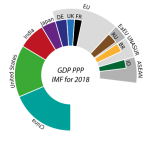
India by GDP PPP holds a decent size pie of global economy.
As we saw earlier, Defense expenses are mostly India only, PPP is a very apt metric. India accounts for 8-9% of entire world economy. If we still harp about us not being rich enough or big enough economically speaking, then we have only to blame ourselves.
India by GDP PPP holds a decent size pie of global economy.
As we saw earlier, Defense expenses are mostly India only, PPP is a very apt metric. India accounts for 8-9% of entire world economy. If we still harp about us not being rich enough or big enough economically speaking, then we have only to blame ourselves.
@randomradio
Here is another source telling where our expenses go as far as defence go :
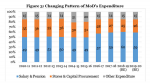
Source : India’s Defence Budget 2020-21 | Manohar Parrikar Institute for Defence Studies and Analyses
A whooping 60% is PURELY Salary and pensions. Only 1/4th is actual capital expenses. Out of which, majority is still be resources acquired from India itself.
Defence is indeed a PPP heavy expense.
Here is another source telling where our expenses go as far as defence go :
Source : India’s Defence Budget 2020-21 | Manohar Parrikar Institute for Defence Studies and Analyses
A whooping 60% is PURELY Salary and pensions. Only 1/4th is actual capital expenses. Out of which, majority is still be resources acquired from India itself.
Defence is indeed a PPP heavy expense.

Here's something for you to ponder upon.@randomradio
Here is another source telling where our expenses go as far as defence go :
View attachment 17334
Source : India’s Defence Budget 2020-21 | Manohar Parrikar Institute for Defence Studies and Analyses
A whooping 60% is PURELY Salary and pensions. Only 1/4th is actual capital expenses. Out of which, majority is still be resources acquired from India itself.
Defence is indeed a PPP heavy expense.
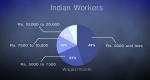
This is your countryman avg salary. If you want to compare yourself with American or other western countries than you need to compare it in every matric. You can't pick and choose.
War is not khwabi pulao or south indian movie where law of physics are broken easily. When you are facing 200 million people on your western borders and 1.4 billion manpower nation towards east....number count no matter the technological edge you have.
You sound to exited & depressed to me. Koi or dikat hai to batao.
Errr.. Does not work like that. War is not a luxury, its a necessity for peace. And no, socio ecnomic parameter have little to do with military abilities and preparedness. China's nominal average income per person is One Fifth of US income but its war potential and military is comparable to USA. How does it work? Because its government collects revenue from a massive base of people and businesses. India's case is similar. Indian population is lower middle class at best but Indian government is NOT poor. Not at all. Its more the question of competence of leadership and decision they have been making. Which was the entire point I was driving home with @randomradio.Here's something for you to ponder upon.
View attachment 17336
This is your countryman avg salary. If you want to compare yourself with American or other western countries than you need to compare it in every matric. You can't pick and choose.
War is not khwabi pulao or south indian movie where law of physics are broken easily. When you are facing 200 million people on your western borders and 1.4 billion manpower nation towards east....number count no matter the technological edge you have.
You sound to exited & depressed to me. Koi or dikat hai to batao.
Still don't believe me? We are already spending 3rd highest amount of money in NOMINAL dollars in the world. Its around 70 billion a year. If with this expense we are getting military capability which is not even able to defend our borders against adversories one tenth of our size then I guess we need to re-look where things are going wrong. Its then certainly NOT finances which are to be blamed. Its somewhere else : which is what this article suggests it is.
If we adjust our expenses by purchase price parity, those 70 billion dollars are more like 185 billion dollars worth of purchasing power when compared to USA.
Last edited:

Most of the idiots think higher dollar per capita income makes other countries better than India. But what they miss is the cost of services is also high which virtually negates the higher income. Good example is in health field, an Indian will have more access to economical medical care than an Individual in foreign country with higher income. By having a larger population base we can afford to lower the cost to a large extent due to economy of scale. Problems arise only when we try to import the goods, due to which cost rises. We need to blame our mismanagement & incompetence rather than saying we dont have funds to fight a war.Errr.. Does not work like that. War is not a luxury, its a necessity for peace. And no, socio ecnomic parameter have little to do with military abilities and preparedness. China's nominal average income per person is One Fifth of US income but its war potential and military is comparable to USA. How does it work? Because its government collects revenue from a massive base of people and businesses. India's case is similar. Indian population is lower middle class at best but Indian government is NOT poor. Not at all. Its more the question of competence of leadership and decision they have been making. Which was the entire point I was driving home with @randomradio.
Still don't believe me? We are already spending 3rd highest amount of money in NOMINAL dollars in the world. Its around 70 billion a year. If with this expense we are getting military capability which is not even able to defend our borders against adversories one tenth of our size then I guess we need to re-look where things are going wrong. Its then certainly NOT finances which are to be blamed. Its somewhere else : which is what this article suggests it is.
If we adjust our expenses by purchase price parity, those 70 billion dollars are more like 185 billion dollars worth of purchasing power when compared to USA.